Trump Calls Canada-EU Associate Plan “Laughable,” Threatens Heavy Tariffs if He Sees Hostile Intent

President Donald Trump has warned of new trade penalties against Europe over a proposal to deepen Canada’s relationship with the European Union, while Prime Minister Mark Carney says Ottawa welcomes closer integration with Europe.

President Donald Trump sharply criticized a proposal for Canada to become the European Union’s first “associate member,” calling the idea “laughable” while warning that Washington could retaliate economically.
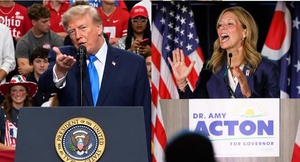
Trump made the remarks Wednesday in Charlotte, North Carolina, after being asked about European Commission President Ursula von der Leyen’s proposal for a significantly deeper political and economic relationship with Canada.
Trump said he could regard the arrangement as a “hostile act” if he concluded that Europe was pursuing closer Canadian ties with intentions directed against American economic interests.
He warned that Washington could respond with “very heavy tariffs” on European goods or potentially restrict trade in selected sectors, although no such additional tariffs have yet been imposed.
The proposal originated with von der Leyen, who suggested moving beyond the existing Canada-EU trade relationship toward an “Alliance for the Future” and potentially making Canada the bloc’s first associate member.
Exactly what “associate membership” would mean remains undefined. European and Canadian officials are still developing the concept, and it would not automatically make Canada a full member of the European Union.
Canadian Prime Minister Mark Carney publicly welcomed the proposal Thursday during an address to the European Parliament in Strasbourg, saying Canada supported the ambition for a much deeper relationship.
Carney argued that closer cooperation with Europe could strengthen Canadian sovereignty and resilience in an international environment where tariffs, financial systems and supply chains are increasingly used as instruments of pressure.
His government is proposing expanded cooperation across critical minerals, energy, defense production, artificial intelligence, computing, space, financial services, research and greater opportunities for citizens to work and study abroad.
Canada and the EU already have extensive economic ties through the Comprehensive Economic and Trade Agreement, or CETA, but both sides are now considering a substantially broader strategic partnership.
Canada has also become the first non-European participant in the EU’s SAFE defense procurement program, strengthening cooperation at a time when Ottawa is attempting to diversify its security partnerships.
The push toward Europe comes amid a serious deterioration in U.S.-Canada trade relations, with the Trump administration imposing new tariffs on selected Canadian products throughout the summer.
Canada suspended bilateral trade negotiations in August after saying last-minute American demands were unfair and uneconomic, while Washington proceeded with 50 percent tariffs on roughly C$28 billion of Canadian goods.
Ottawa responded by matching those tariffs, saying its countermeasures were intended to protect Canadian workers and businesses rather than accept what the government characterized as discriminatory American treatment.
The Trump administration has since tightened some restrictions further, including measures affecting Canadian motor vehicles and an import ban on selected Canadian dairy products scheduled to begin September 29.
Carney has made diversification a central part of Canada’s response, repeatedly arguing that the country should reduce economic vulnerability by building stronger commercial and security relationships beyond the United States.
The shift is economically significant because the United States remains Canada’s dominant export market, accounting for roughly 70 percent of Canadian exports despite Ottawa’s efforts to expand relationships elsewhere.
European officials say a future Canada partnership could include closer coordination on defense, technology, energy and trade, while discussions have also raised possibilities involving greater mobility for workers, students and young people.
However, Carney has said Canada is not pursuing ordinary full EU membership, and any new arrangement would still require negotiations, domestic political debate and decisions by European institutions and member governments.
The next major step is expected at an EU-Canada summit in Montreal in October, where leaders are likely to discuss what associate membership or an expanded “Alliance for the Future” could actually involve.
Trump’s threatened tariffs therefore remain conditional rather than announced policy, while Canada and Europe are continuing talks that could reshape Ottawa’s economic strategy and add another source of tension to transatlantic trade.
Comments (0)
Loading comments...
May You Like

Jack Smith Defends His Integrity as Trump Investigations Face Renewed Political Firestorm
gfnhgmnghnmfgnbvvvvvvvvv

Russian Drone Strikes Kyiv Bridge as German Chancellor Arrives in Ukraine