
Trump Calls Canada “the Most Difficult Country to Deal With” as Carney Holds Firm in Trade Dispute
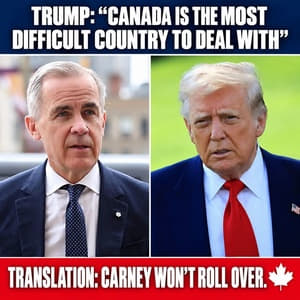
Trump Calls Canada “the Most Difficult Country to Deal With” as Carney Holds Firm in Trade Dispute
U.S. Politics • Canada–U.S. Relations • Trade Policy
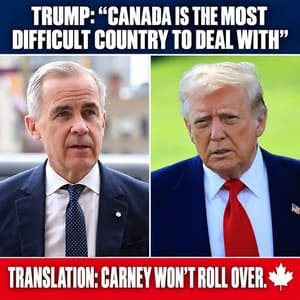
President Donald Trump has intensified his criticism of Canada, calling it the “worst country to deal with” and describing negotiations with its leaders as exceptionally difficult. The remarks reflect a widening trade dispute between Washington and Ottawa, where Canadian Prime Minister Mark Carney has resisted accepting U.S. terms that his government considers unfavorable.
Trump made the comments on September 13, 2026, while discussing tariffs and the prospects for a trade agreement. He also drew a distinction between Canada’s political leadership and its population, saying that he considered Canadian people “fantastic” even as he criticized their leaders.
The image’s caption — “Translation: Carney won’t roll over” — is political commentary rather than a direct quotation. Still, it captures a central tension in the dispute: Trump is demanding concessions, while Carney says Canada will not accept an agreement that fails to protect Canadian interests.
What Trump actually said
In remarks reported by Reuters on September 13, Trump said:
“I find Canada to be the worst country to deal with. The most difficult country.”
He added that Canadian leaders were difficult to negotiate with, while emphasizing that he liked the Canadian people. He also warned that additional tariffs were coming, specifically pointing to higher duties on cars scheduled for January 1, 2027.
The comments came amid a prolonged dispute over tariffs, automobiles, steel and other cross-border trade. They were not an announcement that negotiations had ended or that Canada had agreed to U.S. demands.
Why Carney is resisting Trump’s demands
Carney has argued that Canada needs a deal that protects its economy and workers rather than accepting an agreement simply to end the dispute.
On October 26, Reuters reported that Carney said any progress in negotiations reflected Washington moving closer to Canada’s position. He said Canada had rejected the terms offered in August because they crossed the country’s stated negotiating limits.
The dispute is particularly significant because the United States and Canada have deeply integrated economies. Automobiles and parts, steel, aluminum, energy and agricultural products move across their shared border as part of established supply chains.
A tariff increase can therefore affect more than the country exporting the goods. U.S. manufacturers that rely on Canadian materials may face higher costs, while Canadian businesses may lose sales or have to find alternative markets.
The latest development: Negotiations are still underway
Despite Trump’s harsh rhetoric, the two countries have continued discussing a possible agreement.
A Reuters report published October 26 said U.S. and Canadian officials were negotiating a potential deal to ease American tariffs on Canadian steel and automobiles. The discussions focused on tariffs imposed under Section 232, including duties of up to 50% on Canadian steel and 25% on automobiles.
The talks could produce a limited agreement, but several obstacles remain. Washington is seeking further concessions from Ottawa, and Trump has threatened to raise tariffs on Canadian automobiles and steel to 50% beginning January 1, 2027. The negotiations have also been complicated by disagreements over the scope of any deal.
That means the situation is more complicated than a simple confrontation in which one leader refuses to give in. Both governments have economic and political reasons to keep negotiating, even while publicly defending their positions.
Why the dispute matters to Americans and Canadians
The trade conflict has implications on both sides of the border.
For Canada, tariffs threaten industries that depend heavily on access to the U.S. market, particularly automotive manufacturing and steel production. For the United States, tariffs can raise costs for companies that import Canadian products or rely on cross-border supply chains.
The Associated Press has reported that Carney described the negotiations as increasingly hostile and framed Canada’s response as an effort to defend Canadian jobs and businesses. The dispute has also prompted Canada to look for stronger commercial relationships with other countries.
For consumers, the eventual impact will depend on which tariffs remain in place, which goods receive exemptions and whether businesses pass additional costs on through higher prices.
What the viral graphic gets right — and what it leaves out
What it gets right
-
Trump did describe Canada as exceptionally difficult to negotiate with.
The disagreement is real and centers heavily on tariffs and trade.
Carney has publicly resisted accepting terms that Canada considers unfavorable.
Negotiations remain active despite the leaders’ sharp rhetoric.
What it leaves out
-
“Carney won’t roll over” is the graphic creator’s interpretation, not a verified quotation from Trump or Carney.
Trump explicitly distinguished Canadian leaders from ordinary Canadian people.
The two countries are still negotiating, so the dispute has not reached a final outcome.
Any agreement could be limited to particular industries rather than resolving every trade disagreement.
Bottom line
Trump’s criticism of Canada is genuine, and the trade dispute is serious. But the image turns a complicated negotiation into a simple story of Trump confronting a Canadian leader who refuses to back down.
The more consequential development is that trade talks are still underway. Whether Carney’s resistance produces better terms for Canada — or whether Trump’s tariff threats force further concessions — will depend on the final agreement and its effects on businesses and consumers in both countries.
Comments (0)
Loading comments...
May You Like

EAST COAST MEGASTORM—2 MILLION HOUSES DAMAGED, 5 MILLION AT RISK OF BLACKOUTS, WATER FAILURES!


MINNESOTA NIGHTMARE—UNDERGROUND GAS LEAK, HUNDREDS OF HOMES AT RISK, $300M DAMAGE!









Popular Posts



