
TRUMP CALLS GDP FIGURE “FAKE” AFTER GOVERNMENT’S SCHEDULED REVISION
WASHINGTON — NOV 27, 2026 — President Donald Trump’s latest dispute over federal economic data has placed government statisticians and the political consequences of their reports under renewed scrutiny.
The disagreement emerged after an election campaign in which voters weighed household costs, employment and the administration’s economic record against a backdrop of competing political claims.
At the center of the dispute are officials who publish estimates used by businesses, policymakers and the public to understand changes in the nation’s economy.
Gross domestic product measures the value of goods and services produced in the United States, adjusted for inflation when economists discuss real economic growth.
The Bureau of Economic Analysis, an agency within the Commerce Department, publishes an initial quarterly estimate before all underlying information is available and later updates it, with later releases reflecting additional information collected across sectors and incorporated after the first estimate was published.
Those updates incorporate more complete information from businesses and other sources, and the resulting estimate can move either higher or lower than the initial figure.

An annualized growth rate describes the pace that would result if a quarter’s growth continued for a full year, rather than the actual increase within that quarter.
The agency’s third-quarter report covers activity from July through September, providing a broad measure of economic output rather than a direct measure of every household’s finances or a guarantee of future growth.
The first estimate appeared on Oct 29, five days before Americans voted in the midterm elections, while a second estimate followed on Nov 25.
Federal officials had scheduled the later release in advance, and the bureau attributed its upward revision primarily to updated estimates of investment and consumer spending.
The new report came after Republicans suffered significant losses in the Nov 3 election, when control of Congress was at stake and economic conditions were a prominent issue.
Trump’s reaction also followed an earlier clash over government statistics involving a different agency and a separate report about employment rather than economic output.

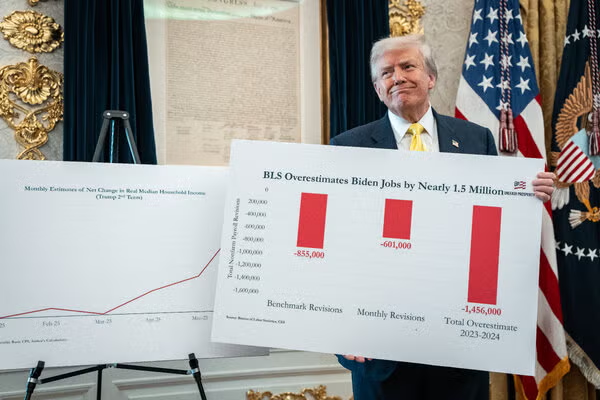
In August 2025, he removed Bureau of Labor Statistics Commissioner Erika McEntarfer after a weak jobs report revised earlier employment gains downward by a combined 258,000.
The Labor Department’s statistics bureau produces employment reports, while the Commerce Department’s economic analysis bureau produces GDP estimates and was responsible for the later revision.
On Nov 26, Trump called the original pre-election GDP figure fake and demanded an investigation after the estimated annualized growth rate rose from 3.4% to 4.3%.
He alleged without presenting evidence that officials had deliberately understated growth before the election, even though the first number already showed expansion and the revision followed the agency’s published schedule.
Behind the demand, Trump sought a political explanation for his party’s losses that would shift attention from voters’ concerns about living costs to the timing of government statistics.
By portraying the earlier estimate as a betrayal of his economic record, he aimed to present the stronger revision as proof that the election campaign had been judged on a false picture.
His accusation placed federal analysts under pressure to defend the integrity of their work, while his administration faced questions about whether an investigation would extend beyond a public demand.
The confrontation leaves the government facing two separate questions: how it will respond to the president’s demand and how future economic estimates will be received when they change.
Comments (0)
Loading comments...
May You Like

ELON MUSK'S MILLION-SATELLITE MEGAPROJECT — THE NEXT FRONTIER OF AMERICAN SPACE POWER?

NYC EMERGENCY—MILLIONS FACE EVACUATION RISKS, MACY'S GIANT BALLOONS REMOVED FOR SAFETY!

WARNING: OVER 1 MILLION COULD LOSE POWER AND NEARLY 2 MILLION FACE WATER ALERTS ON THANKSGIVING!













