
Trump Calls Iran Attack “One of the Greatest Things I Ever Did” as Questions Mount Over Civilian Deaths
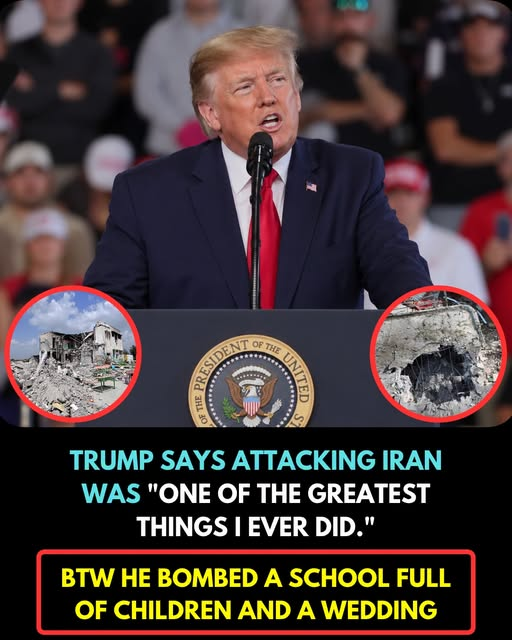
The central claim in the viral post has a factual basis: President Donald Trump did describe the decision to attack Iran as “one of the greatest things I ever did” during a rally at the Port of Corpus Christi in Texas on October 27. He defended the operation as necessary to prevent Iran from obtaining a nuclear weapon and predicted that the conflict would soon end. The remarks came as the war entered its eighth month and the administration continued to face questions about its military objectives, economic consequences and civilian casualties.
But the graphic and accompanying caption compress two separate civilian-casualty incidents into a single accusation. The school strike in Minab and the later explosion at a wedding gathering in Kuhestak have both drawn serious scrutiny. Evidence reported by major news organizations has raised the possibility of U.S. responsibility in each case, but the public record does not establish that Trump personally ordered either strike or that U.S. forces deliberately targeted children or wedding guests.
The Minab school strike: What the evidence shows
The most consequential incident occurred on February 28, the opening day of the war, when a strike hit the Shajareh Tayyebeh girls’ elementary school in Minab, southern Iran. The school was located near an Islamic Revolutionary Guard Corps facility, but satellite imagery and reporting indicated that it was a distinct civilian building, separated from the military compound by a wall.
The precise death toll has varied across reports. Iranian authorities initially reported more than 160 people killed. An Associated Press reconstruction estimated that between 157 and 168 people died, including 123 children aged 13 or younger, as well as school staff and parents. The scale of the deaths made the incident one of the most devastating civilian-casualty events of the conflict.
The question of responsibility has become increasingly difficult for Washington to avoid. Reuters reported in March that preliminary U.S. military findings indicated American forces were likely responsible. Investigators were examining whether outdated targeting information had incorrectly classified the school as part of a nearby military installation. The Pentagon subsequently elevated the inquiry and appointed an investigating officer from outside U.S. Central Command.
The administration has not, however, publicly released a final investigation establishing the full circumstances. A report published by The Straits Times on October 16 said Pentagon officials were considering delaying publication until after the November midterm elections. The Pentagon said the investigation remained ongoing and that it had no update to announce. The report's alleged timing has prompted criticism from lawmakers seeking greater transparency, although the reported internal plans are not themselves proof that the investigation was deliberately manipulated.
The wedding strike in Kuhestak: A separate incident under investigation
A second incident occurred on September 1 in Kuhestak, a coastal town in southern Iran. A building hosting a wedding celebration was hit during a U.S. military operation targeting a nearby communications complex.
Iranian authorities and humanitarian sources reported civilian deaths and dozens of injuries. The reported toll changed as information emerged: Reuters reported that the death toll had reached five, while other early accounts described four fatalities. The victims reportedly included children. These figures have not all been independently verified.
The evidence reviewed by weapons experts raised serious questions about the possibility of a U.S. strike. Reuters published an analysis of verified photographs and video in which experts concluded that the damage was consistent with a direct hit by a U.S. munition, rather than debris or a ricochet from another explosion. Three experts considered a U.S. weapon the likely explanation.
The Washington Post later reported that six U.S. Navy-launched weapons had been directed at a communications complex near the wedding location. Five reportedly struck the intended target, while one appeared to have deviated and hit the home. A person familiar with the operation told the newspaper that investigators considered it highly likely that a U.S. bomb had caused the explosion. The Pentagon was investigating the incident, but had not publicly confirmed responsibility.
The distinction matters: the available evidence raises substantial questions about targeting and civilian-protection procedures, but it does not establish that the wedding was intentionally selected as a target. The U.S. military has said it does not target civilians. Vice President JD Vance also said the incident was being investigated and that the military should learn from mistakes if one had occurred.
International scrutiny and allegations of possible war crimes
The controversy has moved beyond news coverage and domestic political debate. In September, a United Nations-mandated fact-finding mission said it had found reasonable grounds to believe that U.S. forces may have committed war crimes in connection with two February 28 strikes: the attack on the Minab school and a separate strike on a sports complex in Lamerd.
The mission said the school was clearly identifiable as a civilian facility and questioned whether the United States had taken all feasible steps to verify that the target was a legitimate military objective. Its assessment relied on satellite imagery, verified video, weapons analysis and witness accounts. The investigators did not receive access to U.S. personnel and said Washington had not responded to their requests for information.
The wording is important. The mission's conclusion was that there were reasonable grounds to believe war crimes may have occurred; it was not a criminal court judgment, nor a final determination of individual criminal responsibility. The U.S. government has not accepted the mission's findings as a substitute for its own investigation.
International humanitarian law requires parties to distinguish between civilians and combatants, take feasible precautions to avoid civilian harm, and ensure that anticipated civilian losses are not excessive in relation to the concrete and direct military advantage expected. A strike that causes civilian deaths is not automatically a war crime. The legality depends on the target, the information available to decision-makers, the precautions taken and the circumstances of the attack.
What has the Pentagon said—and what remains unanswered?
The Pentagon's public position has emphasized that U.S. forces do not intentionally target civilians and that the incidents are subject to review. In the Minab case, Defense Secretary Pete Hegseth announced an investigation and said the department would seek the truth. Reuters' reporting on preliminary findings, however, indicated that U.S. forces were likely responsible, while the final public accounting remained outstanding.
The wedding incident has also generated demands for answers in Congress. On October 13, Representative Jason Crow and other lawmakers pressed Hegseth for information about whether U.S. forces carried out the September 1 strike, what the intended target was, what civilian-harm assessment had been conducted and whether a formal investigation had begun. Their letter also sought an update on the Minab investigation and the separate Lamerd incident.
As of October 30, the publicly available reporting reviewed for this article does not establish that the Pentagon has released final findings for either the Minab school strike or the Kuhestak wedding incident. That absence of a public conclusion is itself a central part of the dispute: families, lawmakers and outside investigators are still seeking a clear account of what happened, who made the targeting decisions and what measures will prevent similar incidents.
Trump’s defense of the war and the political consequences
At the October 27 rally, Trump defended the decision to attack Iran by arguing that the country had to be prevented from acquiring a nuclear weapon. He said that if he were asked whether he would launch the attack again, his answer would be yes, adding that it was “one of the greatest things I ever did.” He also described the economic consequences as short-term pain for long-term gain and predicted that gasoline prices would fall when the war ended.
His remarks came as the war was increasingly affecting the political debate at home. The Associated Press reported that Trump traveled to Texas to campaign for Republican Senate candidate Ken Paxton, while the conflict and rising gasoline prices had become difficult issues for Republican candidates ahead of the November midterms. A CNN transcript of the rally coverage noted that the national average price of gasoline was $1.29 per gallon higher than before the war began.
The administration's argument is that military action was necessary to address the threat posed by Iran's nuclear program and military capabilities. Critics, including lawmakers pressing for civilian-casualty investigations, argue that the government must also account for the consequences of its targeting decisions. Those positions are not mutually exclusive questions: a government can defend the strategic rationale for a military operation while still being required to investigate and explain civilian deaths.
The viral graphic accompanying the claim uses photographs of damaged buildings and the headline about Trump celebrating the attack. Its central juxtaposition is grounded in two real incidents that have generated significant scrutiny. But its wording—particularly the suggestion that Trump personally “bombed a school full of children and a wedding”—is imprecise. The evidence concerns U.S. military operations conducted under his administration; it does not establish that Trump personally selected or ordered those specific targets. Nor does the available evidence establish that either civilian site was deliberately attacked.
The most consequential unanswered questions are therefore not limited to Trump's public description of the war. They concern the accuracy of U.S. intelligence, the targeting process, the protection of civilians, the findings of military investigations and whether the administration will release enough information for Congress and the public to assess responsibility.
For the families who lost children in Minab and relatives in Kuhestak, the distinction between a deliberate attack and a catastrophic targeting failure does not erase the loss. It does, however, matter profoundly for establishing accountability under military rules and international law. Until the Pentagon publishes credible findings and explains what went wrong, the civilian toll will remain a major unresolved issue in the public record of the Iran war.
Comments (0)
Loading comments...
May You Like

IRAN CLAIMS IT FIRED AT U.S. WARPLANES — WAS AN AMERICAN F-16 FORCED TO RETREAT?

BLACK FRIDAY TENSIONS IN NYC — DID PROTESTERS CROSS THE LINE AT A DISNEY STORE?

BANGCHAK REFINERY DISASTER IN THAILAND—120,000 BARRELS A DAY SHUT DOWN, U.S. OIL PRICES SURGE 10%!












