
Trump Calls Iran Conflict “Small Potatoes” After 18 U.S. Service Members Are Killed
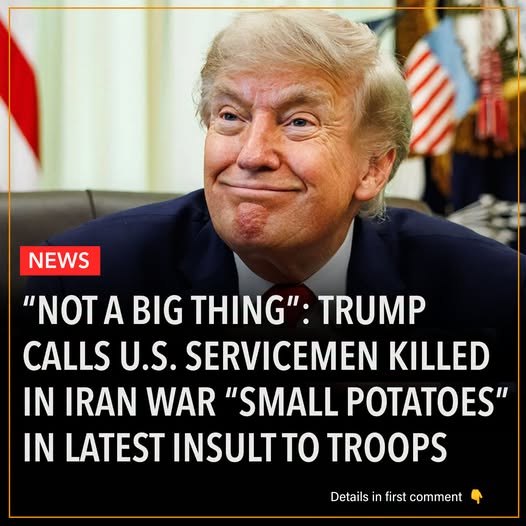
A graphic circulating online claims that President Donald Trump called an American servicemember killed in the Iran conflict “small potatoes” and describes the remark as an “insult to troops.” The wording is somewhat misleading, but it is built around a genuine and highly controversial statement Trump made Friday.
Trump did not specifically call a dead servicemember “small potatoes.” He called the Iran conflict itself “small potatoes” while explaining why he agreed with Vice President JD Vance that it should not be described as a war.
That distinction matters—but the context also explains why the comment has generated such intense backlash.
What Trump actually said
During an Oval Office exchange with reporters on September 4, Trump was asked about Vance's assertion the previous day that the Iran conflict should not be called a war.
Trump responded that he understood Vance's position.
“I call it a military conflict because it’s small potatoes for us. It’s not a big thing.”
He then compared the current American death toll with previous conflicts, saying that the United States had lost 18 people in Iran, compared with far larger numbers in Vietnam and other wars.
When a reporter pressed him about whether it was appropriate to call the conflict “small potatoes” given the deaths and lengthy deployments, Trump continued defending the comparison.
The graphic therefore compresses Trump's words into a harsher formulation. He was referring to the conflict, not describing an individual fallen servicemember as “small potatoes.”
At least 18 Americans have died
The controversy is particularly sensitive because the conflict has produced a substantial American military toll.
As of September 4, 18 U.S. service members had been killed, according to Department of Defense data cited by ABC News. The same reporting put total U.S. casualties at 808, including deaths and injuries.
The deaths have occurred in a variety of incidents across the region, including Iranian missile and drone attacks on American facilities.
In July, for example, Trump attended a dignified transfer ceremony at Dover Air Force Base for four American service members killed in Iranian attacks. Reuters reported at the time that the overall American military death toll had reached at least 18.
That history is one reason Trump's choice of the phrase “small potatoes” has been so controversial.
The conflict is still active
Trump's characterization also comes amid continuing military operations.
On September 1, U.S. Central Command announced that American forces had conducted another wave of strikes against Iranian military targets, including air-defense sites, radar systems, maritime assets, mine-laying capabilities and communications facilities. CENTCOM said more than 50,000 U.S. service members were operating across the Middle East.
The administration argues that major combat operations have subsided and that current U.S. action consists largely of intermittent strikes.
But that does not mean military activity has stopped.
Recent exchanges have included U.S. strikes on Iranian targets and Iranian attacks involving U.S. allies and American military positions in the region. AP reported that Iran fired at Kuwait on September 3 following U.S. strikes earlier in the week.
Why Vance says it isn't a “war”
Trump's comments followed Vance's own controversial description of the conflict.
At a September 3 White House briefing, Vance said:
“I wouldn’t call it a war.”
He argued that there was no active shooting at that moment and that major combat operations had ended months earlier.
The administration's terminology is politically and legally significant.
Calling something a “military conflict” rather than a “war” doesn't automatically determine its legal status, but the debate is occurring alongside questions about congressional authorization and presidential war powers.
Republican Rep. Thomas Massie, a prominent critic of the administration's Iran policy, argued that avoiding the word “war” could have implications under the War Powers Resolution.
The “small potatoes” comment comes after a separate casualty controversy
The timing has made Trump's statement even more explosive.
On September 3, Commerce Secretary Howard Lutnick incorrectly suggested during a CNBC interview that there had been no American fatalities in the Iran conflict.
Trump subsequently corrected him, saying that 18 U.S. service members had been killed and that Lutnick had apparently been thinking about the January Venezuela operation, in which no Americans died.
Lutnick apologized and acknowledged the mistake.
That episode put renewed attention on the military death toll just one day before Trump's “small potatoes” remarks.
Trump says the mission has achieved its objective
Trump's defense of his wording was tied to his argument that the military operation has been successful.
He said U.S. action had prevented Iran from obtaining a nuclear weapon and argued that the scale of American losses should be understood in comparison with much larger historical wars.
The administration has also emphasized that American forces have not conducted a ground invasion of Iran. AP reported that U.S. and Israeli operations have primarily involved air strikes.
That is the central argument behind Trump's description of the conflict as relatively limited.
Critics, however, point out that limited compared with Vietnam does not mean insignificant to the families of the 18 Americans who have died or to the hundreds who have been wounded.
The human cost behind the political argument
Military families interviewed by ABC News described the deaths in personal terms rather than as statistics.
Among those killed was Army 1st Lt. Tyler James Feehan, who died during an Iranian ballistic missile and drone attack on a military base in Jordan. Other service members died in attacks across Iraq, Kuwait, Jordan and elsewhere in the region.
For those families, the distinction between “war” and “military conflict” is unlikely to change the reality of losing a loved one.
That is why Trump's wording has become a political flashpoint even though his precise statement was about the scale of the conflict, not the worth of the people killed.
What the graphic gets right — and what it leaves out
What it gets right:
- Trump really did use the phrase “small potatoes” to describe the Iran conflict.
- He also said it was “not a big thing.”
- At least 18 U.S. service members have died in the conflict.
- The comments came while Trump was defending Vance's decision not to call the fighting a “war.”
What it leaves out:
- Trump did not say an individual killed servicemember was “small potatoes.”
- He was describing the conflict as relatively minor for the United States, particularly compared with wars such as Vietnam.
- U.S. military operations against Iran remain active, including strikes announced by CENTCOM on September 1.
- More than 50,000 U.S. service members remain deployed across the Middle East.
- The administration's refusal to call the conflict a “war” is part of a broader political and legal dispute over the nature and authority of the U.S. military operation.
Bottom line
The graphic is based on a real Trump quote, but its headline overstates what he actually said. Trump called the Iran conflict “small potatoes” and “not a big thing”; he did not call a fallen American servicemember “small potatoes.”
At the same time, the underlying controversy is very real. Eighteen Americans have died, hundreds have been wounded, tens of thousands remain deployed in the region, and U.S. forces were still conducting strikes as recently as September 1.
For the families of those killed, Trump's comparison with Vietnam may offer little comfort. For the administration, however, the language reflects its argument that the Iran operation is a limited military campaign rather than another major American war.
Comments (0)
Loading comments...
May You Like

Russian Drone Strikes Kyiv Bridge as German Chancellor Arrives in Ukraine

OBAMA STUNS ON INSTAGRAM: MESSAGE MARKING 34-YEAR MILESTONE SPARKS A BUZZ

Shocking news from Ohio: an unexpected development ahead of Trump's rally












