Trump Calls Judge Ana Reyes a “Crazed Lunatic” After Court Halts Tree Cutting at Washington Golf Course
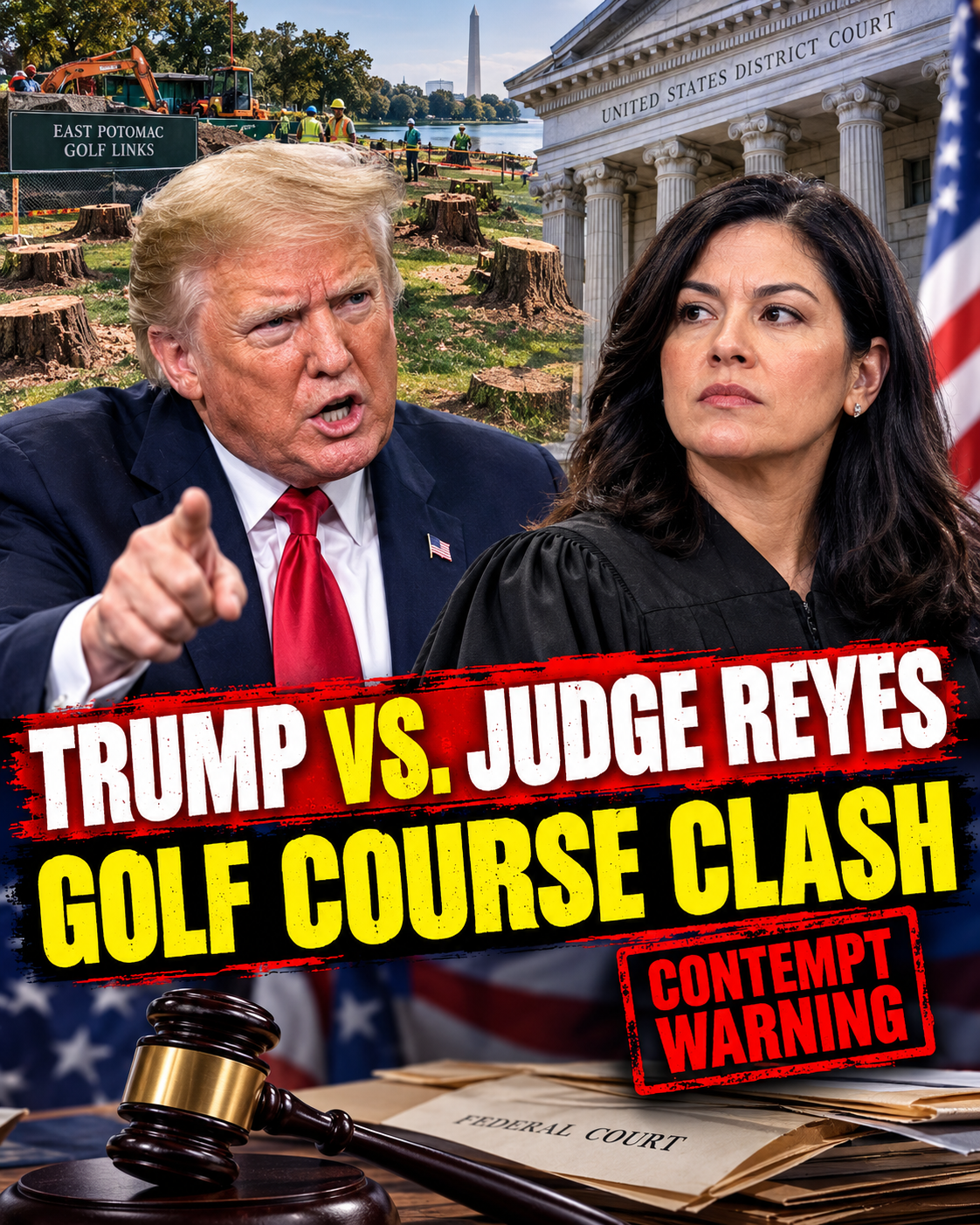
President Donald Trump launched a personal attack on a federal judge early Monday after she blocked further tree removal at a historic public golf course he wants to transform into a championship-level facility. The dispute has escalated into a wider legal confrontation over environmental protections, compliance with court orders and the limits of presidential authority.
U.S. District Judge Ana C. Reyes. Portrait courtesy of Williams & Connolly LLP, published by the Washington Blade.
WASHINGTON, October 19, 2026 — President Donald Trump’s latest clash with the federal judiciary intensified Monday morning after he used Truth Social to describe U.S. District Judge Ana C. Reyes as a “crazed lunatic” and question whether she was “insane.” His remarks followed a series of court orders restricting work at East Potomac Golf Links in Washington, D.C., where the administration has pursued plans to overhaul a historic public golf course.
The immediate cause of the dispute is a court-ordered halt to further tree removal at the site. Reyes had directed the administration to provide advance notice before undertaking substantive or irreversible work, but National Park Service crews removed hundreds of trees over a holiday weekend. At an emergency hearing on October 12, the judge sharply criticized government lawyers for failing to provide adequate notice and questioned why the work had proceeded so quickly. She subsequently extended the restriction on tree cutting through October 26. The order followed a lawsuit brought by the DC Preservation League and Washington-area residents challenging the administration’s handling of the proposed redevelopment. (Reuters; court opinion)
East Potomac Golf Links after hundreds of trees were cut down in October 2026. Photograph: Kevin Lamarque/Reuters.
The court’s October 13 opinion said approximately 430 healthy, non-invasive trees had been removed during the operation. The government had argued that the work was connected to an earlier landscape-restoration plan intended to improve safety and restore the course’s historic character. Preservationists, however, contend that the speed and scale of the tree removal were connected to Trump’s broader redevelopment ambitions and could cause irreversible environmental and historical damage before the legal challenges were resolved.
Reyes found that the plaintiffs had made a sufficient showing to justify a temporary restraining order. Her ruling prevented additional tree cutting while the case proceeded and required advance notice of further irreversible changes. It did not amount to a final judgment invalidating the entire renovation project. Instead, it preserved the situation while the court examined whether the administration had complied with applicable legal requirements, including the National Environmental Policy Act. (Court opinion)
The hearing that prompted the confrontation was unusually tense. Reyes told Justice Department lawyers that the government’s failure to notify the court and plaintiffs in a timely fashion had cost it “all of its credibility” in the case. She also said she was deeply disappointed that the tree removal had gone forward despite her earlier instructions to provide notice before substantive work. During the hearing, she questioned why officials had believed the operation was acceptable and warned that further defiance of a court order could lead to contempt proceedings. (Reuters)
The conflict then escalated beyond the courtroom. On Friday, October 16, the Justice Department filed a motion asking Reyes to recuse herself, accusing her of displaying hostility and bias toward the Trump administration. The filing described her courtroom conduct as showing “deep-seated and unequivocal antipathy” and requested that the case be transferred to another judge. The administration argued that her comments at the hearing raised doubts about her impartiality.
Reyes rejected the recusal request late Sunday. In a 13-page opinion, she wrote that it was “easy to weaponize selective quotations to bring a baseless recusal motion,” adding that meeting the legal standard for disqualification required consideration of the full record. She reviewed the government’s allegations and cited previous proceedings in which she had declined to grant requests from the plaintiffs that would have formally restricted the administration’s actions. The decision meant she would remain in charge of the case. (Bloomberg Law)
It was against this background that Trump posted his attack early Monday. He defended the Interior Department’s authority to improve what he called an unsafe and poorly maintained course, insisting that officials had an “absolute right” to conduct a first-class renovation and did not need additional approval. He also questioned the judge’s mental state and complained that courtroom recordings had been blocked from use. The remarks appeared to challenge both the judge’s handling of the lawsuit and her authority to restrict the administration’s actions while the legal dispute remained unresolved. (Reuters)
The E. Barrett Prettyman United States Courthouse, home of the U.S. District Court for the District of Columbia. Photograph: Caroline Cornett/Lawfare.
The dispute has produced an unusual contrast between the administration’s public messaging and its arguments in court. In a filing dated October 9, government lawyers maintained that the renovation remained at a conceptual stage and that the litigation was premature. Trump, however, announced publicly on Sunday that East Potomac Golf Links would close beginning November 15 for approximately 15 months of renovation, with the goal of creating a course capable of hosting major tournaments such as the U.S. Open and the Ryder Cup. On Monday morning, he then declared that work was scheduled to begin “IMMEDIATELY.” The different descriptions of the project have intensified the court’s questions about whether the administration considers the redevelopment merely preliminary or is already taking concrete steps to carry it out. (Reuters)
The government’s position is that tree removal can be justified as landscape restoration and maintenance rather than as the beginning of the wider renovation. The plaintiffs argue that the rapid execution of the work, coupled with Trump’s public statements about transforming the course, indicates that the actions are inseparable from the broader project. Reyes’s latest opinion supports the need for further scrutiny at this stage, but the court has not issued a final ruling on the merits of every claim concerning the future of the golf course.
The dispute raises immediate questions about contempt of court, but the legal distinction is important. Reyes previously warned that further violations of her orders could lead to contempt proceedings. Those warnings concerned compliance with court directions governing tree removal and notice—not simply the president’s public criticism of the judge. As of the latest reporting reviewed for this article, no contempt sanction or gag order had been announced against Trump for his Truth Social remarks. A personal attack on a judge does not, by itself, establish that a court order has been violated. The more immediate legal issue is whether government officials comply with the existing restrictions and the court’s requests for evidence.
The government’s motion to remove Reyes also remains separate from the underlying environmental case. A recusal request asks a judge to step aside because a party believes her impartiality could reasonably be questioned. Reyes’s rejection of the motion means that the case remains with her unless a higher court or a subsequent legal development changes that arrangement. It does not decide whether the administration can eventually proceed with its renovation plans.
The stakes extend beyond a golf course. East Potomac Golf Links is a century-old public recreation facility on federal land. Preservationists and local users argue that a major redevelopment could alter the historic landscape, remove established public amenities and affect access to a space used by golfers, walkers and cyclists. The administration says the project will restore the course and improve its quality, with the eventual goal of hosting high-profile tournaments. The litigation is forcing the government to explain how it intends to pursue those changes while meeting environmental and administrative requirements.
Trump has made the redesign part of a broader effort to reshape prominent sites in Washington, including proposals involving other federal properties and landmarks. Such projects can raise complicated questions about agency authority, environmental review, historic preservation and public access. The legal disputes surrounding them illustrate the role federal courts play when challengers allege that executive-branch agencies are moving ahead without following required procedures.
For the administration, the immediate challenge is to explain the legal basis for the work and establish that its actions comply with the judge’s orders. For Reyes, the task is to determine the status of the project, establish what officials knew about the tree-removal plan and decide whether additional court intervention is warranted. The evidentiary hearing scheduled for Monday, October 19, was expected to hear from senior officials at the Interior Department and National Park Service about how the tree-removal plan was approved and why it proceeded so quickly. The outcome of that hearing was not yet confirmed in the reporting reviewed for this article.
Trump’s social media attack has made the dispute more politically charged, but the core legal questions remain specific: whether the government gave adequate notice, whether the tree removal complied with environmental requirements, whether the administration’s actions can be challenged in court and whether the existing orders will be followed. Those questions will be resolved through filings, evidence and rulings—not by the intensity of the president’s criticism of the judge.
The episode therefore presents two distinct tests. One concerns the administration’s authority to renovate a public golf course and the procedural requirements that apply to work on federal land. The other concerns the relationship between the executive branch and the judiciary when a president publicly attacks a judge overseeing litigation involving his administration. The public rhetoric has intensified the second issue, but it does not replace the evidence the court must assess in the first.
For now, Reyes remains assigned to the case, the restriction on further tree removal runs through October 26, and the broader renovation remains under legal challenge. Trump has insisted the Interior Department can proceed, while the plaintiffs continue to argue that the administration must comply with environmental and preservation requirements before making irreversible changes. The next filings and court proceedings will determine whether the renovation can move forward, under what conditions and whether additional restrictions are necessary.
Sources and further reading: Reuters — Trump attacks Judge Reyes and says work will begin immediately; Reuters — Reyes criticizes the Justice Department over tree removal; Bloomberg Law — Reyes rejects the recusal motion; The Associated Press — court challenges to Trump’s Washington redevelopment plans; Court opinion granting the temporary restraining order.
Editorial image note: The additional photographs are illustrative or archival and are not all from the events described. Confirm original captions, dates, attribution and licensing before republication.
Comments (0)
Loading comments...
May You Like
TRUMP: "LOOK AT FRANCE"! THE WARNING EVERY AMERICAN NEEDS TO HEAR...
Obama Is Back on the Political Front Line-Barack Obama stuns nation with announcement

Viral Claim That Trump Will Leave Office Early if Republicans Lose Midterms Lacks Evidence
Latest Posts




Popular Posts



Trump’s administration is threatening Europe
Oct 20, 2026
Trump Impeachment Debate Intensifies
Oct 20, 2026