
Trump Calls on All International Criminal Court Member States to Withdraw
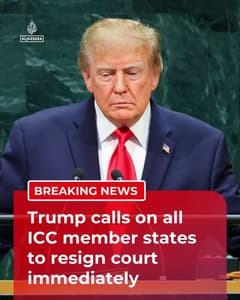
Trump Calls on All International Criminal Court Member States to Withdraw, Escalating Global Legal Dispute
UNITED NATIONS, NEW YORK — October 28, 2026
U.S. President Donald Trump has called on all member states of the International Criminal Court (ICC) to withdraw from the tribunal, escalating his administration’s confrontation with an institution responsible for prosecuting genocide, war crimes, crimes against humanity, and the crime of aggression.
Trump made the demand during his address to the United Nations General Assembly on September 22, 2026. Although the statement is genuine, the image’s “BREAKING NEWS” presentation is misleading if interpreted as a new announcement made today. Reuters reported the remarks on the day they were delivered.
What Did Trump Say?
During his speech, Trump described the ICC as a “rogue institution” and urged countries belonging to the court to leave immediately.
His administration argues that the tribunal overreaches its authority when investigating matters involving citizens of countries that have not ratified the Rome Statute, the treaty establishing the court. Washington has particularly objected to the possibility of ICC proceedings involving American military personnel and Israeli officials.
The United States is not a party to the Rome Statute and has long disputed the court’s jurisdiction over American nationals in certain circumstances. However, the ICC’s jurisdiction can depend on factors such as where alleged crimes occurred and whether a situation falls within its legal authority.
How Have Other Countries Responded?
Trump’s demand comes amid a broader U.S. campaign to pressure the ICC and its member states.
A Reuters report published on September 24 said that Naoero, also known as Nauru, was the only country to announce its withdrawal in response to Trump’s appeal during that week’s UN General Assembly meetings. Other governments, particularly in Europe, have continued to support the court.
Separately, Burkina Faso, Mali, Niger, Chad, and Venezuela have announced plans to withdraw from the Rome Statute during 2026. Those developments have raised concerns about the court’s ability to maintain international cooperation and accountability.
Why Does the ICC Matter?
Established by the Rome Statute, the ICC is a permanent international court based in The Hague, Netherlands. It investigates and prosecutes individuals accused of some of the gravest crimes under international law when national authorities are unable or unwilling genuinely to do so.
The court is distinct from the International Court of Justice, which principally handles legal disputes between states.
Supporters argue that the ICC provides an important avenue for accountability when domestic justice systems fail. Critics, including the Trump administration, question its jurisdiction, independence, and potential impact on national sovereignty.
The disagreement therefore reaches beyond the United States: it raises fundamental questions about the relationship between international justice and the authority of individual countries.
What Happens Next?
The immediate question is whether more governments will respond to Washington’s pressure by reconsidering their ICC membership.
Withdrawal is a formal legal process, not an automatic consequence of a president’s demand. Under the Rome Statute, a state’s withdrawal generally takes effect one year after the relevant notification is received, and it does not erase obligations or proceedings arising from the period when the state was a member.
The court’s future will depend partly on whether its member states continue to cooperate with investigations, enforce arrest warrants, and defend the institution against political pressure.
The bottom line: Trump did publicly urge ICC member states to withdraw from the court. The statement is verified, but it dates to September 22, 2026—not the past few minutes. The wider dispute concerns national sovereignty, international criminal jurisdiction, and the future of global accountability.
Comments (0)
Loading comments...
May You Like


EAST COAST CATASTROPHE — $20 BILLION AT STAKE, 5 MILLION AT RISK OF LOSING POWER, WATER AND HEAT!

WEYMOUTH HORROR — FIRE TRUCK BRAKES TO SAVE DOG, ONE FIREFIGHTER DEAD, TWO CRITICAL!
MINNESOTA EMERGENCY — HOUSE EXPLOSION PUTS 2 HUNDRED FAMILIES AT RISK OF FIRE AND WINTER EVACUATION!










Popular Posts




