
Trump Calls Reports of U.S. Munitions Shortages “Treasonous,” Says America Has More Than It Could Ever Use
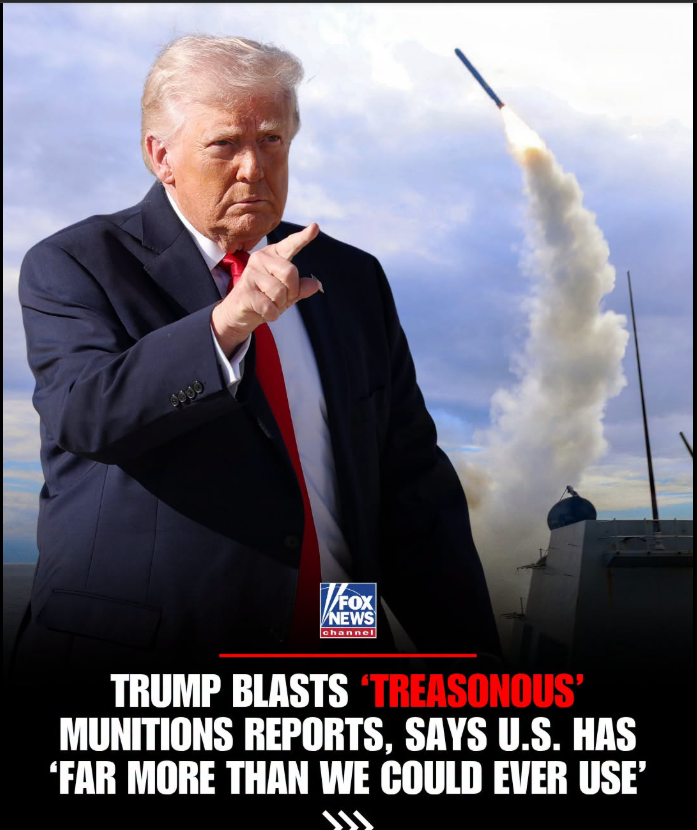
WASHINGTON — September 4, 2026 — President Donald Trump has sharply rejected reports that the United States is running dangerously low on key weapons after months of military operations against Iran, calling media coverage of ammunition shortages “treasonous” and claiming the U.S. has “virtually unlimited” supplies.
In a Truth Social post on September 3, Trump said the United States has more mid- to high-grade ammunition than it could use in the current conflict or in any other potential war. He also said American defense companies are producing munitions at “levels never seen before” and that Washington is temporarily prioritizing its own stockpiles over sales to allies.
The comments came amid increasingly detailed reporting from Reuters, CBS News and defense analysts that the Iran conflict has significantly depleted inventories of several high-end U.S. missiles.
Trump Pushes Back Against Reports of Weapons Shortages
Trump's latest statement was unusually emphatic.
He accused people and media outlets reporting on ammunition shortages of refusing to accurately portray the U.S. military operation in Iran. He said the United States was “stockpiling and preparing for any contingency” and that weapons sales to allies would resume soon.
Trump also argued that the Biden administration had provided Ukraine and NATO with substantially more munitions than the United States has used in Iran, and said European countries would eventually be asked to reimburse Washington for some of that assistance. Reuters separately reported on September 3 that the Trump administration intends to seek payment from European countries for military aid previously provided to Ukraine.
The president has made similar claims before. In August, after reports of weapons shortages emerged, Trump said the U.S. had “massive amounts” of munitions and accused unnamed leakers of making “treasonous” statements.
But Reports of Depleted Stockpiles Have Not Disappeared
The central dispute is not whether the United States possesses large quantities of ammunition overall. It does.
The question is whether specific high-demand weapons are becoming scarce after months of combat.
A Reuters investigation published August 4 reported that the U.S. Army had used “virtually all” of its stockpile of two important long-range missile systems — the Army Tactical Missile System (ATACMS) and Precision Strike Missile (PrSM) — according to people familiar with the data. Reuters also reported that the United States had used somewhat less than half of its global Tomahawk inventory.
Those weapons are particularly important because they allow U.S. forces to attack targets at long distances while keeping aircraft, ships and ground forces farther from enemy defenses.
The depletion therefore matters beyond Iran. Such missiles would also be valuable in a major conflict involving China or Russia.
Air-Defense Weapons Are Another Concern
Independent defense analysts have also documented pressure on U.S. air-defense inventories.
The Center for Strategic and International Studies (CSIS) reported in July that U.S. Patriot inventories had fallen below 1,000 interceptors, while THAAD inventories stood at roughly 250. The organization warned that diminished stocks could constrain U.S. options in a future conflict, particularly in the Indo-Pacific.
CSIS has repeatedly stressed an important distinction: the United States is not necessarily on the verge of running out of ammunition altogether.
Its April analysis concluded that the U.S. had enough munitions to continue fighting the Iran conflict under plausible scenarios, but that inventories of several critical weapons had been substantially reduced. Rebuilding them could take one to four years, depending on the system.
That assessment helps reconcile seemingly contradictory claims.
Trump can say the United States has enormous quantities of ammunition while analysts simultaneously warn that inventories of particular missiles are dangerously thin. Both statements can be true because “munitions” is an extremely broad category.
Production Is Increasing — But Replenishment Takes Time
The administration has taken steps to increase weapons production.
In June, Trump met with major U.S. defense manufacturers as the administration pushed companies to accelerate production following the heavy expenditure of weapons in Iran. Reuters reported that the Pentagon had reached framework agreements aimed at increasing production of systems including Patriot and THAAD interceptors, Tomahawk missiles and AMRAAMs.
But expanding production capacity does not immediately restore depleted inventories.
CSIS has described rebuilding the U.S. missile inventory as a multiyear project, noting that some systems can take years to manufacture in sufficient quantities.
That creates a strategic dilemma for Washington: the military can maintain enough weapons to continue its present operations while simultaneously having fewer weapons available for a second major conflict.
What the Viral Fox News Graphic Gets Right — and Leaves Out
The graphic accurately reflects the substance of Trump's September 3 statement: he did claim that the United States has virtually unlimited ammunition and far more than it could ever use.
However, the graphic does not provide the wider context.
Independent reporting and defense analysis do not establish that the United States is simply “out of ammunition.” Instead, they point to shortages or sharply reduced inventories of particular high-end weapons, especially long-range precision missiles and air-defense interceptors.
At the same time, the Pentagon and defense industry are increasing production, meaning current inventory levels should not be treated as static.
The most accurate description is therefore neither “America has run out of weapons” nor “America has virtually unlimited supplies of every type of ammunition.”
The United States retains a vast military arsenal, but months of combat have put significant pressure on some critical missile inventories while Washington races to rebuild them.
The Bigger Strategic Question
The debate has implications well beyond the current conflict with Iran.
CSIS concluded in July that the Iran war has exacerbated a pre-existing U.S. munitions problem caused by strategic, industrial, institutional and operational factors. The organization warned that depleted inventories could create a near- and medium-term vulnerability if Washington faced a major conflict in the Western Pacific.
Meanwhile, the Trump administration is trying to increase production while also preserving enough weapons for U.S. forces and eventually resuming sales to allies.
That makes the ammunition debate less about whether the United States possesses “a lot” of weapons and more about how quickly it can manufacture the specific weapons modern warfare consumes at the highest rates.
For now, Trump's message is clear: he rejects the portrayal of the U.S. military as running out of ammunition and insists American production is rapidly expanding. But available reporting and independent analysis indicate that some U.S. weapons inventories have nevertheless been substantially depleted — a distinction that the viral graphic does not capture.
Comments (0)
Loading comments...
May You Like

OBAMA STUNS ON INSTAGRAM: MESSAGE MARKING 34-YEAR MILESTONE SPARKS A BUZZ


Jack Smith Defends His Integrity as Trump Investigations Face Renewed Political Firestorm













