Trump Celebrates New Syria-Iraq Oil Route as 'Fantastic,' Declares End of U.S. Dependence on Hormuz
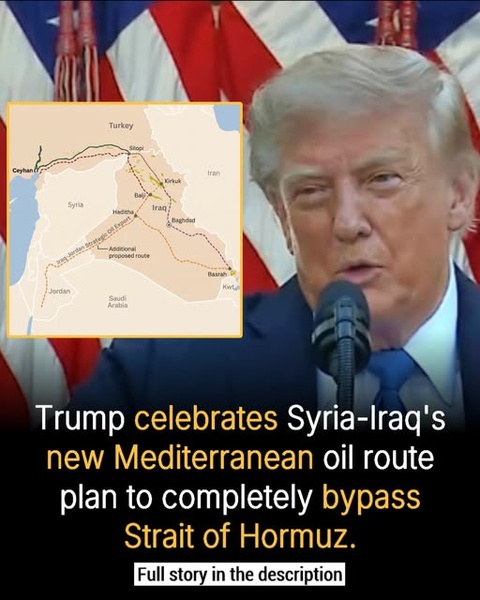
President Donald Trump has enthusiastically endorsed a new plan to completely bypass the Strait of Hormuz for Middle Eastern oil exports, pointing to a surge of thousands of oil-laden trucks traversing Syria and a massive new pipeline project backed by the U.S. and a Chevron-led consortium. The president suggested that within a few years, the strategic waterway will become a "worthless piece of water," as Washington seeks to economically sideline Iran.
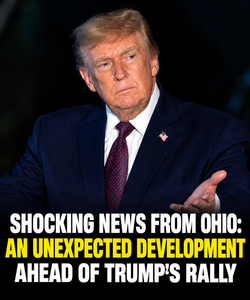
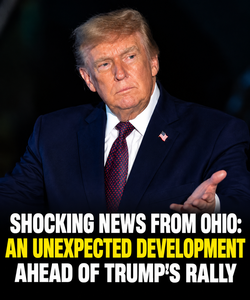
WASHINGTON – The image circulating online captures a real and significant shift in Middle Eastern energy geopolitics. President Trump is openly celebrating the emergence of Syria as a major alternative trade and energy corridor, with a $5.7 billion pipeline project and a daily convoy of thousands of trucks bypassing the Strait of Hormuz.
Trump has welcomed reports that about 5,000 oil-laden trucks are now transiting daily from southern Iraq through Syrian territory toward the Mediterranean port of Baniyas. The shipments began in April as a limited trial, expanding into a large-scale operation amid the U.S.-Israeli war with Iran.
"This is fantastic!" Trump wrote on Truth Social in response to a Washington Post report highlighting Syria's growing role. He later told reporters that many oil pipelines are being built in the Middle East, adding that the Strait of Hormuz "is not what it used to be." U.S. Treasury Secretary Scott Bessent went even further, declaring: "In two years, the Straits of Hormuz will be a worthless piece of water."
The New Corridor: A $5.7 Billion Pipeline
At the heart of the plan is a major infrastructure project to rehabilitate the Kirkuk-Baniyas pipeline, which was originally built in 1952. The U.S. State Department officially welcomed the agreement between Iraq and Syria in July 2026, describing it as a "priority infrastructure project of bilateral and regional strategic significance."
The project is backed by a U.S.-led international consortium that includes Chevron, Qatar's UCC Urbacon Concessions Investments, and TI Capital. According to the State Department, the pipeline will have an initial transport capacity of 2 million barrels per day of crude oil once rehabilitated. The proposed route would extend about 1,000 miles from Basra in southern Iraq to the Syrian port of Baniyas, with construction expected to cost $5.7 billion and take at least two and a half years.
The U.S. State Department statement explicitly credited Trump's "vision and leadership" for the project's advancement.
Bypassing Iran: The Geopolitical Angle
The Trump administration's enthusiasm for the new route is driven in large part by the desire to weaken Iran. With the Strait of Hormuz effectively closed to normal shipping due to the ongoing conflict, Iran's ability to influence global oil markets has become a liability.
Trump framed the development as a direct challenge to Tehran. "If Iran doesn't get wiser, it will soon be left with the Strait of Hormuz, which will not be very useful," the American President said.
Analysts note that Washington is betting on economic corridors — pipelines, ports, and infrastructure — to reduce Iran's influence without deeper military involvement. "The objective is no longer solely to contain Tehran through security alliances, but to create a network of economic interests that makes regional integration more attractive," wrote one publication on the emerging strategy.
Iraq, which derives about 95% of its revenue from oil, has been especially eager to diversify its export routes. As the second-largest OPEC producer, the country's heavy dependence on the Strait of Hormuz made it vulnerable when the war disrupted shipping. By offering an alternative route through Syria, Iraq can continue to export its crude to Mediterranean markets and beyond without relying exclusively on the Persian Gulf.
How Realistic Is the Plan?
While the administration is bullish, energy analysts urge caution. Some have described the idea that the Strait could soon become irrelevant as "pure rhetoric." Richard Bronze, co-founder and executive director of market intelligence analysts Energy Aspects, said: "Even if all of these projects go through, it's just not realistic from a purely energy flows point of view to think the strait won't matter, let alone all the other types of goods that move through that waterway."
Robert McNally, who served as senior director for international energy on President George W. Bush's National Security Council, told NPR that saying the Strait of Hormuz could become irrelevant "is way too strong and overstated." He added: "When we talk about energy flows, the Strait of Hormuz is the most relevant chokepoint on the planet."
Trucking oil by road is also not a long-term solution. "This is a very expensive alternative to pipelines," Bronze said. "It's much less efficient, it's slower, it costs a lot more for every barrel that you move, and you're constrained by the capacity and number of trucks you have. So this is a way to work in a crisis, but it's not a desirable long-term option."
Even the pipeline project faces significant challenges. Technical studies are still in early stages, and rehabilitation will require billions of dollars and years of work. Additionally, security and political tensions between the Iraqi federal government, Iraqi Kurdistan authorities, and Turkey have historically limited pipeline capacity.
The Current Situation
Despite the skepticism, the corridor is already functioning. The truck convoys are operating 24/7 across Syria. And the U.S.-backed pipeline project is advancing, with agreements signed in Washington. Lebanon has also expressed interest in becoming an outlet for Iraqi oil to the Mediterranean, potentially adding another dimension to the route.
| What the Viral Graphic Suggests | What's Actually Happening |
|---|---|
| Trump is celebrating a new Syria-Iraq oil route | Yes — he called it "fantastic" and highlighted it in media statements |
| The route bypasses the Strait of Hormuz | Yes — both truck convoys and the planned pipeline would do so |
| The route is operational | The truck route is operating; the pipeline is a major infrastructure project still under planning |
| The U.S. supports the plan | Yes — the State Department has formally welcomed the project |
The Bottom Line
President Trump's celebration of the new Syria-Iraq oil route reflects a significant shift in Middle East energy strategy. By revitalizing a decades-old pipeline and leveraging Syria as a transit corridor, the U.S. aims to break Iran's stranglehold on the Strait of Hormuz.
But analysts caution that the transition from maritime routes to overland pipelines will take years — and it's unclear whether the infrastructure can ever fully replace the capacity and flexibility of the tanker fleet. For now, the Strait remains the most important energy chokepoint on the planet.
The project is real. The vision is bold. But history suggests the Strait of Hormuz will not be rendered "worthless" anytime soon.
Comments (0)
Loading comments...
May You Like
TRUMP HIT WITH 26 ARTICLES OF IMPEACHMENT

OBAMA STEPS BACK INTO THE POLITICAL SPOTLIGHT