
Trump Claims He Could Have Won the Vietnam War in One Week as He Defends His Iran War Strategy
Trump Claims He Could Have Won the Vietnam War in One Week as He Defends His Iran War Strategy
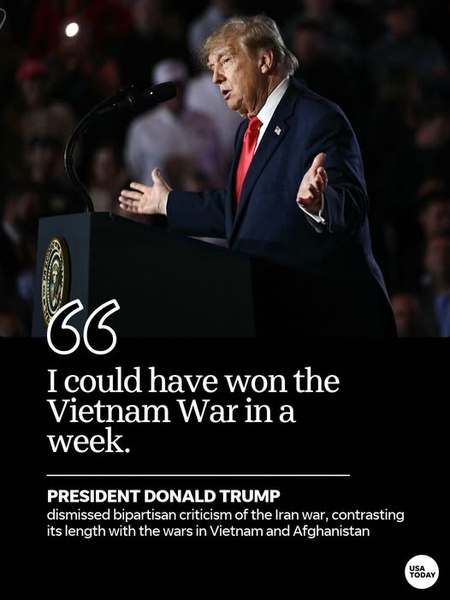
1. Trump Makes a Remarkable Claim About the Vietnam War
President Donald Trump has sparked a new political controversy after declaring that he could have won the Vietnam War in just one week.
Trump made the statement on November 1, 2026, during a campaign rally in Dubuque, Iowa, while discussing the ongoing war with Iran and comparing it with previous American military conflicts.
“I could have won the Vietnam War in a week,” Trump told the audience.
He criticized previous presidents for what he described as a failure to fight wars decisively, arguing that American military strategy had repeatedly prolonged conflicts that could have been resolved much faster.
The statement immediately drew attention because the Vietnam War lasted nearly two decades and cost tens of thousands of American lives.
2. The Iran War Was the Backdrop to Trump's Comments
Trump's comments were not made in isolation. They came during a speech in which he defended his administration's military campaign against Iran and contrasted it with America's previous wars in Vietnam and Afghanistan.
He argued that earlier presidents had failed to pursue decisive military victories, saying the United States had repeatedly fought to a stalemate rather than achieving its objectives.
Trump also claimed that the United States had significantly weakened Iran's military capabilities and suggested that he was holding back further action because he wanted to avoid additional casualties.
His remarks were part of a broader defense of his foreign-policy record ahead of the November 3 midterm elections.
3. Trump Criticizes the Strategy Used During Vietnam
During the rally, Trump argued that American leaders had wasted years relying on military tactics that failed to bring the Vietnam conflict to a successful conclusion.
He specifically criticized the use of chemicals to destroy vegetation in the Vietnamese countryside, referring to Agent Orange.
Trump suggested that American forces should have focused on major cities instead of repeatedly spraying forests.
He said:
“Agent Orange, they drop it in the forest for years and years and years, instead of going after Ho Chi Minh City and the different places.”
He then repeated his claim that he could have won the war in a single week.
4. A Major Historical Mix-Up: Ho Chi Minh City Was Not the Enemy Capital
One of the most controversial details in Trump's remarks involved his reference to Ho Chi Minh City.
During the Vietnam War, the city was known as Saigon and served as the capital of South Vietnam, the government supported by the United States.
North Vietnam, the communist government fighting against South Vietnam and its American allies, had its capital in Hanoi.
Saigon was captured by North Vietnamese forces on April 30, 1975, and was subsequently renamed Ho Chi Minh City.
This distinction is important because Trump's suggestion that American forces should have targeted Ho Chi Minh City appears to confuse the capital of America's South Vietnamese ally with the capital of communist North Vietnam.
5. Agent Orange Was a Chemical Defoliant, Not a Simple Military Solution
Trump also drew attention to Agent Orange, a herbicide used extensively by the U.S. military during the Vietnam War.
The chemical was part of a wider defoliation campaign intended to destroy vegetation that could provide cover for enemy forces and eliminate crops believed to support opposing troops.
However, Agent Orange became one of the most devastating environmental and public-health legacies of the conflict. Its contamination with dioxin has been linked to serious health consequences among exposed people, including veterans and Vietnamese civilians.
The substance was not a weapon capable of independently delivering military victory. Its use also did not resolve the political, military and social challenges that made the Vietnam War so difficult for the United States.
Trump's reference to Agent Orange therefore reopened a sensitive chapter of American military history.
6. The Human Cost of the Vietnam War
The Vietnam War was not simply a military campaign that could be measured by the number of cities captured or battles won.
According to the U.S. National Archives, 58,220 American military personnel died in the Vietnam conflict. The U.S. Navy's historical account estimates that between one million and three million people died across the wider conflict, including Vietnamese civilians and combatants.
The war also left millions of people displaced, devastated communities and created long-term health and environmental consequences.
The United States withdrew its remaining combat forces in 1973, but fighting continued until the fall of Saigon in April 1975.
These historical realities help explain why Trump's claim that he could have won the war in a week attracted criticism.
7. Critics Question Trump's Understanding of the Conflict
Critics focused on the apparent confusion between Saigon and Hanoi, arguing that the mistake undermined Trump's confidence in his proposed alternative strategy.
Some also questioned how a president could claim to have a simple solution to a conflict that involved complex political divisions, guerrilla warfare, international alliances and domestic opposition.
The remarks also revived discussion of Trump's own military-service history. During the Vietnam War era, he received five draft deferments: four for education and one medical deferment related to bone spurs.
That history has long been a subject of political debate, particularly when Trump comments on military strategy and the sacrifices made by American service members.
8. The Political Timing Adds Another Dimension
Trump made the remarks just two days before the November 3 midterm elections, during a period when Republicans were campaigning to maintain control of Congress.
The Iowa rally was part of a broader final-weekend campaign effort, with Trump urging voters to support Republican candidates and defend his administration's agenda.
His comments about Vietnam and Iran quickly became another issue for political opponents to highlight, while supporters may interpret his statements as evidence of his preference for decisive military action.
The controversy also reflects a broader question facing the administration: whether its military approach to Iran can deliver a clear outcome without creating another prolonged conflict.
9. A Bold Claim That Raises Questions About America's Military Future
Trump's declaration that he could have won the Vietnam War in one week has become a major talking point because it combines a sweeping military boast with an apparent historical error.
His supporters may see the statement as a criticism of the caution and indecision they associate with previous administrations. His critics, however, argue that the complexity of the Vietnam War cannot be dismissed with a hypothetical promise of a quick victory.
The comparison with Iran makes the issue even more significant. Trump is defending his own military strategy while criticizing earlier presidents for failing to bring previous conflicts to a decisive end.
Ultimately, whether the United States can avoid another prolonged war remains a much more consequential question than Trump's hypothetical claim about Vietnam. The historical record shows that the conflict was shaped by far more than the choice of targets—and that its consequences lasted for generations.
Comments (0)
Loading comments...
May You Like

TRUMP NAMES PICKAXE TARGET AS NETANYAHU PUSHES FOR MORE IRAN STRIKES

STORM WARNING: MILLIONS FACE EVACUATION, MACY'S GIANT BALLOONS GROUNDED!

I-75 THANKSGIVING NIGHTMARE — MAIL TRUCK CRASH RAISES OVERPASS COLLAPSE FEARS!
Latest Posts








Popular Posts




