Trump Claims Record 95% Approval Among Republicans — But Independent Polls Show a Different Picture
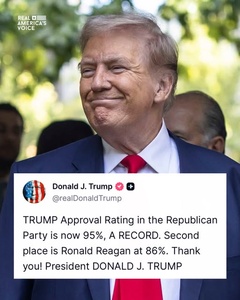
President Donald Trump says his standing inside the Republican Party has reached a historic 95%, yet recent national polling places his Republican approval lower and complicates comparisons with Ronald Reagan.
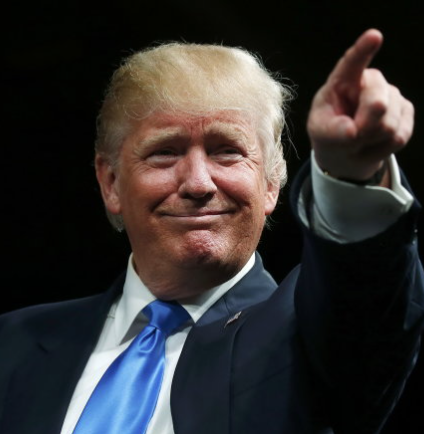
WASHINGTON, Sept. 19, 2026 — President Donald Trump is celebrating what he describes as a historic level of support inside the Republican Party, claiming his approval among Republicans has reached 95%.
Trump made the assertion Friday afternoon on Truth Social, writing that his 95% Republican approval represented “A RECORD” and naming Ronald Reagan as second place at 86%.
The post immediately circulated through conservative media and social platforms, where graphics portrayed the number as evidence that Trump has achieved unprecedented popularity among members of his own party.
There is, however, an important problem with evaluating the claim: Trump’s post did not identify the polling organization, survey dates, sample size, questionnaire wording or methodology behind the 95% figure.
That makes direct verification difficult, because approval ratings can vary substantially depending on whether surveys include only self-identified Republicans, Republican-leaning independents, registered voters or the broader adult population.
A major Reuters/Ipsos survey conducted September 11–14 provides one useful comparison. It interviewed 1,143 U.S. adults, including 309 respondents identified as Republicans.
In that poll, 82% of Republicans approved of Trump’s job performance, with 42% saying they strongly approved and another 41% saying they somewhat approved.
The Republican subgroup carried a margin of sampling error of approximately ±5.6 percentage points, meaning estimates involving Republicans were less precise than the poll’s overall national result.
The same Reuters/Ipsos survey found Trump’s overall approval among all adults at 35%, while 62% disapproved, illustrating the enormous difference between party-base support and nationwide job approval.
CBS News/YouGov polling conducted September 8–11 similarly placed Trump’s Republican approval at roughly 83%, according to the presidential polling compilation maintained by the American Presidency Project.
Other surveys have produced still lower Republican numbers. A Financial Times/Focaldata poll conducted August 28–September 1 reported about 72% approval among Republican voters, highlighting substantial methodological variation.
Pew Research Center also reported in August that 69% of Republicans and Republican-leaning independents approved of Trump’s performance, down from 84% in February 2025.
Those polls do not prove that no legitimate survey could produce a 95% result. They do show that 95% is not the consensus measurement across current national polling.
The historical comparison with Reagan is even more complicated. Gallup data show Reagan’s Republican approval frequently exceeded 86% during his presidency, including readings of 88%, 90%, 91% and 92%.
For example, Gallup recorded Reagan at 92% approval among Republicans in September 1986, while January 1986 showed 91% and several 1985 surveys placed him at 90%.
By December 1988, near the end of Reagan’s presidency, Republican approval of his performance reached 93%, according to the historical Gallup series compiled by the American Presidency Project.
That means the claim that Reagan’s highest comparable Republican approval was simply 86% does not match the historical Gallup data if the comparison involves individual job-approval polls.
Gallup’s retrospective polling produces an even higher figure. In a 2006 survey, 97% of Republicans said they approved of Reagan’s presidency when looking back on his performance.
Historical comparisons also show that other Republican presidents have reached exceptionally high partisan approval. Gallup recorded George W. Bush at 95% among Republicans during portions of his presidency.
A Washington Post review of historical polling noted that Bush reached 99% Republican approval in some Post-ABC surveys following the September 11 attacks, while George H.W. Bush reached 98%.
That historical record means describing Trump’s unspecified 95% figure as an unquestioned all-time record among Republican presidents requires much more methodological detail than the Truth Social post provides.
Trump has made similar claims before. During his first presidency, he repeatedly said he had achieved record Republican approval, prompting fact-checkers to compare his numbers with previous presidents.
Gallup found Trump averaged 87% Republican approval during his first quarter in 2017, which was strong partisan support but not uniquely unprecedented when compared with other modern presidents.
Trump’s Republican support nevertheless remains much stronger than his national standing. The latest Reuters/Ipsos data show an 47-point difference between Republican approval of 82% and overall approval of 35%.
That gap reflects the increasingly polarized nature of presidential approval. Gallup has documented widening differences between how presidents are evaluated by members of their own party and members of the opposition.
Current polls also show Trump remains the central figure in Republican politics even as his national approval has weakened amid concerns over inflation, energy prices, tariffs and the Iran conflict.
His influence was highly visible at September’s Republican convention in Dallas, where Trump placed himself at the center of the party’s midterm campaign and promoted several major policy promises.
Support inside the GOP also should not be confused with support for every Trump proposal. Republican lawmakers have shown differing levels of enthusiasm for policies including his proposed $5,000 dividend.
Comments (0)
Loading comments...
May You Like

Obama Steps Back Into the Political Spotlight as Democrats Target Trump’s Senate Majority

Russian Drone Strikes Kyiv Bridge as German Chancellor Arrives in Ukraine