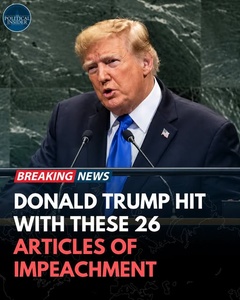
Trump Could Face Impeachment, Removal, and Jail Before Christmas? Here’s What the Constitution Actually Allows

A viral claim making the rounds on social media asserts that President Donald Trump could be “impeached, removed by Congress, and jailed by Florida before Christmas 2026.” The graphic, shared by BlinkNews and World Times Institute, taps into a potent mix of legal jeopardy and political uncertainty. But how much of it is grounded in reality — and how much is wishful thinking?
ONLINE — The image is bold and provocative, suggesting a trifecta of consequences for the sitting president before the year is out. While the claim has been amplified by social media users, including Virginia state delegate Nick Freitas, the constitutional and legal reality is far more complex .
The Impeachment Question: A Constitutional Blunt Instrument
Could Trump be impeached? The short answer is yes, constitutionally speaking. The U.S. House of Representatives holds the sole power of impeachment and can pass articles of impeachment by a simple majority vote .
Democrats are already laying the groundwork. In September 2026, as the midterms approach, the question has become a central political talking point. If they retake the House, Democratic leaders would have the constitutional authority to launch proceedings against the president . In fact, Democratic Rep. Al Green of Texas introduced articles of impeachment against Trump on August 24, 2026, citing "high crimes and misdemeanors" . Earlier in April, Rep. John Larson of Connecticut submitted a separate resolution with 13 articles, even calling on the Cabinet to invoke the 25th Amendment over concerns about the president's "instability" .
However, constitutional authority doesn't guarantee success. Impeachment is only the first step — it's the political equivalent of a formal charge. Removal from office requires a two-thirds majority vote in the Senate, a far higher bar . Trump was impeached twice during his first term and acquitted both times by the Senate . With the current 53-47 Republican majority in the Senate, even a Democratic House victory would likely fall short of the 67 votes needed to convict, absent a dramatic, bipartisan rebellion .
The Legal Framework in Florida: A Labyrinth of Delays
The claim that Trump could be "jailed by Florida" points to the federal classified documents case, which was being prosecuted in the Southern District of Florida. This case involves charges of illegal retention of national defense information, conspiracy to obstruct justice, and false statements, centered on his handling of documents at Mar-a-Lago .
However, the legal pathway to a trial, let alone a jail sentence, is proving to be a constitutional and procedural quagmire. The case has been presided over by Judge Aileen Cannon, a Trump appointee, who indefinitely postponed the trial date, making it highly unlikely to proceed before the presidential election . The Supreme Court's ruling on presidential immunity has also complicated the timeline, as the defense argues Trump's actions could constitute "official acts" .
For a sitting president to face incarceration, multiple improbable steps would need to occur:
-
The legal case would have to proceed to a trial and a guilty verdict.
The conviction would have to survive appeals, which could take years.
The ultimate sentencing, which could include prison time, would still face the unprecedented logistical and constitutional hurdle of incarcerating a sitting president.
The social media graphic is a potent distillation of Democratic legal and political hopes. The reality is that while the threats of impeachment and legal jeopardy are real, the constitutionally defined checks and balances, combined with the slow pace of the legal system, make the scenario of Trump being impeached, removed, and jailed before the end of the year an ambitious one.
Comments (0)
Loading comments...
May You Like


Shocking news from Ohio: an unexpected development ahead of Trump's rally