Trump Declares 'The Moon Is Ours' — But International Law Says Otherwise
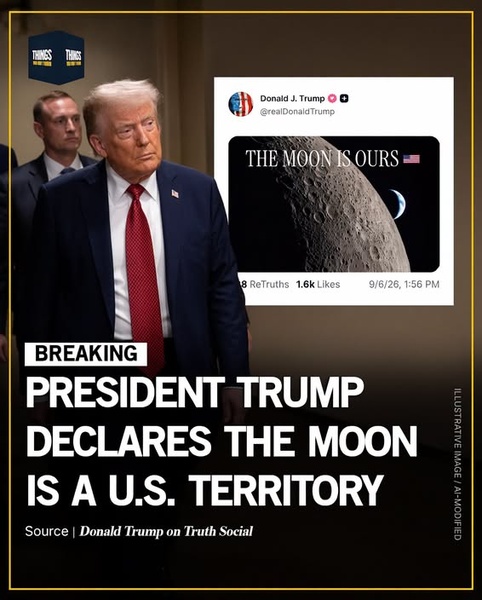
President Donald Trump has sparked a fresh wave of controversy by posting an AI-generated image of the Moon emblazoned with an American flag and the caption "THE MOON IS OURS." The declaration, made on his Truth Social platform, is the latest in a series of provocative territorial claims from the president — but it runs headlong into a decades-old international treaty that explicitly prohibits any nation from claiming sovereignty over celestial bodies.
WASHINGTON – The image circulating online is real: President Donald Trump posted an AI-generated image of the Moon on September 6, 2026, with the words "THE MOON IS OURS" . The post, which showed a US flag planted on the lunar surface, was shared without further explanation . A separate viral screenshot claiming he had issued an official executive order declaring the Moon a US territory was later identified as satire, not a genuine presidential post .
The declaration came during a broader Truth Social spree in which Trump also shared a map suggesting New Mexico be renamed "New America" and another image depicting the Strait of Hormuz as a "new U.S. Territory" . The Moon post followed Trump's August 28, 2026, speech at NASA's Johnson Space Center, where he spoke about returning to the Moon, establishing a permanent American settlement, and eventually traveling to Mars .
Why the Post Has No Legal Force
Despite the bold declaration, Trump's claim faces an insurmountable legal obstacle: the Outer Space Treaty of 1967, a United Nations agreement ratified by more than 100 countries — including the United States .
Article II of the treaty states explicitly: "Outer space, including the Moon and other celestial bodies, is not subject to national appropriation by claim of sovereignty, by means of use or occupation, or by any other means" . This means that no country can claim ownership of the Moon or any part of it, regardless of a flag planting or a presidential post.
"The Moon cannot belong to the United States, Russia, China, or any other country," Yevgeny Kuznetsov, CEO of Digital Evolution Ventures and a space industry expert, told TASS . He added that while states and private operators can build infrastructure and conduct scientific activities on the Moon, "ownership of a station, landing module, or other infrastructure does not create ownership of the area of the Moon on which that object is located" .
Even the US Moon landings, as historic as they were, do not provide a legal basis for a territorial claim. "Sending 12 people to the Moon 50 years ago means nothing in the context of its ownership," said University of British Columbia astronomy professor Jamie Matthews .
A Pattern of Territorial Rhetoric
The Moon post fits a broader pattern of Trump's efforts to reshape geographic and territorial identity . Over the past 18 months, he has:
-
Ordered federal agencies to rename the Gulf of Mexico to the "Gulf of America"
Signed an executive order directing that Lake Ontario be referred to as "Lake America" in official US use
Suggested renaming New Mexico as "New America" — though he has no legal power to change a state's name without legislative action
According to analysts, Trump's use of provocative posts, many AI-generated, is a calculated political strategy. KBS News reported that Trump posted more than 60 messages during the Labor Day holiday period, deploying AI-generated images that glorify himself or mock his opponents . Experts interpret this as an effort to project a strong-leader image ahead of the November midterm elections and rally his MAGA base .
The Lunar Geopolitics: What's Really at Stake
While Trump's claim is legally baseless, the post reflects a growing and complex geopolitical reality. The Moon is becoming a new frontier of strategic competition.
| Key Point | Details |
|---|---|
| Artemis Accords | 71 countries have signed the US-led agreement on principles for lunar activity, as of 2026 |
| Lunar infrastructure | States can build bases and extract resources — but cannot claim the territory |
| Resources | The Moon's south pole contains water ice, potentially crucial for future exploration and fuel production |
| De facto control | Through infrastructure and exclusion zones, the first-arriving state can effectively "draw a line on the lunar map," as Harvard law scholars note |
Harvard Law School scholars Jack Wright Nelson and David S. Schuman have explored the tension in the Outer Space Treaty's language. While Article II formally prohibits territorial claims, Article VIII grants states "jurisdiction and control" over their space objects, and Article XII permits them to establish "stations" and control access to them . This creates a legal grey area: a state may not be able to claim territory, but it can effectively occupy and defend a lunar base.
Comments (0)
Loading comments...
May You Like
gfnhgmnghnmfgnbvvvvvvvvv

Obama Steps Back Into the Political Spotlight as Democrats Target Trump’s

Shocking news from Ohio: an unexpected development ahead of Trump's rally