
Trump Defends His Leadership With ‘America First’
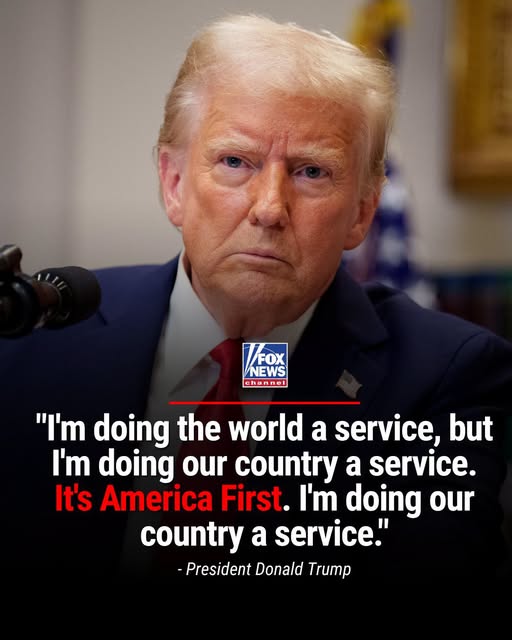
Trump Defends His Leadership With ‘America First’ Message, Says He Is Doing the Country and the World a Service
October 31, 2026 | Washington, D.C. | U.S. Politics & Foreign Policy
President Donald Trump's declaration that he is serving both the United States and the wider world has renewed attention to his America First philosophy, highlighting the administration's approach to national security, international relations, and American leadership.
A widely circulated image features Trump defending his actions as beneficial to the country while suggesting that his decisions also provide a broader service to the international community.
The statement reflects a central theme of Trump's political identity: American interests should take priority in government decision-making, even when those choices create disagreements with traditional allies and international institutions.
His remarks also raise a larger question about the relationship between national priorities and global responsibilities, particularly as Washington confronts difficult decisions involving military intervention, diplomacy, and economic security.
Verification note: The uploaded image contains a direct quotation attributed to Trump but does not identify the interview date or provide the complete exchange. Its precise context should be established before assigning it to a particular policy announcement.
The Original Interview Confirms Trump's Statement
The quotation has now been traced to an interview conducted by journalist Kristen Welker in Chippewa Falls, Wisconsin, on June 5, 2026, and broadcast two days later.
During the conversation, Welker challenged Trump over his longstanding campaign commitment to avoiding new wars, asking whether military operations against Iran had broken that promise.
Trump rejected the suggestion, arguing that preventing Iran from acquiring nuclear weapons justified American intervention and represented an important contribution to international security.
He then delivered the America First statement reproduced in the viral image, explicitly connecting his defense of military action with what he considered America's national interests.
Trump Rejects Accusations of Breaking His No-New-Wars Promise
The interviewer pressed Trump on why his administration had entered another military conflict after years of campaigning against prolonged American involvement in overseas wars.
Trump responded that he had never offered an unconditional guarantee against military intervention, arguing that maintaining a powerful military necessarily included the possibility of using it.
He defended the decision by presenting Iran's nuclear ambitions as an unacceptable security risk, insisting that preventing nuclear proliferation outweighed the political consequences of military action.
The exchange revealed a distinction in Trump's position between opposing prolonged military commitments and supporting operations he believes are necessary to address immediate national security threats.
Iran's Nuclear Program Remains Central to the Dispute
Trump's justification rests heavily on his assessment of Iran's nuclear intentions, including his belief that Tehran would eventually use nuclear weapons if permitted to acquire them.
That assessment should be distinguished from independently verified findings about Iran's nuclear capabilities, enrichment activities, and the existence of an operational nuclear weapon.
International nuclear monitoring has historically documented serious proliferation concerns, although determining the precise status of Iran's program requires reliable intelligence and access to relevant facilities.
The distinction matters because the strategic justification for military intervention depends partly on the nature, urgency, and credibility of the threat American officials claim to be confronting.
The Debate Over America's Global Responsibilities
Trump's comments also illustrate the tension between an America First foreign policy and the United States' longstanding role as a major international military and diplomatic power.
Supporters of his approach argue that decisive action can protect American interests while discouraging adversaries from threatening regional allies or developing increasingly dangerous military capabilities.
Critics question whether additional military operations can achieve sustainable security, warning that prolonged confrontation may increase economic costs, regional instability, and risks to American personnel.
The competing arguments reflect a broader debate about whether military intervention strengthens American leadership or creates new responsibilities that ultimately undermine the administration's domestic priorities.
What the Statement Means Politically
Trump's remarks provide insight into how he reconciles his opposition to prolonged foreign wars with his administration's willingness to use substantial military force against Iran.
Rather than presenting the intervention as a departure from America First, he characterized it as an extension of that philosophy, arguing that American security required confronting the perceived threat.
His comments also demonstrate how the administration seeks to frame international military decisions in terms of direct benefits to American citizens rather than broader commitments alone.
Final Fact-Check Verdict
The viral quotation is authentic. Trump made the statement during his June 5 interview, broadcast on June 7, 2026.
The important missing context is that he was defending military action against Iran after being questioned about his earlier opposition to starting new wars.
The screenshot therefore accurately reproduces his central message, although presenting it without the original interview context could obscure the specific foreign-policy controversy that prompted the remarks.
Comments (0)
Loading comments...
May You Like

NYC EMERGENCY—MILLIONS FACE EVACUATION RISKS, MACY'S GIANT BALLOONS REMOVED FOR SAFETY!

FCC CLEARS SPACEX FOR ONE MILLION AI SATELLITES AS ASTRONOMERS SOUND ALARM

TRUMP CALLS GDP FIGURE “FAKE” AFTER GOVERNMENT’S SCHEDULED REVISION

Latest Posts







Popular Posts




