
Trump Defends JD Vance’s Refusal to Call Iran Conflict a “War” — Then Calls It “Small Potatoes”
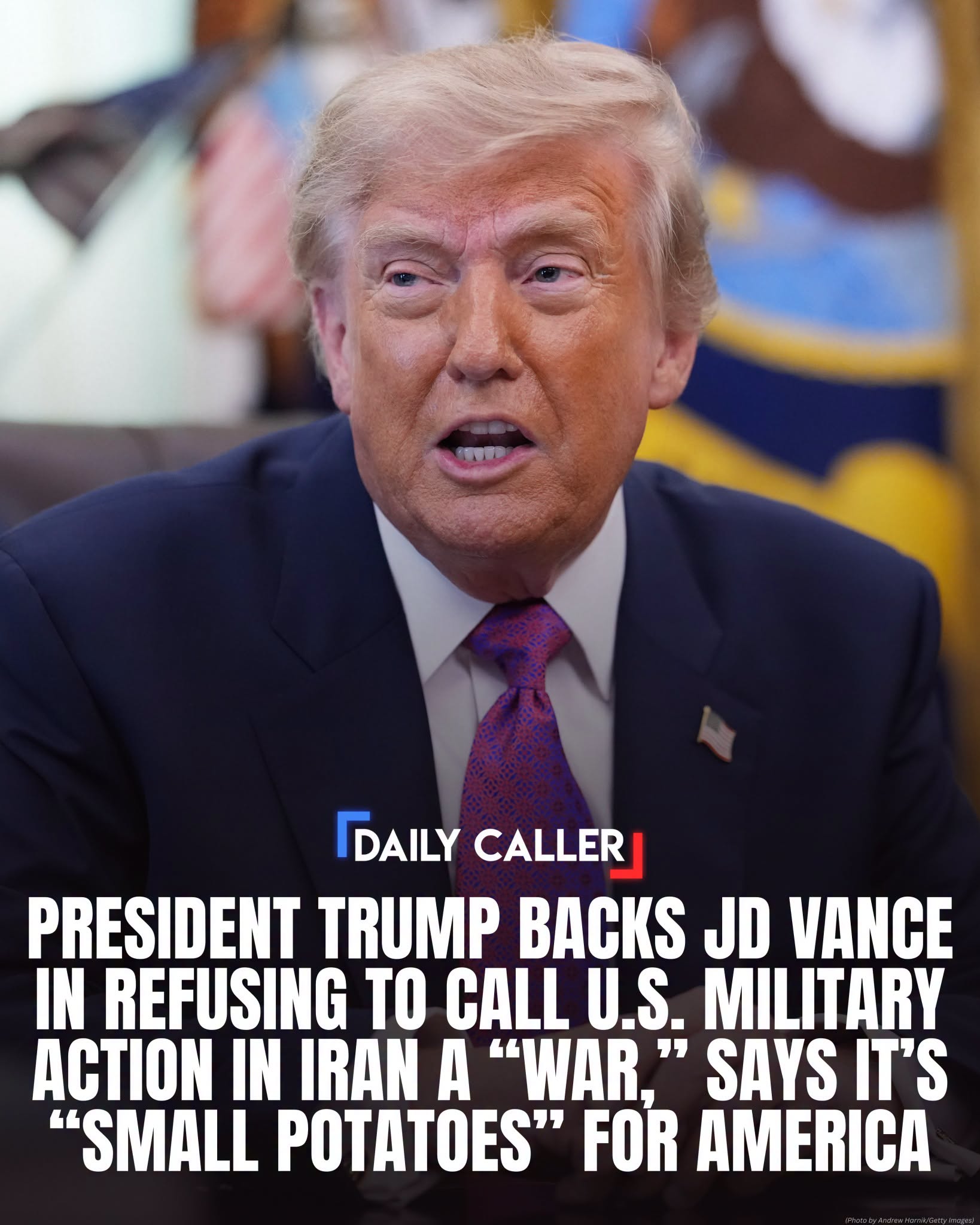
WASHINGTON — President Donald Trump has thrown his full support behind Vice President JD Vance’s controversial decision to avoid calling the ongoing U.S. military confrontation with Iran a “war,” arguing that the conflict is better described as a limited “military conflict” and dismissing its scale as “small potatoes” for the United States.
Trump made the remarks Friday, Sept. 4, in the Oval Office, one day after Vance faced repeated questions at a White House briefing about whether the United States was still at war with Iran.
The comments immediately drew attention because the confrontation has already lasted roughly six months, involved repeated U.S. and Iranian attacks, cost American taxpayers more than $37.5 billion and resulted in the deaths of 18 U.S. service members, according to The Associated Press.
Trump nevertheless insisted that the situation should not be compared with America's largest wars.
“I call it a military conflict because it’s small potatoes for us. It’s not a big thing.”
His words have opened a new political and rhetorical battle over how the administration describes a conflict that Washington has spent months trying to contain — while U.S. troops, warships and aircraft remain heavily involved across the Middle East.
Trump Backs Vance: “I Can Understand What He’s Saying”
Trump was asked about Vance's comments from Thursday, when the vice president rejected the characterization of the confrontation as a war.
Vance told reporters:
“I wouldn’t call it a war.”
He argued that the United States had ended its major combat operations against Iran and said there was no continuous active shooting, although he acknowledged that fighting had “flared up” in various locations.
Reuters reported that Vance declined to provide a timeline for when the conflict would definitively end. He said an end would require Iran to stop attacking commercial shipping in and around the Strait of Hormuz.
Trump, rather than distancing himself from his vice president, reinforced the argument.
“I can understand what he’s saying,” Trump said, adding that the U.S. strikes had become “intermittent.”
The administration's preferred terminology is therefore becoming increasingly clear: not a war, but a military conflict.
That distinction may sound semantic, but politically it matters enormously.
The Numbers Tell a Different Story
Whatever terminology Washington chooses, the military confrontation has had tangible consequences.
The conflict began on Feb. 28, 2026, and the United States and Israel have carried out airstrikes against Iranian targets. American forces have not deployed ground troops into Iran, according to AP.
But the absence of a U.S. ground invasion does not mean the conflict has been insignificant.
According to AP, 18 U.S. service members have been killed, while the cost to American taxpayers has exceeded $37.5 billion.
The United States also maintains more than 50,000 troops in the Middle East, while the Trump administration has deployed substantial naval forces to the region, including nearly 20 warships associated with efforts around the Strait of Hormuz.
Iran has also continued attacking U.S. interests and regional partners.
On Thursday, Iran fired at Kuwait, a U.S. Gulf ally, following a new round of American strikes against Iranian targets earlier in the week.
That makes Trump's “small potatoes” description particularly striking.
For the White House, the comparison is about scale.
For critics, the deaths, financial cost and continuing military deployments tell a very different story.
Why Is Vance Refusing to Say “War”?
Vance's language comes at a politically sensitive moment.
The conflict has entered its seventh month just as Americans prepare for the Nov. 3 midterm elections, when Republicans will attempt to defend narrow majorities in Congress.
Reuters reported this week that senior Trump administration officials are attempting to keep the Iran conflict from escalating before the election.
According to people familiar with internal discussions, the administration wants to rely more heavily on economic pressure and avoid a major escalation before voters go to the polls. Some officials have discussed the possibility of renewed military action after the election, although Reuters emphasized that no decision for a return to full-scale conflict has been made.
The political stakes are substantial.
A late-August Reuters/Ipsos poll found that only 31% of Americans approved of the war, while 63% disapproved. Rising gasoline prices have added another layer of political pressure.
In other words, the administration has an obvious incentive to present the conflict as limited, controlled and nearing a quieter phase rather than as a prolonged war.
The Strait of Hormuz Has Become the Center of the Crisis
One of the central issues is the Strait of Hormuz, a critical global oil-shipping route.
Iran has disrupted commercial shipping in the area, while the United States has attempted to ensure that oil can continue moving through the waterway.
Vance has presented the American military presence as an effort to prevent a much larger global energy crisis.
But Reuters reported that repeated attacks and counterattacks have kept oil prices elevated, while the latest U.S. strikes pushed prices sharply higher.
That creates a difficult contradiction for Washington.
The administration wants to demonstrate that it has restored stability to the region.
Yet every new strike, missile launch or disruption of commercial shipping risks producing another escalation.
Trump Says Iran Will Not Get a Nuclear Weapon
Trump also used the Oval Office exchange to defend the strategic purpose of the military campaign.
When pressed about his description of the conflict as “small potatoes,” despite the deaths of American service members, Trump returned to his central argument: the operation has significantly weakened Iran's nuclear capabilities.
“Iran will not have a nuclear weapon,” Trump said, arguing that the consequences would be unacceptable if Tehran were able to obtain one.
The administration has repeatedly portrayed preventing an Iranian nuclear weapon as one of the central objectives of its campaign.
But the conflict has evolved far beyond a single nuclear question.
It now involves commercial shipping, regional military bases, Gulf allies, energy infrastructure, sanctions and the possibility of another escalation.
A Conflict the Administration Cannot Simply Declare Over
Vance's comments also revealed a major problem facing the administration: there is no clear end date.
When reporters asked when the confrontation would actually end, Vance did not promise that it would be over before the November election.
Instead, he pointed to Iran's attacks on commercial shipping.
“If” Tehran continues those attacks, the United States has signaled that military pressure could continue.
Reuters reported that Vance also ruled out negotiations while Iran continues targeting commercial shipping.
That means the administration's attempt to keep the conflict contained may ultimately depend on Tehran's decisions as much as Washington's.
And that is precisely what makes the situation so unpredictable.
The Midterm Elections Add Another Layer of Pressure
The political calendar is now impossible to ignore.
Republicans currently hold narrow congressional majorities, and the Iran conflict has become an increasingly uncomfortable issue for the administration.
According to Reuters, senior officials want to prevent the conflict from dominating the political conversation before November.
But the strategy faces an obvious obstacle:
Iran does not have to follow the White House's electoral timetable.
A single Iranian attack on a U.S. base, an American strike that kills senior Iranian officials, a major incident involving an oil tanker or another disruption in the Strait of Hormuz could rapidly transform a “contained” conflict into something much larger.
And if that happened in the final weeks before the election, the political consequences could be enormous.
“Small Potatoes” Could Become One of Trump’s Most Controversial Phrases
Trump has frequently used blunt and provocative language when describing wars and foreign-policy crises.
But calling the Iran conflict “small potatoes” carries particular political risks because it comes after months of fighting and the deaths of 18 American service members.
The president's argument is essentially comparative: the conflict is smaller than Vietnam and other major American wars, and the United States has not suffered anything approaching the casualty levels of those conflicts.
AP noted that 58,220 U.S. service members died during the Vietnam War, according to National Archives records.
Yet comparing casualty totals does not answer the central question confronting Americans now:
How should a military conflict be judged when it has already cost billions of dollars, killed American troops, disrupted global energy markets and continued for more than half a year?
Trump and Vance Are Sending the Same Message
The significance of the latest comments may ultimately lie less in the phrase “small potatoes” itself and more in the fact that Trump and Vance are now presenting a remarkably similar description of the conflict.
Vance says it is not a war.
Trump says he understands that position.
Vance says major combat operations have ended.
Trump says American strikes are intermittent.
Meanwhile, Reuters reports that U.S. and Iranian forces have exchanged attacks again this week, while more than 50,000 U.S. troops remain stationed in the region.
The contradiction is becoming increasingly difficult to ignore.
Washington may not want to call it a war. But the military, financial and geopolitical consequences increasingly look like those of a war.
The Bigger Question: How Long Can the Conflict Stay “Small”?
For now, Trump is betting that the confrontation can remain limited.
His administration wants Iran under pressure, commercial shipping protected and the nuclear threat neutralized — without being pulled back into a prolonged regional war.
That is a difficult balance.
The United States has already spent more than $37.5 billion and lost 18 service members. Iran continues to possess the ability to disrupt regional security, while American forces remain deeply engaged across the Middle East.
And with the midterm elections approaching, every additional escalation carries political consequences.
Trump may call it “small potatoes.”
Vance may refuse to call it a war.
But the real test will not be the words used to describe the conflict.
It will be whether Washington can actually prevent the next exchange of fire from becoming something much bigger.
Comments (0)
Loading comments...
May You Like

Shocking news from Ohio: an unexpected development ahead of Trump's rally

Barack Obama Draws Attention With New Literary Podcast













