Trump Demands Fed Rate Cuts After Blockbuster Jobs Report — Threatens to ‘Stop Trading’ With Deficit Countries
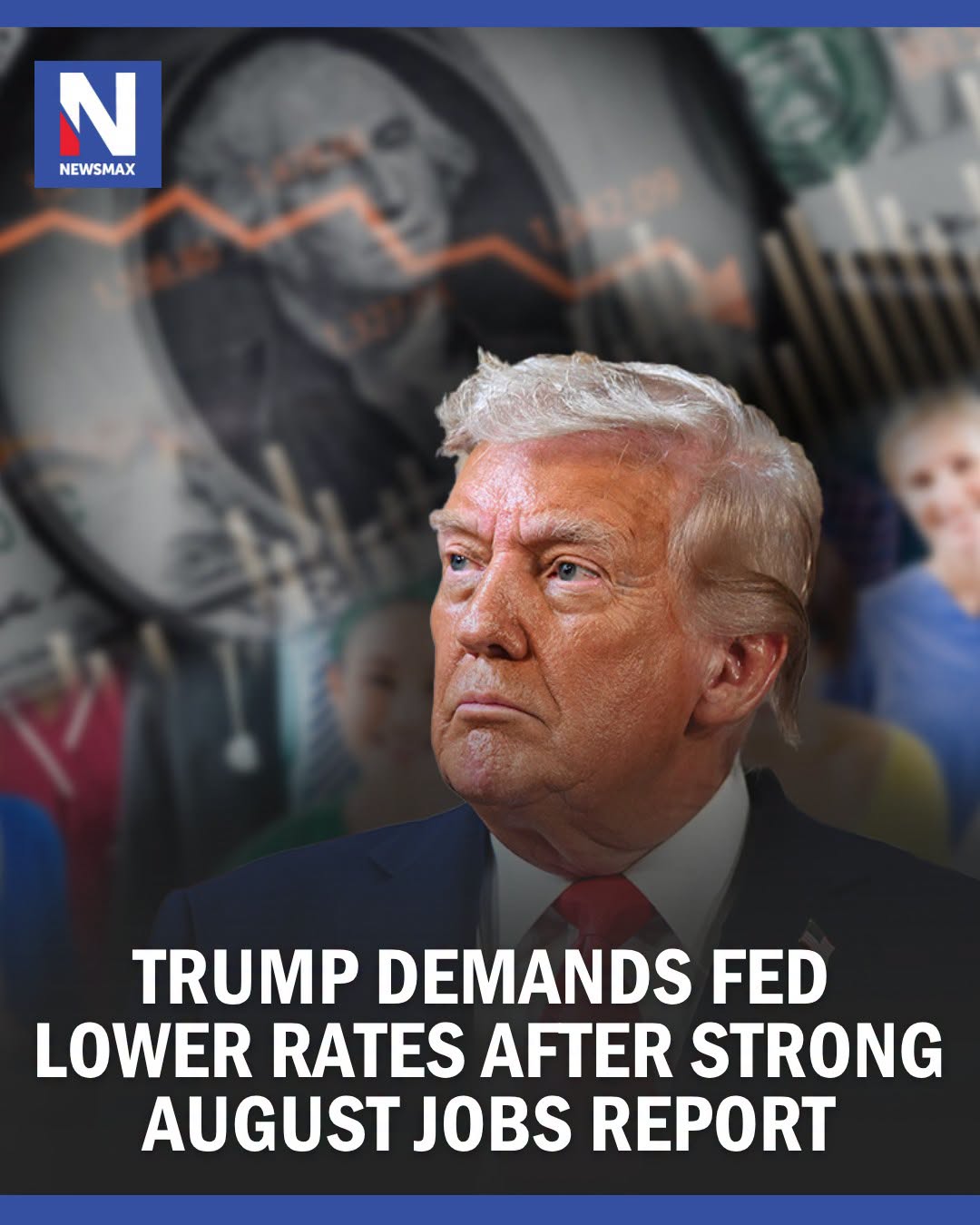
President Trump celebrated a "great jobs number" that nearly tripled expectations — then immediately turned around and demanded the Federal Reserve cut rates, warning he would halt trade with countries that run surpluses with the U.S. if the central bank doesn't comply. The problem? The strong employment data has actually made a September rate hike more likely.
WASHINGTON – President Donald Trump on Friday renewed his pressure campaign against the Federal Reserve, demanding lower interest rates just hours after the Labor Department released a blockbuster August jobs report that exceeded virtually every forecast .
The U.S. economy added 162,000 nonfarm payrolls in August, nearly triple the 56,000 expected by economists, while the unemployment rate held steady at 4.1% . July's previously reported loss of 23,000 jobs was revised sharply upward to a gain of 21,000 — a swing of 44,000 jobs .
"Great jobs number just announced, breaking all estimates (except mine!) by double and triple," Trump posted on Truth Social at 9:41 a.m. ET .
Then came the demand.
"A STRONG COUNTRY MEANS LOWER RATES — THAT'S BETTER CREDIT... Very simple!" Trump wrote. "We should have the LOWEST RATE of any country in the world, like the 'old days.' LOWER THE RATE OR I'LL STOP TRADING WITH COUNTRIES WITH WHICH WE HAVE A DEFICIT" .
The Paradox: Strong Jobs Data Makes Rate Cuts Less Likely
The president's demand comes at a moment when the economic data points in the opposite direction.
Following the jobs report, market expectations for a September rate hike surged. CME FedWatch showed the probability of a 25-basis-point hike rising from approximately 52% before the release to nearly 60% afterward .
"The August jobs report changed the tone of the September Federal Reserve debate almost immediately," analysts noted. "A labor market adding nearly three times as many jobs as expected, with unemployment stable, gives policymakers more room to concentrate on inflation without immediately worrying that higher rates will push employment into a serious downturn" .
The 2-year Treasury yield, particularly sensitive to Fed expectations, jumped 7.6 basis points to 4.41%, while the 10-year yield rose to 4.792% . Gold dropped 1.7% as the dollar strengthened .
Jeffrey Roach, chief economist for LPL Financial, said the report changes the September debate significantly. "Given the strength of the payroll report, a rate hike on September 16 appears increasingly likely" .
Trump's Economic Argument: Sound or Flawed?
The president's reasoning for lower rates appears to conflate two distinct concepts: creditworthiness and monetary policy.
Trump argued that because the U.S. economy is stronger, the country "represents a stronger credit" and therefore "deserves a lower interest rate" .
However, economists point out a fundamental flaw: "A stronger sovereign credit profile can affect the risk premium investors demand when lending to a government. The federal funds rate serves a different purpose. The Fed sets monetary policy primarily according to inflation and labor-market conditions, rather than assigning the United States an interest rate based on its credit quality" .
The employment numbers simply do not support a rate-cutting narrative. If employment had collapsed, there would be a straightforward economic case for reducing rates to support demand. Instead, payroll growth came in at 162,000 against expectations around 56,000, and July's negative number disappeared after revision .
The Trade Threat: 'Better Than Tariffs'
Trump's threat to cut off trade with surplus countries is among the most aggressive public pressure tactics he has employed since Kevin Warsh became Fed chair in May .
"If the U.S. doesn't agree to allow them to have huge surpluses — which we can stop immediately — then they should no longer be considered financial ELITE nations!" Trump wrote. "LOWER THE RATE OR I'LL STOP TRADING WITH COUNTRIES WITH WHICH WE HAVE A DEFICIT... BETTER THAN TARIFFS!" .
The threat, if taken literally, would be extraordinarily disruptive. The U.S. runs trade deficits with approximately half of its individual trading partners, and the total goods and services deficit reached **$88.6 billion in July alone** — a $17.4 billion increase from June . Imports in July totaled $399.3 billion, exceeding exports of $310.7 billion .
Restricting trade with surplus countries would affect trade flows, supply chains and import prices — potentially complicating the inflation calculation rather than making monetary easing easier to justify .
The Inflation Elephant in the Room
The Fed's dual mandate covers maximum employment and price stability . With payrolls running at five times the prior year's monthly average of 31,000, unemployment steady at 4.1%, and the workweek lengthening, the employment side of that mandate is not sending a distress signal .
That frees the central bank to concentrate on the other side — which remains a long way from target.
Headline PCE inflation ran 3.7% year-over-year in July and core PCE 3.3%, against a 2% goal . Inflation has now remained above the Fed's target for over 65 consecutive months .
Energy prices add another complication. Diesel prices have reached a record $5.85 per gallon, while Brent crude remains around $95 per barrel . Energy costs do not automatically translate one-for-one into underlying inflation, but they represent another source of price pressure the Fed must consider.
VP Vance Joins Pressure Campaign
Vice President JD Vance added his voice to the pressure campaign on Thursday, calling on the Fed to cut rates to ease housing affordability .
"Obviously, the president is very focused on interest rates," Vance said at a White House press briefing. "The main reason he cares so much is that he wants Americans to be able to afford homes. When rates go up, borrowing costs go up with them" .
"We believe the Fed should lower rates," Vance said, calling it the "appropriate and responsible" response to recent inflation data .
Vance's remarks came less than two weeks before the FOMC convenes on September 16 to decide whether to adjust rates .
Fed Chair Warsh Signals a Different Path
Just one week before Trump's demand, Fed Chair Kevin Warsh — Trump's own appointee — delivered a hawkish speech at the Jackson Hole economic symposium .
Warsh "reiterated his commitment to the 2% inflation target and said elevated prices should be the central bank's primary focus" . He emphasized that monetary policy should respond to economic conditions rather than political pressure .
Fed Governor Christopher Waller, in a surprise dovish shift Thursday, said he could support holding rates steady if upcoming inflation data confirms price pressures are cooling . He would consider a hike, however, if August prices run hot .
That report arrives September 11 — five days before the FOMC convenes .
Market Reaction: The Adjustment
Financial markets responded in a fairly conventional way to stronger-than-expected data when the central bank is deciding whether another rate increase is necessary .
The dollar index rose 0.37% following the report, while gold moved sharply lower toward $4,392 an ounce . Wall Street was much less dramatic: the Dow opened 0.19% lower, while the S&P 500 and Nasdaq were essentially flat .
"The clearest adjustment happened in rates, currencies and gold rather than equities," analysts observed .
What Happens Next: CPI Is the Deciding Factor
Friday's jobs report removed the labor market as an argument against tightening. Next week's inflation report will decide whether the Fed acts on it .
White House NEC Director Kevin Hassett said he is particularly focused on the August CPI data, noting that the Fed "will do as it pleases. We respect the Fed's independence" . However, he also argued that "the case for holding rates steady is quite strong" based on recent three-month annualized inflation running around 1.6% .
Economists surveyed by Bloomberg expect headline CPI to rise to 3.4% year-over-year, with core CPI dipping to 2.4% .
BlackRock portfolio manager Jeffrey Rosenberg said whether the Fed hikes in September still depends on the next inflation report and energy price trends .
The Bottom Line
| What Trump demands | What the data suggests |
|---|---|
| Immediate rate cuts | September rate hike probability at ~60% |
| U.S. "deserves" lower rates | Fed sets policy on inflation, not creditworthiness |
| Stop trade with deficit countries | U.S. trade deficit hit $88.6 billion in July |
| Rates should be "lowest in the world" | Fed's 2% inflation target remains unmet |
President Trump's demand for lower rates — backed by a threat to upend global trade — has arrived at precisely the moment when the economic data makes rate cuts least justifiable. With payrolls surging, unemployment stable, and inflation persisting, the Fed finds itself under political pressure to do exactly the opposite of what its mandate demands.
The next chapter in this drama will be written on September 11, when the August CPI report is released. For now, the president's "fireworks" are more rhetorical than real — but the stakes for the U.S. economy, and for the independence of the Federal Reserve, could hardly be higher.
Comments (0)
Loading comments...
May You Like

Barack Obama Draws Attention With New Literary Podcast

FIGHT OVER OBAMA’S IRAN POLICY

gfnhgmnghnmfgnbvvvvvvvvv