
Trump Demands Fed Rate Cuts After Strong Jobs Report — Threatens to Halt Trade with Deficit Countries
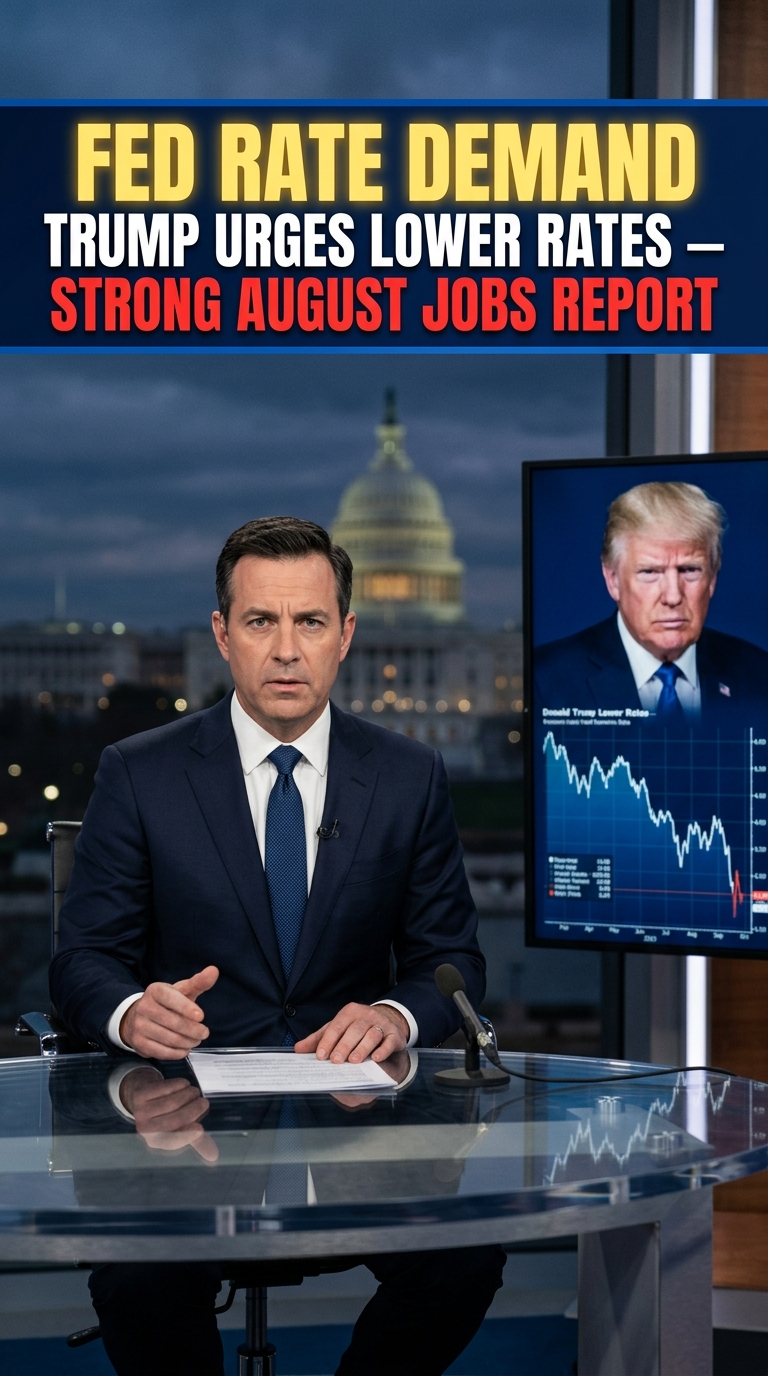
President Trump celebrated a blockbuster August jobs report that nearly tripled expectations — then immediately demanded the Federal Reserve lower interest rates, warning he would halt trade with countries where the U.S. runs a deficit if the central bank doesn't comply. The problem? The strong employment data has actually made a September rate hike more likely.
WASHINGTON – President Donald Trump on Friday renewed his pressure campaign against the Federal Reserve, demanding lower interest rates just hours after the Labor Department released a surprisingly strong August jobs report .
The U.S. economy added 162,000 nonfarm payrolls in August, far exceeding economists' expectations of just 53,000 jobs . The unemployment rate held steady at 4.1%, while the labor force participation rate ticked up to 61.6% .
"Great jobs number just announced, breaking all estimates (except mine!) by double and triple — And you haven't seen anything yet!" Trump posted on Truth Social . "EMPLOYERS ADDED 162,000 JOB IN AUGUST. Lower the interest rates because the U.S.A. is a much stronger credit than it was just a short time ago!"
The Paradox: Strong Jobs Data Makes Rate Cuts Less Likely
The president's demand comes at a moment when the economic data points in the opposite direction. Following the jobs report, market expectations for a September rate hike surged. The CME FedWatch tool showed the probability of a 25-basis-point hike rising to approximately 62-65% — up from around 49% just a day earlier .
"A STRONG COUNTRY MEANS A LOWER INTEREST RATE — IT'S A BETTER CREDIT…Very simple!" Trump wrote, arguing that the U.S. economy's strength justifies lower borrowing costs .
However, economists point out a fundamental flaw in this reasoning: the Federal Reserve sets monetary policy based on inflation and labor-market conditions, not on the country's creditworthiness . The employment numbers simply do not support a rate-cutting narrative — if employment had collapsed, there would be a clear case for reducing rates .
The Trade Threat: 'Better Than Tariffs'
Trump's threat to cut off trade with surplus countries is among the most aggressive public pressure tactics he has employed since Kevin Warsh became Fed chair in May .
"LOWER THE RATE OR I'LL STOP TRADING WITH COUNTRIES WITH WHICH WE HAVE A DEFICIT," Trump wrote. "IT'S BETTER THAN TARIFFS! The Fed Board, with its great new leader, must get smart — BE PATRIOTS for a change" .
The threat, if taken literally, would be extraordinarily disruptive. The U.S. runs trade deficits with more than 90 countries , and the total goods and services deficit reached **$88.6 billion in July alone** — a 24.4% surge from June's $71.2 billion . Major trading partners with deficits include Mexico ($27.5 billion in July), Vietnam ($23.3 billion), China ($15.2 billion), and the European Union ($8.9 billion) .
Trump cited the International Emergency Economic Powers Act of 1977, which gives the president authority to impose embargoes over what is deemed an economic emergency .
The Inflation Elephant in the Room
The Fed's dual mandate covers maximum employment and price stability . With payrolls running at nearly three times expectations, unemployment steady at 4.1%, and the workweek lengthening, the employment side of that mandate is not sending a distress signal. That frees the central bank to concentrate on the other side — which remains a long way from target.
Inflation has remained above the Fed's 2% target for over 65 consecutive months . Headline PCE inflation ran at 3.4% year-over-year in July, well above the central bank's goal .
Fed Chair Kevin Warsh, Trump's own appointee, delivered a hawkish speech at the Jackson Hole economic symposium just one week earlier, "reiterating his commitment to the 2% inflation target and saying elevated prices should be the central bank's primary focus" . Three Fed officials dissented in favor of a quarter-point hike at the July meeting, where rates were left unchanged .
VP Vance and Administration Officials Join Pressure Campaign
Vice President JD Vance added his voice to the pressure campaign this week, calling on the Fed to cut rates to ease housing affordability.
"We believe that the Fed should be lowering interest rates," Vance said. "We're doing a lot of things to try to keep those interest rates down, but it would be nice to have some help from the Federal Reserve" .
Treasury Secretary Scott Bessent noted in a CNBC interview that the Fed typically doesn't raise rates during a supply shock until there are second- or third-order inflationary effects . Senior economic counselor Peter Navarro went further, calling the rate-setting Federal Open Market Committee members "clowns" and warning that a rate hike would be "careless" .
Market Reaction: The Adjustment
Financial markets responded in a conventional way to stronger-than-expected data when the central bank is deciding whether another rate increase is necessary.
| Indicator | Reaction |
|---|---|
| 2-year Treasury yield | Jumped 7.6 basis points to 4.41% |
| 10-year Treasury yield | Rose to 4.792% |
| Dollar index | Rose 0.37% |
| Gold | Dropped 1.7% |
| Rate hike probability | Surged from 49% to ~62-65% |
The clearest adjustment happened in rates, currencies and gold rather than equities — Wall Street opened with modest losses, with the Dow down 0.19% .
What Happens Next: CPI Is the Deciding Factor
Friday's jobs report removed the labor market as an argument against tightening. Next week's inflation report — the August CPI and PPI data — will decide whether the Fed acts on it .
The Fed's next policy meeting is scheduled for September 15-16, just ten days away . The meeting comes just two months before the November midterm elections, in which polls show the administration faces widespread voter dissatisfaction with higher prices and interest rates .
The Bottom Line
| What Trump demands | What the data suggests |
|---|---|
| Immediate rate cuts | September rate hike probability at ~62-65% |
| U.S. "deserves" lower rates | Fed sets policy on inflation, not creditworthiness |
| Stop trade with deficit countries | U.S. trade deficit hit $88.6 billion in July |
| Rates should be "lowest in the world" | Fed's 2% inflation target has been unmet for 65+ months |
President Trump's demand for lower rates — backed by an unprecedented threat to upend global trade — has arrived at precisely the moment when the economic data makes rate cuts least justifiable. With payrolls surging, unemployment stable, and inflation persisting, the Fed finds itself under political pressure to do exactly the opposite of what its mandate demands .
The next chapter in this drama will be written on September 11, when the August CPI report is released. For now, the president's "fireworks" are more rhetorical than real — but the stakes for the U.S. economy, and for the independence of the Federal Reserve, could hardly be higher.
Comments (0)
Loading comments...
May You Like

TRUMP’S OHIO WARNING UNDER THE SPOTLIGHT

Russian Drone Strikes Kyiv Bridge as German Chancellor Arrives in Ukraine

Shocking news from Ohio: an unexpected development ahead of Trump's rally












