Trump Demands Ilhan Omar Resign, but the Evidence Behind His Claim Remains Unproven
Trump Demands Ilhan Omar Resign, but the Evidence Behind His Claim Remains Unproven
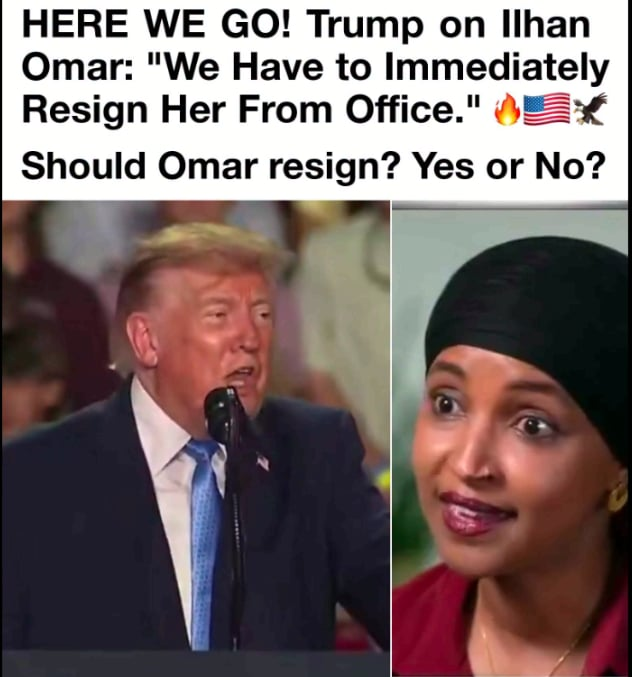
President Donald Trump has called for Democratic Representative Ilhan Omar of Minnesota to resign from Congress, escalating a political dispute over her name and a federal investigation. The demand was repeated at campaign rallies during the final stretch before the November 2026 midterm elections.
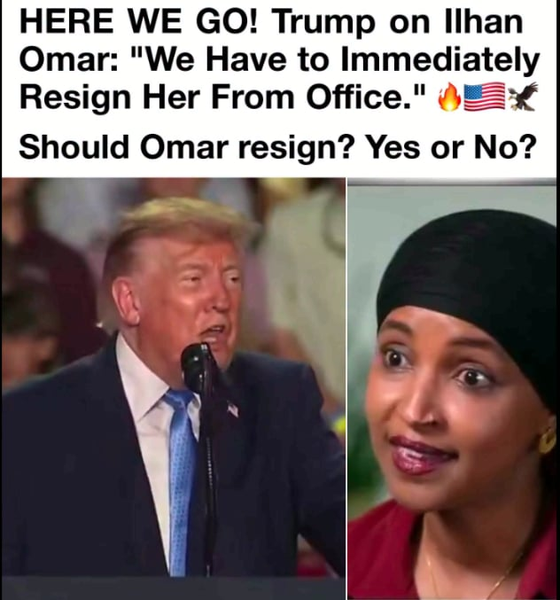
At a rally in Fort Myers, Florida, on October 23, Trump said he assumed Omar “must immediately resign from Congress,” alleging that she used a false name when she was sworn in. A transcript confirms that he made the demand, while the graphic circulating online presents it as a call to remove her from office.
The controversy intensified after a Justice Department court filing referred to the congresswoman as “Ilhan Nur Said Elmi, a/k/a Ilhan Abdullahi Omar.” The abbreviation “a/k/a” means “also known as.” The filing did not explain the relationship between the names, and the reference alone does not establish that Omar committed fraud.
That distinction is central to evaluating Trump’s accusation. A legal document using an alternate name is not, by itself, a finding that a public official used a false identity unlawfully. The public record described in recent reporting does not establish that the filing concluded Omar committed fraud or that she was legally disqualified from serving in Congress.
Omar has rejected the allegation. A spokesperson told Al Jazeera that her name has always been Ilhan Omar, and the congresswoman has described the claims as false and politically motivated. Her response disputes the premise of Trump’s demand rather than accepting that the court filing proves wrongdoing.
The federal investigation adds another layer to the story. Federal agents executed a court-authorized search warrant at Omar’s Washington home on October 12, according to Associated Press reporting. Authorities have not publicly provided a complete account of the investigation, and the existence of a search does not establish guilt.
Trump has linked the investigation and the name controversy in his public comments, but the claims need to be considered separately. A search warrant indicates that investigators obtained judicial authorization to search for specified evidence; it is not a conviction, a criminal charge, or a judicial determination that a person committed the conduct being investigated.
During the October 23 rally, Trump also urged political allies to tell House Speaker Mike Johnson that Omar’s seat had effectively been conceded by Democrats. That statement was political rhetoric, not a formal congressional action. A president cannot remove a House member simply by declaring that the seat is vacant.
Under the U.S. Constitution, the House of Representatives judges the elections and qualifications of its members, and a member can be expelled only with a two-thirds vote. Resignation is a decision for the member herself. Any effort to remove a sitting representative must follow constitutional and legal processes rather than a rally demand.
Omar represents Minnesota’s 5th Congressional District and is one of the first two Muslim women elected to Congress. She was born in Somalia and became a U.S. citizen as a child after her family resettled in the United States. Her background has repeatedly made her a target of political attacks, while supporters say the current controversy is being used to question her legitimacy.
The dispute also draws on older rumors about Omar’s past marriage. Those rumors have circulated for years, but repetition on social media does not convert them into established facts. Responsible coverage should distinguish allegations, denials, verified records and findings by courts or investigators.
The immediate political context is the midterm campaign. Trump has been holding rallies for Republican candidates, and his attacks on Omar have drawn attention away from local contests to a national argument over immigration, identity, law enforcement and political belonging.
Such rhetoric can mobilize supporters, but it can also intensify hostility toward a lawmaker and communities associated with her background. Trump’s comments about Somalia at the rallies were broadly disparaging, and critics argue that linking a Somali American representative to unproven allegations encourages suspicion based on origin rather than evidence.
Supporters of Trump argue that elected officials should face scrutiny if credible evidence of misconduct emerges. That principle applies to all public officials. But scrutiny must be evidence-based, and allegations should not be presented as legal conclusions before investigators or courts establish the relevant facts.
The public should therefore keep three questions separate: what name or names appear in a government filing, whether any conduct violated the law, and whether any such conduct would affect Omar’s eligibility to serve in Congress. Each question requires evidence and legal analysis; none is resolved merely by a political speech.
The circulating graphic asks whether Omar should resign, inviting a yes-or-no response. But a resignation call is a political judgment, while the underlying allegations are factual and legal questions. Readers can disagree about Omar’s politics without assuming that an accusation has already been proven.
At the time of writing, the clearest confirmed fact is that Trump publicly demanded Omar’s resignation. Reporting also confirms that a Justice Department filing used an additional name and that investigators searched her home under a judicially authorized warrant. Those facts do not, on their own, prove that she committed fraud or must leave office.
The next meaningful developments would be an official explanation of the investigation, any charges or court findings if they occur, and documented responses from Omar and her legal representatives. Until then, it is important not to treat anonymous claims or interpretations of a court filing as a final verdict.
The episode illustrates how fast political claims can spread when a document is cited without its full context. A filing may contain a name, but determining what that means legally requires more than a screenshot or a headline. The distinction between an allegation and an established fact is essential to fair reporting.
In short, Trump has indeed called on Ilhan Omar to resign, but the public evidence cited in the current controversy does not itself establish the fraud he alleges. Whether the investigation produces substantiated findings remains a separate question. For now, the demand is a political statement—not a legal order, and not proof that Omar is disqualified from Congress.


Comments (0)
Loading comments...
May You Like
Rick Santorum Says Obama Reignited Racism, Rejects Claim Trump Was Most Divisive President
Latest Posts




Popular Posts