Trump Did Not Announce ‘No Property Taxes’ for Homeowners 65+: Viral Graphic Misstates a State-Level Proposal
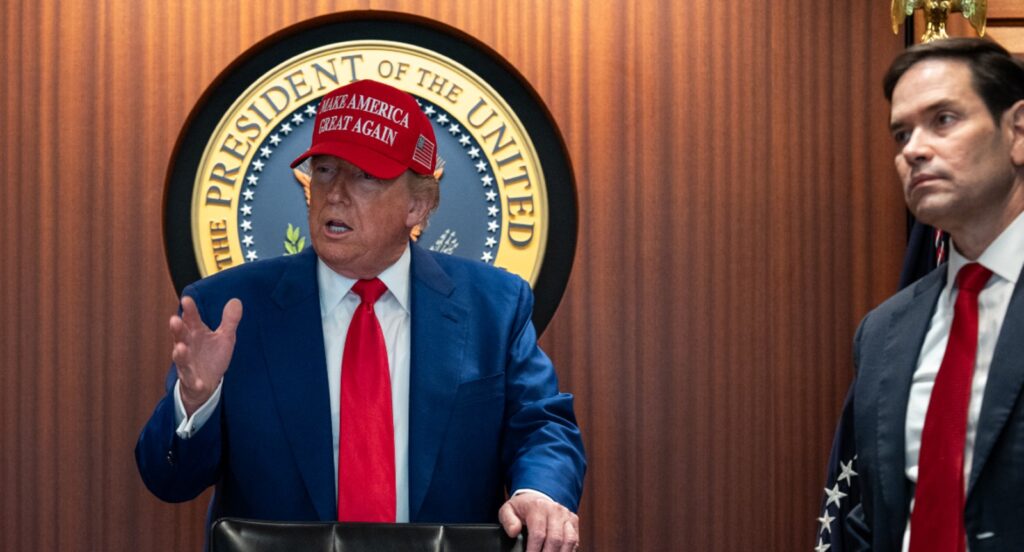
The widely shared graphic claims President Donald Trump has announced a sweeping property-tax exemption for homeowners 65 and older who own their homes outright. The available official record does not support that claim. A remarkably similar proposal does exist — but it was introduced by an Oklahoma state senator, not Trump.
The viral graphic shown above makes a dramatic claim: “President Trump announces ‘no property taxes’ for homeowners 65+ who own their homes outright.” It then asks viewers whether they support the proposal.
The underlying idea is real as a piece of tax policy. But the attribution to Trump, and the suggestion that a nationwide exemption has been announced, are misleading.
As of September 4, 2026, there is no verified federal policy eliminating property taxes for Americans 65 and older who have paid off their homes. Instead, the closest match to the graphic is an Oklahoma proposal introduced by Republican state Sen. David Bullard.
The striking Oklahoma connection
In December 2025, Bullard introduced the Ad Valorem Reform Act of 2026, including Senate Joint Resolution 23.
The Oklahoma Senate described the proposal explicitly: it would eliminate property taxes for Oklahomans age 65 or older who own their primary homes outright, while seeking to freeze property taxes for other qualifying homeowners. The proposal would also shift some local-government and school funding toward consumption taxes.
The official legislative summary is even more specific. SJR 23 proposes removing property taxes for seniors 65 or older who do not have a lien on their homestead, while expanding a property-value freeze and allowing counties to pursue consumption taxes as a replacement revenue source.
That is remarkably close to the wording used in the viral graphic.
But there is a critical difference:
The Oklahoma proposal was authored by Sen. David Bullard. It was not announced by President Trump.
Oklahoma's official legislative record lists SJR 23 as a measure by Bullard, introduced in December 2025 and read for the first time in the Senate on February 2, 2026. The record currently shows no votes on the measure.
So where did the Trump claim come from?
The wording circulating online can be traced to social-media posts from 2025 that attributed the statement to Trump.
A June 2, 2025 post reproduced the formulation “No property taxes for people over 65 who own house outright! Housing should not be a burden for seniors.”
That wording subsequently appeared repeatedly in reposts and political accounts.
However, searches of the official presidential and federal tax records do not establish that Trump announced a nationwide property-tax exemption matching the graphic.
The federal government has enacted significant tax relief for seniors under Trump's 2025 tax legislation, but that is a different policy.
What Trump actually delivered for seniors
The Trump administration's major enacted senior tax provision is an additional federal $6,000 deduction for eligible taxpayers age 65 and older.
According to the IRS, the deduction applies for tax years 2025 through 2028. It is worth up to $6,000 per eligible individual, or $12,000 for a qualifying married couple, and phases out above specified income levels.
This is a federal income-tax deduction.
It does not mean that a 65-year-old homeowner stops paying county, municipal or school-district property taxes.
The distinction is important because a deduction from federal taxable income and an exemption from local property taxation are entirely different mechanisms.
Property taxes are primarily a state and local issue
The graphic also obscures another major issue: property taxes are generally imposed by local governments, not by Washington.
The Tax Policy Center reports that real-property taxes are primarily levied by cities, counties and school districts. In 2022, state and local governments collected about $627 billion in property taxes, with property taxes representing roughly 27% of local government revenue. Those revenues help fund services including roads, police, parks and K-12 education.
That means a nationwide federal declaration saying certain homeowners owe no property tax would raise a complicated question: who replaces the revenue currently collected by local governments?
The Oklahoma proposal illustrates one possible answer.
Bullard's plan would permit counties to use consumption taxes to replace some property-tax revenue. His legislation specifically contemplates shifting the funding structure for schools and local governments rather than simply making the existing revenue disappear.
Oklahoma's proposal is real — but it is not federal law
SJR 23 is therefore an important piece of context for understanding the viral image.
The measure would:
- remove property taxes for qualifying Oklahomans 65 and older;
- require the homeowner's primary residence to meet the proposal's ownership requirements;
- freeze the fair cash value of other homesteads under specified circumstances;
- move property-tax provisions from the state Constitution into statutes;
- allow counties to pursue voter-approved consumption taxes to replace property-tax revenue.
But the measure has not become a nationwide senior tax exemption.
Oklahoma's official legislative page shows SJR 23 was introduced and referred to the Senate Rules Committee, with no recorded votes listed.
That is a very different status from an enacted law — and an even greater distance from a federal presidential announcement.
Other states already offer senior property-tax relief
The idea itself is not unusual.
States use various mechanisms to reduce property-tax burdens for older homeowners, including exemptions, assessment freezes, credits and deferrals. The exact rules differ considerably from one jurisdiction to another.
For example, New Jersey's Senior Freeze program reimburses qualifying homeowners for increases in property taxes above an established base year. Eligibility includes being 65 or older, meeting ownership and residency requirements and satisfying income limits.
Texas also expanded its senior homestead exemption in 2025. Texas lawmakers increased the general homestead exemption and separately increased the additional exemption available to homeowners 65 and older or with disabilities.
California has also seen proposals for much broader senior property-tax exemptions. In February 2026, the California Secretary of State announced that an initiative had entered circulation that would exempt certain homeowners 60 and older from property taxes if ultimately approved through the state's initiative process.
These examples show why the viral claim can sound plausible: senior property-tax relief is a genuine policy issue being debated around the country.
But those state initiatives should not be confused with a Trump-announced national exemption.
What about Trump's other housing-tax proposals?
Trump has discussed other housing-related tax changes.
For example, in July 2025, Reuters reported that Trump said his administration was considering eliminating capital-gains taxes on home sales. That proposal concerns the federal tax treatment of profits from selling a home — not the recurring property taxes imposed by local governments.
That distinction matters because social-media posts can easily merge several different tax proposals into one seemingly comprehensive "no property tax" plan.
The federal government has also taken steps aimed at reducing housing costs more broadly. A March 2026 White House executive order directed agencies to review regulatory barriers to housing construction and included language concerning the reduction of property-tax burdens, among other housing-related objectives. But it did not abolish property taxes for senior homeowners.
What the viral graphic gets right — and what it leaves out
What is real:
- There are active proposals to reduce or eliminate property taxes for older homeowners.
- Oklahoma introduced a proposal specifically targeting homeowners 65 and older who own their primary homes outright.
- Trump has backed and enacted broader tax relief for seniors.
- Several states have expanded senior property-tax exemptions, freezes or credits.
What is misleading:
- There is no verified evidence that Trump announced a nationwide policy eliminating property taxes for all homeowners 65+ who own their homes outright.
- The closest policy match is an Oklahoma state proposal, not a federal Trump initiative.
- The $6,000 senior benefit enacted under Trump's tax law is a federal income-tax deduction, not a property-tax exemption.
- A social-media statement asking whether people support "no property taxes" is not the same thing as legislation, an executive order or enacted law.
Why the distinction matters to homeowners
For a homeowner, the difference between these policies could be worth thousands of dollars.
A full property-tax exemption could eliminate the annual local tax bill on a qualifying residence.
A property-tax freeze generally prevents future increases in the taxable assessment but does not necessarily eliminate the existing tax.
A homestead exemption reduces the portion of a home's value subject to taxation.
A federal income-tax deduction, such as the $6,000 senior deduction, reduces taxable income and therefore potentially lowers federal income-tax liability. It does not cancel a local property-tax bill. The IRS explicitly describes the senior provision as a deduction.
Those differences are lost in the viral graphic's simple phrase: “NO PROPERTY TAXES.”
The larger policy question: who pays for local services?
The appeal of eliminating property taxes for seniors is straightforward.
Many older homeowners have substantial equity in their houses but live on relatively fixed incomes. A homeowner who has paid off a mortgage can still face a significant annual property-tax bill, particularly in areas where assessments have climbed sharply.
But eliminating those taxes doesn't eliminate the underlying cost of government.
Property taxes help pay for schools, police, roads and other local services. The Tax Policy Center notes that they are particularly important to local governments, where they make up a much larger share of revenue than they do for state governments.
That creates the central question facing proposals such as Oklahoma's: Should other taxpayers, consumers or the state make up the difference?
Bullard's Oklahoma proposal attempts to answer that by shifting toward consumption-based taxation. Other jurisdictions use state reimbursements, tax credits or targeted exemptions instead.
Bottom line
The graphic is built around a real policy idea, but it presents that idea as something President Trump has already announced nationally.
That is not supported by the evidence currently available.
The strongest documented match is Oklahoma Sen. David Bullard's Ad Valorem Reform Act of 2026, which would eliminate property taxes for qualifying Oklahomans 65 and older who own their primary homes outright. The measure is a state legislative proposal and has not become a nationwide federal policy.
Trump has enacted a separate senior tax benefit — an additional federal deduction of up to $6,000 per eligible person — but that does not eliminate property taxes.
Fact-check verdict: Misleading
The claim combines a genuine senior property-tax proposal with an unsupported presidential attribution. There is no verified nationwide “no property taxes for homeowners 65+ who own their homes outright” program currently in effect.
Comments (0)
Loading comments...
May You Like

South Korea–Ukraine Rift Deepens Over North Korean POW Transfer as PURL Draws New Scrutiny
FIGHT OVER OBAMA’S IRAN POLICY