Trump Escalates Canada Trade Fight, Saying Ottawa Has “Ripped Us Off” for Years


WASHINGTON — President Donald Trump has intensified his criticism of Canada, accusing its government of taking advantage of the United States for decades and describing Ottawa as one of Washington’s most difficult negotiating partners.
Trump made the comments while discussing the continuing trade dispute with Canada, saying the United States had suffered financially from what he characterized as an unfair economic relationship.
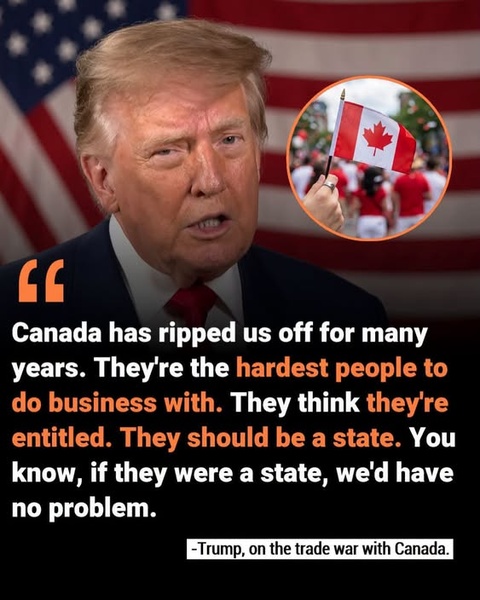
“Canada has been ripping off the United States for many, many years,” Trump said, claiming the United States had traditionally recorded substantial losses in its relationship with its northern neighbor.
Trump also criticized Canadian trade policies affecting American farmers, tourists, airlines and financial institutions, arguing that Canadian regulations and market restrictions have disadvantaged U.S. companies operating across the border.
The president went further by saying Canada should become a U.S. state, arguing that such an arrangement would eliminate many of the economic disagreements currently dividing the two countries.
The provocative comments come as Washington and Ottawa remain locked in an increasingly serious tariff confrontation, with both governments imposing measures against each other’s exports.
Canada suspended formal trade negotiations with the United States in August after Ottawa said Washington had introduced last-minute demands that were unfair and economically damaging.
Prime Minister Mark Carney said Canada had sought tariff-free access for most businesses while attempting to reduce U.S. duties affecting strategically important Canadian industries.
Carney emphasized that Ottawa was prepared to negotiate a fair agreement but would not accept a deal “at any price or on any deadline,” signaling a tougher Canadian negotiating position.
The breakdown was followed by a new round of retaliatory measures, with Canada matching U.S. tariffs on roughly $28 billion worth of Canadian goods.
On September 8, Canada imposed additional tariffs on approximately $20 billion of American exports, including steel, dairy products and agricultural equipment.
The Trump administration responded by announcing import restrictions on selected Canadian products, including certain alcoholic beverages and other goods, further escalating tensions between the longtime allies.
The dispute threatens one of the world’s most integrated trading relationships, with manufacturers, farmers, energy producers and retailers on both sides depending heavily on cross-border commerce.
Trump has repeatedly argued that Canada maintains unfair barriers against American companies, particularly in agriculture, while Canadian officials insist that their policies protect domestic industries and national interests.
The Canadian government has responded by pursuing a broader strategy to reduce its dependence on the United States and expand commercial relationships with Europe, Asia and other international markets.
Carney is now promoting Canada as an attractive destination for global investment, with Ottawa seeking major investments in energy, artificial intelligence, critical minerals, infrastructure and advanced industries.
The Canadian prime minister’s strategy reflects growing concern that prolonged U.S. trade pressure could expose vulnerabilities created by Canada’s heavy dependence on the American market.
Canada has therefore increased efforts to diversify exports while strengthening domestic economic capacity, although replacing the scale of U.S. trade would likely require significant time and investment.
Trump, meanwhile, continues to argue that his tariff strategy is designed to bring manufacturing and investment into the United States while forcing trading partners to make concessions.
The latest confrontation has created uncertainty surrounding the future of the United States-Mexico-Canada Agreement, the framework that has governed much of North American trade.
Despite the increasingly hostile rhetoric, neither Washington nor Ottawa has completely ruled out future negotiations, leaving open the possibility that the two governments could eventually seek another agreement.
For now, Trump’s comments underscore how sharply relations have deteriorated between two historically close allies, while Canada prepares for a longer period of economic pressure and greater independence from the United States.
Comments (0)
Loading comments...
May You Like

Russian Drone Strikes Kyiv Bridge as German Chancellor Arrives in Ukraine

Barack Obama Draws Attention With New Literary Podcast