Trump Extends $100,000 H-1B Requirement and Orders Tougher Scrutiny of Employers
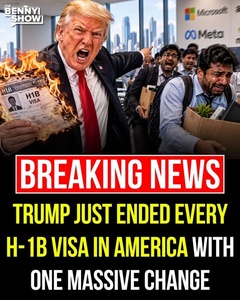
The president has not eliminated H-1B visas, but his administration is extending a costly entry restriction while ordering agencies to scrutinize companies that sponsor foreign workers after laying off Americans.
WASHINGTON, Sept. 21, 2026 — President Donald Trump has extended one of his administration’s most consequential restrictions on H-1B workers, keeping a $100,000 payment requirement in place for another year.
The new proclamation, signed September 18, extends restrictions first imposed in September 2025 through September 21, 2027, unless the administration changes or renews them again.
Contrary to viral claims, Trump did not terminate every H-1B visa or abolish the underlying program, which continues to provide temporary work authorization for qualifying specialty occupations.
Instead, the proclamation restricts entry for certain prospective H-1B workers unless their petitions are accompanied or supplemented by a $100,000 payment, subject to specified exceptions.
The restriction primarily concerns workers outside the United States who need admission to begin employment associated with the covered H-1B petition, rather than simply canceling existing visas held nationwide.
The Homeland Security secretary can also grant exceptions for particular workers, companies or industries when their employment is considered in the national interest and does not threaten American security or welfare.
Trump originally introduced the $100,000 requirement in September 2025, arguing that parts of the H-1B system had evolved into a mechanism for replacing American employees with cheaper foreign labor.
The administration particularly targeted IT staffing and outsourcing companies, which it argues have disproportionately used H-1B workers for comparatively lower-paid positions rather than recruiting exceptionally specialized talent.
The White House says the policy has dramatically changed employer behavior. Registrations submitted by the largest IT staffing and outsourcing firms reportedly fell from 24,946 to 2,055, a 92% decline.
Consular-processing requests associated with bringing workers into America also declined nearly 97% between the FY2025 and FY2027 cap seasons, according to figures presented by the administration.
At the same time, registrations involving beneficiaries with at least a U.S. master’s degree increased from 45.1% for FY2026 to 66.1% for FY2027, the proclamation states.
The administration interprets those changes as evidence that its policies are shifting H-1B usage toward more highly skilled and highly compensated employees while discouraging lower-wage recruitment.
That interpretation comes from the Trump administration itself. Measuring whether H-1B workers broadly suppress wages or displace American employees remains a disputed economic and immigration-policy question.
Trump also signed a separate executive order September 18 that could substantially increase scrutiny of companies seeking H-1B workers while simultaneously reducing their American workforce.
Under the order, State, Labor and Homeland Security officials must consider whether an employer has conducted layoffs during the previous year or plans layoffs affecting similarly situated U.S. employees.
The Labor Department has additionally been ordered to begin reviewing previously submitted labor-condition application data within 30 days to determine whether enforcement action against individual sponsoring employers may be warranted.
The order also expands coordination between agencies, bringing the Commerce and Education departments and Small Business Administration into information-sharing surrounding wages, employment conditions and specialized occupations.
This component could be particularly significant for major technology companies, where rounds of layoffs have sometimes occurred alongside continued recruitment of foreign workers through employment-based immigration programs.
The White House argues such situations deserve additional examination because the H-1B program was designed to supplement American workers with specialized foreign talent rather than facilitate their replacement.
Employers, however, often argue that H-1B workers fill specialized positions for which domestic recruitment can be difficult and that access to international talent helps American companies remain globally competitive.
The latest changes also build upon another major reform introduced after Trump’s original proclamation: the traditional H-1B lottery has been replaced with a weighted selection system for cap-subject petitions.
The Department of Homeland Security finalized that system in December 2025, prioritizing higher-paid and higher-skilled applicants rather than treating qualifying registrations identically within the selection process.
For the FY2027 selection process, job offers corresponding to the two highest wage levels represented approximately 46.3% of selections, while the lowest wage level accounted for 17.8%.
The Labor Department is separately developing changes to prevailing-wage rules. The administration says those changes are intended to bring compensation requirements closer to wages earned by comparable American employees.
Together, these policies represent a significant restructuring of H-1B administration even though the underlying visa category continues to exist.
The distinction is important for current H-1B workers and employers. A headline saying “every H-1B visa ended” could incorrectly suggest that hundreds of thousands of people immediately lost their legal immigration status.
The September 18 proclamation says its entry restriction applies to people entering or attempting to enter the United States after its effective date under the covered circumstances.
It also retains national-interest exceptions, meaning even workers otherwise covered by the restriction can potentially receive exemptions when Homeland Security determines their employment satisfies the proclamation’s criteria.
The administration says more than 700 H-1B petitions have already included the $100,000 payment since the requirement took effect last year, demonstrating that the policy functions as a barrier rather than a complete prohibition.
Trump’s decision therefore represents continuity plus additional enforcement, not the sudden destruction of the H-1B system suggested by the viral thumbnail.
The policy could nevertheless have substantial consequences for employers relying on overseas recruitment, particularly staffing and outsourcing companies whose business models involve relatively large numbers of H-1B petitions.
For technology companies such as Microsoft and Meta, the most relevant new issue may be heightened scrutiny when H-1B sponsorship occurs alongside layoffs of similarly situated American workers.
Whether the changes survive future legal challenges or subsequent administrations is another question. The proclamation relies partly on presidential immigration authorities, while the H-1B category itself exists under federal statute.
Comments (0)
Loading comments...
May You Like
Obama Steps Back Into the Political Spotlight as Democrats Target Trump’s
Shocking news from Ohio: an unexpected development ahead of Trump's rally

South Korea–Ukraine Rift Deepens Over North Korean POW Transfer as PURL Draws New Scrutiny