
Trump Faces Backlash Over $5,000 Dividend Promise: ‘Empty Promises’ or Economic Boost?
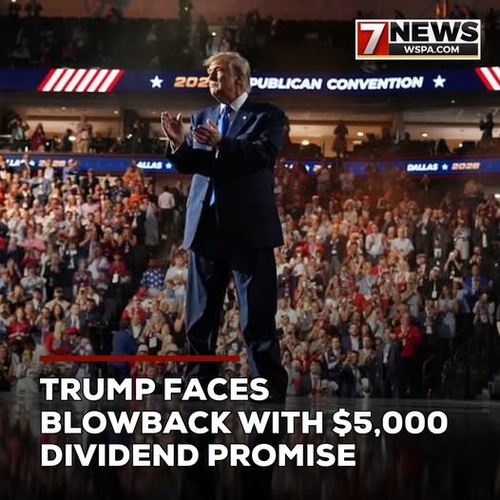
President Donald Trump stunned supporters at the Republican midterm convention this week with a bold pledge: $5,000 checks for every American adult if Republicans hold Congress. But the proposal is drawing fierce criticism from Democrats, fiscal hawks, and even some Republicans who call it fiscally reckless and politically motivated.
WASHINGTON – President Donald Trump promised a crowd of cheering Republicans on Wednesday night that if the GOP retains control of the House and Senate in November, every American adult would receive a $5,000 “dividend” check .
“Here is my promise: If the Republicans win the House of Representatives and the United States Senate, both of them — because of our tremendous economic success — I will issue a dividend to every adult citizen in the United States of America for $5,000,” Trump declared at the first-ever Republican midterm convention in Dallas .
The crowd erupted in applause. But within hours, the pledge was facing intense scrutiny from across the political spectrum — with critics pointing out that Trump has made similar promises before, and none have materialized.
A Familiar Pattern of Unfulfilled Promises
This is not the first time Trump has pitched direct payments to Americans.
In early 2025, Trump and Elon Musk floated a $5,000 “DOGE dividend” funded by savings from the Department of Government Efficiency. That payment never happened. DOGE ultimately claimed only $110 billion in savings — far short of the $2 trillion Musk had originally targeted — and the Government Accountability Office determined the figure wasn’t sufficiently documented .
Later that year, Trump promised $2,000 “rebates” from tariff revenue. That payment also never materialized, particularly after the Supreme Court ruled many of those tariffs unconstitutional .
Now, with the midterms approaching, Trump is recycling the concept — this time without specifying how it would be funded .
The Staggering Cost
The math behind the proposal is daunting. With nearly 270 million American adults, a $5,000 payment to each would cost approximately **$1.3 trillion** .
The United States already faces a 2026 deficit of $1.8 trillion and a national debt exceeding $40 trillion . Adding another $1.3 trillion in spending, fiscal watchdogs warn, could trigger inflationary pressures and higher interest rates.
“This proposal is fiscally dangerous, economically backwards, and fundamentally unserious,” said Maya MacGuineas, president of the Committee for a Responsible Federal Budget. “It’s hard to understand how anyone could look at our current fiscal and economic situation and think we need to borrow another $1.2 trillion to send everyone cash” .
Democratic Response: ‘The Guy Is All About Empty Promises’
Democrats wasted no time in dismissing the proposal as a desperate campaign stunt.
“Donald Trump is a known liar. This is the biggest liar to ever serve in government, period,” said Rep. Robert Garcia of California, the top Democrat on the House Oversight Committee. “The dividend is not happening” .
Garcia pointed to Trump’s previous unfulfilled promises — the DOGE dividend and the tariff rebates — as evidence that this latest pledge is equally hollow.
“So there’s no one in the country that thinks somehow this new dividend is actually going to happen,” Garcia said. “What the American people want is the president to actually focus on lowering their costs of gas, groceries, and expand healthcare. The president has done the opposite” .
Rep. Sydney Kamlager-Dove echoed that sentiment: “The guy is all about empty promises” .
Republican Skepticism
The backlash is not limited to Democrats. Some Republicans are also expressing alarm at the proposal’s fiscal implications.
Outgoing Republican Rep. Thomas Massie of Kentucky said he fears the payments would cause more inflation and accused Trump of trying to buy votes.
“Frankly, I’m insulted by the notion that my vote this November could be bought for 5k,” Massie wrote on X .
Sen. Susan Collins, facing a tough re-election fight in Maine, called the payments “extraordinarily costly” and said tax and spending decisions “should not appear to be tied to election results” .
Even Senate Majority Leader John Thune was noncommittal when asked whether he could muster enough votes to pass such a measure. “We’ll cross that bridge when we come to it,” Thune told Fox News .
The Legal Question: Is It Even Possible?
There are also serious legal questions about whether Trump could unilaterally issue such payments.
Congress holds the power of the purse under the Constitution. Any $1.3 trillion expenditure would require congressional approval — and with Democrats uniformly opposed and some Republicans skeptical, passage appears highly unlikely .
Trump, however, suggested he might not need Congress. “I think Congress will do it if we needed it,” he told CBS News. “But we think not” .
Legal experts are dubious. Dr. Joan Mahoney, a law lecturer at the University of Southampton, told the BBC that while campaign promises of tax cuts are legal, direct payments tied to election outcomes raise thornier questions .
“On one hand, it sounds a bit like bribery: vote Republican and you’ll get money, which would clearly be illegal,” she said. “But on the other hand, the money would be given to everyone, regardless of who they vote for — in that sense, it’s not bribery” .
Where Would the Money Come From?
Trump has offered shifting explanations for how the program would be funded.
At the convention, he cited “tremendous economic success.” Later, he told reporters the money would come from “tremendous growth” — claiming that “trillions of dollars are pouring into the country” .
Vice President JD Vance suggested tariff revenue could fund the checks. But tariff collections remain far short of the $1.3 trillion needed .
The White House issued a statement suggesting the funds could come from private-sector investment commitments secured by the administration — though how those investments would convert into direct payments to citizens remains entirely unclear .
The Bottom Line
| What Trump promises | What the reality shows |
|---|---|
| $5,000 to every adult if GOP wins | Cost would exceed $1.3 trillion |
| Funded by “economic growth” | No specific funding mechanism identified |
| Previous promises delivered? | DOGE dividend and tariff rebates never happened |
| Congress will approve | No indication of sufficient support |
| Legal and constitutional? | Congress holds power of the purse; passage unlikely |
The midterm elections are scheduled for November 3. Whether Trump’s $5,000 promise will prove to be a winning message or a political liability remains to be seen — but for now, the proposal has succeeded in one thing: generating headlines, controversy, and deep skepticism from all sides.
The White House has not responded to requests for additional comment on the funding mechanism. This story will be updated as more information becomes available.
Comments (0)
Loading comments...
May You Like

OBAMA STUNS ON INSTAGRAM: MESSAGE MARKING 34-YEAR MILESTONE SPARKS A BUZZ
Jack Smith Defends His Integrity as Trump Investigations Face Renewed Political Firestorm














