Trump Faces Protests During Ireland Visit as Thousands Rally in Dublin
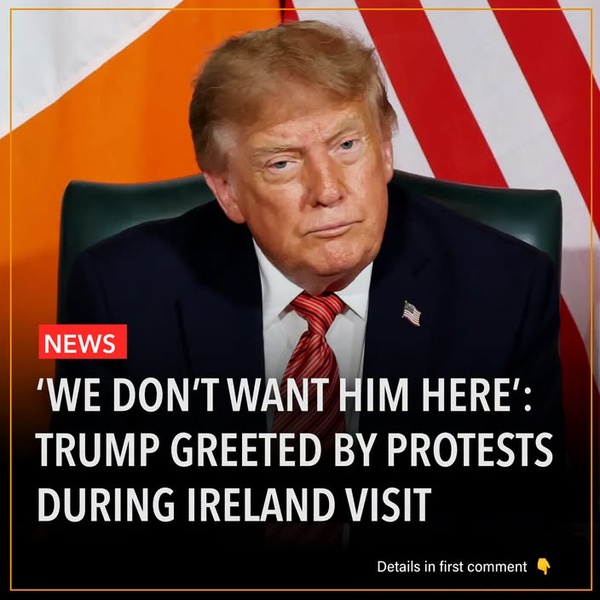

U.S. President Donald Trump’s two-day visit to Ireland drew thousands of protesters, a massive security operation and political controversy, while also highlighting strong diplomatic, economic and sporting ties between the two countries.
U.S. President Donald Trump faced large demonstrations in Ireland during a two-day visit that combined official meetings in Dublin with an appearance at the Irish Open in Doonbeg, County Clare.
Thousands of demonstrators marched through central Dublin on September 12, gathering near Dáil Éireann after a procession from Parnell Square involving more than 30 political, campaign and trade-union groups.
Protesters carried signs criticizing Trump over U.S. foreign policy, climate policy, immigration, civil rights and the war in Gaza, while Palestinian and Irish flags were visible throughout the crowd.
The demonstrations were largely peaceful, although a smaller breakaway group burned an American flag and set off firecrackers before dispersing as the main rally continued outside Ireland’s parliament.
Trump said he had not seen the protests during his movements around Dublin, questioning their size even as Irish media reported thousands of people participating in the city-center demonstration.
Opposition was not limited to Dublin. Smaller protests were also held near Shannon Airport and in Doonbeg, where demonstrators said they wanted the visiting president to know he was unwelcome.
In Doonbeg, however, Trump also encountered visible support from residents and visitors who credit his golf resort with bringing jobs, tourism and international attention to the small coastal community.
The Irish government mounted an extensive security operation for the visit, with road restrictions, heightened airport checks, temporary airspace controls and a substantial Garda presence in Dublin and County Clare.
Before traveling west, Trump met Irish President Catherine Connolly at Áras an Uachtaráin, where the two leaders held a private discussion lasting more than 20 minutes after a ceremonial welcome.
Connolly later said she conveyed the Irish public’s strong concern about war, genocide and climate change, while emphasizing the long-standing relationship linking Ireland and the United States.
Trump also met Taoiseach Micheál Martin at Farmleigh House, where discussions were overshadowed by the U.S. president’s unexpected comments in favor of eventual Irish reunification.
He told reporters that he would like to see Ireland unified and described the prospect as a “fantastic” development, remarks that immediately drew attention in Dublin, Belfast and London.
The issue remains politically sensitive because Northern Ireland is part of the United Kingdom, while the 1998 Good Friday Agreement provides a democratic framework for any future change in constitutional status.
After completing his Dublin engagements, Trump traveled to County Clare, where his family-owned Trump International Golf Links in Doonbeg was hosting the Irish Open golf tournament.
His presence at the tournament blended presidential travel with a visit to a private business bearing his name, drawing scrutiny from critics while supporters highlighted the resort’s economic importance locally.
At the golf course, Trump watched players including leading Irish stars and later attended the final stages of the competition, where Shane Lowry secured a commanding victory before home supporters.
Security remained tight around Doonbeg throughout the weekend, with access restrictions, helicopters, motorcades and designated protest areas established as authorities balanced presidential protection with public demonstrations.
The visit illustrated Ireland’s complicated relationship with Trump: government leaders maintained formal diplomatic engagement, protesters voiced strong opposition, and some local communities welcomed the commercial benefits associated with his resort.
For Washington and Dublin, the trip also underscored the depth of bilateral economic and cultural ties, even as disagreements over foreign policy, climate issues and political rhetoric remained clearly visible.
Trump left Ireland after a weekend that produced both diplomatic headlines and street-level dissent, ensuring that his visit would be remembered as much for the protests as for politics and golf.


Comments (0)
Loading comments...
May You Like
South Korea–Ukraine Rift Deepens Over North Korean POW Transfer as PURL Draws New Scrutiny
TRUMP HIT WITH 26 ARTICLES OF IMPEACHMENT
Obama Steps Back Into the Political Spotlight as Democrats Target Trump’s