
Trump Fires Back at Obama Over White House Renovations, Declaring: “That Just Shows Why You Were a Lousy President”
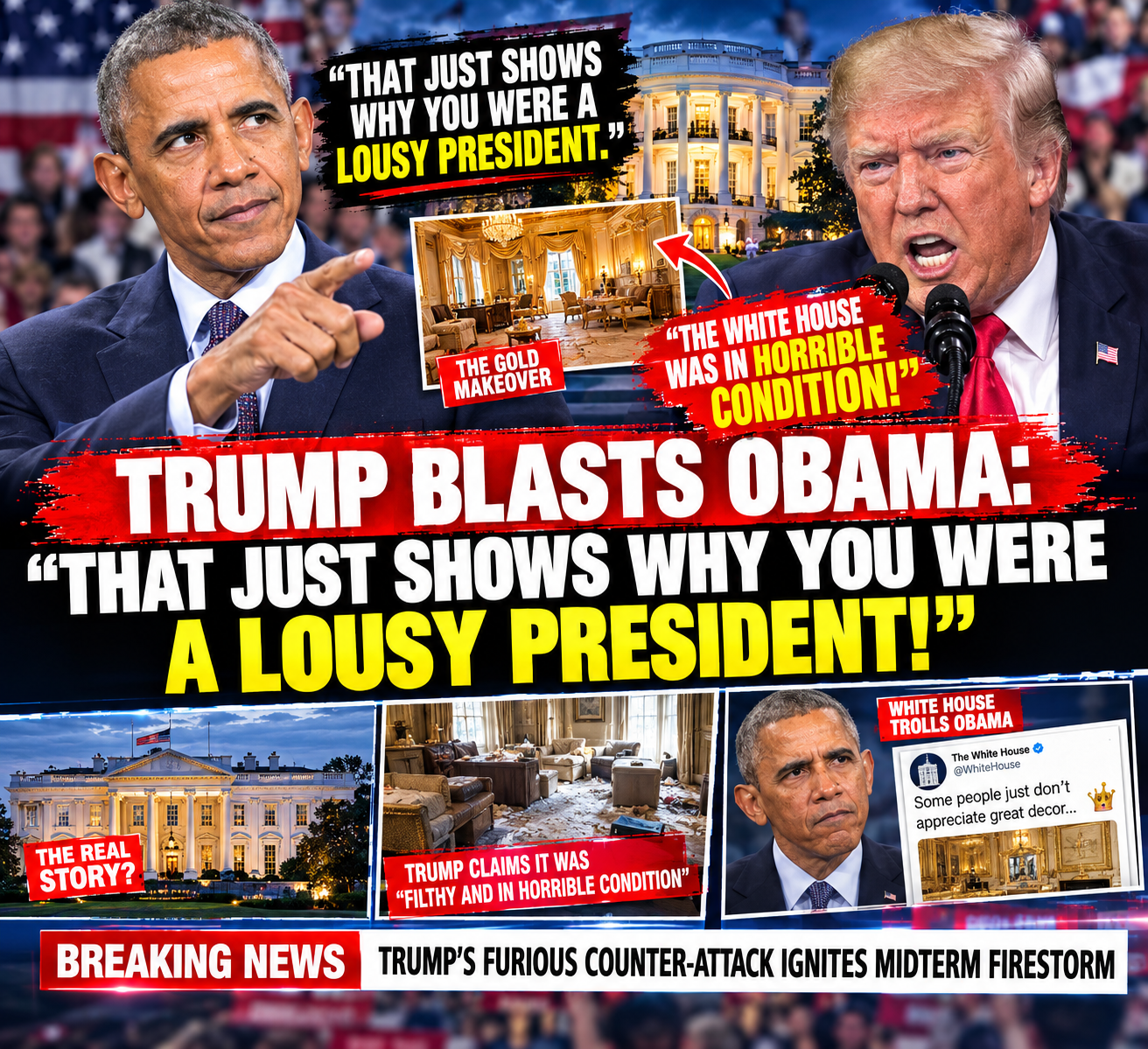
The clash between President Donald Trump and former President Barack Obama has erupted into a fresh public exchange over the White House’s appearance, the cost and purpose of its renovations, and what the historic residence should represent. On October 26, 2026, Trump responded sharply to Obama’s mocking comparison of the building’s gold-heavy makeover to a restaurant designed by former Iraqi leader Saddam Hussein, accusing his predecessor of failing to appreciate the condition of the presidential residence and declaring that the criticism demonstrated why Obama had been a “lousy president.” The remarks, delivered during an exchange with reporters and revisited at a Mississippi campaign rally, turned a dispute over architectural taste into another confrontation in the wider struggle between the two presidents’ political camps.

The exchange began over the weekend, when Obama appeared at a Democratic campaign event in Ohio ahead of the November midterm elections. Obama criticized Trump’s focus on construction and renovation projects, pointing to the planned White House ballroom, changes to the Rose Garden, a proposed helicopter landing area and the prominent use of gold decoration. He joked that Trump should appear on HGTV, the home-improvement television network, before delivering the line that quickly became the centerpiece of the dispute: the White House looked as though Saddam Hussein had opened a Cheesecake Factory.
The remark was a political jab, not a formal assessment of the renovation work. Its force came from the contrast Obama drew between the president’s attention to the physical appearance of the White House and the economic and policy concerns he argued should be receiving greater attention. Obama was campaigning for Democratic candidates, including Senate candidate Sherrod Brown and gubernatorial candidate Amy Acton, making the exchange part of a broader effort to challenge the administration’s priorities before voters head to the polls.
Trump’s response: The White House was in “horrible condition”

Trump did not confine his response to a brief dismissal of the joke. Speaking to reporters on Monday, he defended the renovation and restoration work, arguing that the White House needed substantial maintenance when he returned to office. He cited damaged exterior plaster, cracked masonry, missing or broken ornamental details around windows and areas he said had not been properly maintained for years.
“I’ve taken care of the White House,” Trump said, describing the work as a restoration carried out by skilled artisans. He maintained that the building had been in “horrible shape” and said his team had used existing architectural details to reproduce missing or damaged ornamentation. He also argued that the White House, as a symbol of the United States, should be maintained to a high standard.
Trump then turned his criticism directly toward Obama, questioning his predecessor’s intelligence and leadership before delivering the line that dominated coverage of the confrontation: “For you to say it’s a Cheesecake Factory, that just shows why you were a lousy President.” The wording is documented in video and transcript coverage of the exchange.
The president’s account of the building’s previous condition, however, remains his own characterization in this exchange. His remarks identify specific areas he says required work, but they do not independently establish the full condition of the White House when he took office or demonstrate that every element of the renovation was necessary. Those questions require separate documentation, including preservation records, maintenance histories, project descriptions and information about costs.
The White House joins the feud with a social-media counterattack

The dispute quickly spread beyond the two presidents. On October 26, the official White House account joined the exchange with a tongue-in-cheek post referencing the Cheesecake Factory’s famously extensive menu. The mock menu promoted what the administration described as Trump’s accomplishments, turning Obama’s restaurant comparison into an opportunity for political messaging.
The post illustrates how the modern White House uses social media not only to communicate policy but also to respond directly to critics and shape the public narrative around a controversy. Rather than allowing Obama’s joke to stand on its own, the administration reframed the exchange around Trump’s claimed achievements.
Treasury Secretary Scott Bessent also entered the argument, visiting a Cheesecake Factory restaurant in Washington and using the occasion to criticize Obama’s own post-presidential library project. The response widened what had begun as a dispute about interior decoration into a broader contest over taste, status and political identity.
The White House’s post was a political joke, not an independent assessment of the administration’s record. Its significance lies in how quickly the president’s allies mobilized around the remark and turned it into a coordinated public exchange.
The renovations raise questions beyond decoration

The dispute also touches on substantive questions about how the White House should be maintained and altered. The executive mansion is both a working government building and a historic landmark. Routine repairs, preservation of original architectural features and changes made to accommodate presidential functions can serve different purposes—and should not be treated as interchangeable.
Trump has defended the restoration work by pointing to damaged plaster, cracked architectural elements and missing ornamentation. He has also promoted larger projects, including a ballroom and a South Lawn helicopter landing area. Those projects have drawn attention because of their scale and their effect on the White House grounds.
Obama’s criticism focused on the visible gold decoration and construction work, while also arguing that the president should be concentrating on affordability and other issues affecting Americans. Trump’s response focused on the building’s physical condition and his belief that maintaining the residence is a presidential responsibility. The two men are therefore arguing from different premises: Obama is using the renovation projects to criticize Trump’s priorities, while Trump is presenting them as necessary improvements to a national symbol.
Questions about project costs, preservation standards, construction decisions and the extent of alterations are best answered through official documentation, rather than through either president’s rhetoric. The available remarks establish what each man said, but they do not settle every question about the necessity, cost or historical appropriateness of the work.
Why the exchange matters during the midterm campaign

The timing is significant. Obama’s October 24 appearance in Ohio was part of a campaign effort supporting Democratic candidates, and his criticism extended well beyond the White House’s appearance. He also challenged Trump over economic conditions, the administration’s priorities and what Obama described as concerns about self-enrichment and political accountability. Those broader claims formed part of his political argument and should be assessed separately from the verifiable exchange about renovations.
Trump’s response similarly expanded beyond architecture. By attacking Obama’s presidency and intelligence, he sought to turn the former president’s joke into a broader dispute over leadership and legacy. The personal language is consistent with the increasingly confrontational tone of the exchange between the two political camps, but it does not offer evidence on its own about the quality of either administration’s policies.
The White House account’s participation added another layer: the controversy was no longer simply a disagreement between a current and former president. It had become material for campaign messaging, administration communications and partisan commentary.
For voters, the useful questions remain concrete. What work has been undertaken at the White House? What did it cost? Which elements were necessary repairs, and which were discretionary design choices? How do the projects fit alongside the administration’s other responsibilities? Those questions can be examined through budgets, construction records, preservation assessments and public statements.
A feud about gold, history and presidential legacy
The latest clash offers a striking example of how a seemingly narrow dispute can become a national political story. Obama’s restaurant comparison gave Democrats a memorable way to criticize Trump’s focus on renovation projects. Trump’s response allowed him to defend the work as restoration and attack his predecessor’s record. The White House’s mock menu then carried the argument into the online political arena.
The key facts are clear: Obama mocked the renovations at a Democratic campaign rally on October 24; Trump responded on October 26 by describing the White House as being in poor condition when he took office and calling Obama a “lousy president”; and the official White House account joined the exchange with a satirical post.
What remains contested is the broader interpretation. Whether the renovations represent necessary preservation, an excessive focus on appearances or some combination of the two is a question that requires evidence about the work and its costs—not just competing insults. And whether the exchange influences voters cannot be established from the viral clips alone.
For now, the argument has made White House decoration an unlikely campaign talking point. Beneath the jokes and personal attacks lies a more substantive debate about presidential priorities, public spending, historical preservation and how political leaders present their records to the electorate.
Comments (0)
Loading comments...
May You Like

DAVENPORT AIRBNB HORROR — “SHOTS AT THE DOOR” GAME, 1 DEAD, 6 INJURED!

WWE BRONSON REED DEAD AT 38, STIMULANTS DETECTED, $10M INSURANCE PAYOUT FROZEN!

WEYMOUTH HORROR—80-MPH WIND GUSTS, FIRE TRUCK FLIPS, 3 FIREFIGHTERS CRITICAL!









Popular Posts



