
Trump Floats Renaming Strait of Hormuz ‘Trump Strait’ as U.S.-Iran Conflict Escalates
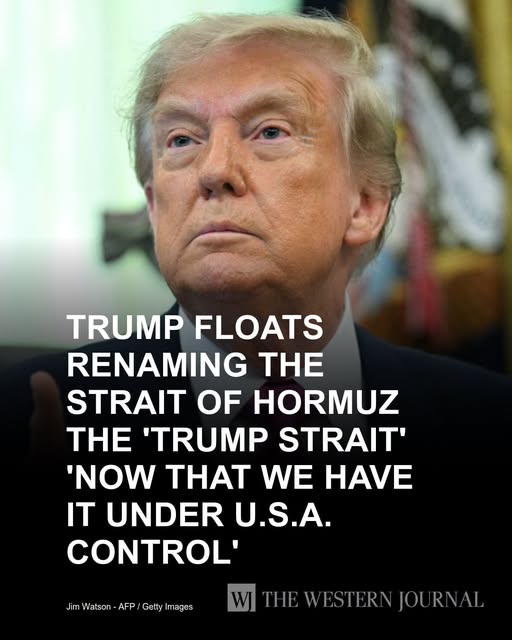
The claim in the viral graphic is based on a real statement by President Donald Trump—but his assertion that the waterway is under U.S. control is far more complicated than the graphic suggests.
A viral graphic from The Western Journal says President Donald Trump is considering renaming the Strait of Hormuz the “Trump Strait,” quoting him as saying the waterway is now under U.S. control. The wording in the graphic closely tracks Trump's actual September 2, 2026 post on Truth Social.
But there is an important update the graphic does not include: Trump later indicated that he was not necessarily serious about carrying out the renaming.
At the same time, the underlying dispute is anything but a joke. The Strait of Hormuz has become one of the central pressure points in the ongoing U.S.-Iran conflict, with sharply reduced commercial shipping, military strikes and competing claims over who controls passage through the strategic waterway.
What Trump actually said
On September 2, Trump posted on Truth Social:
“Now that we have it under U.S.A. control, should we change the name Hormuz Strait to TRUMP STRAIT???”
He added that, like America itself, it would be “‘hotter’ than ever before.” The White House subsequently amplified the idea by posting a map showing the waterway labeled “Trump Strait” and commenting that the name had “a nice ring to it.”
That makes the central claim of the graphic — that Trump floated the name “Trump Strait” — accurate.
There is, however, a significant caveat.
Later that day, when an AFP reporter asked Trump in the Oval Office whether he was serious about renaming the strait, he reportedly laughed and replied that it was “just thrown out there.”
So this was a presidential proposal, but not an announced formal renaming process.
The bigger claim: Is the Strait of Hormuz really under U.S. control?
This is where the viral graphic becomes much more misleading.
Trump has repeatedly asserted that the United States has gained control of the waterway. His administration has conducted military operations around the strait and has imposed a naval blockade that has severely constrained Iranian oil exports. Reuters reported that the U.S. blockade had effectively halted most Iranian crude exports through Hormuz by late August.
But that does not mean the United States has acquired sovereignty over the Strait of Hormuz.
The strait lies between Iran and Oman and is an international maritime chokepoint. Both countries have territorial interests in the surrounding waters. Legal analyses generally treat Hormuz as an international strait subject to important navigation rights, although the precise legal arguments are complicated because neither Iran nor the United States is a party to the UN Convention on the Law of the Sea.
In other words, military control of shipping lanes is not the same thing as territorial sovereignty.
Trump's statement is best understood as a description of the current military balance and U.S. ability to influence or restrict maritime traffic — not as an internationally recognized transfer of ownership.
Hormuz remains contested
The situation on the water itself also complicates Trump's assertion.
Reuters reported September 2 that only four commodity vessels had transited the strait on Tuesday, compared with a 10-day average of about 13. The figure could change because some vessels have been operating with transponders switched off, but the decline nevertheless illustrates how severely the conflict has disrupted traffic.
Iran, meanwhile, has continued attempting to regulate which ships can pass.
On September 2, Reuters reported that Iran had expanded its blacklist of vessels prohibited from passing through Hormuz to 56 ships, including oil tankers and gas carriers.
Two Saudi oil tankers were also attacked near Khasab, Oman, on September 1, further highlighting the continuing danger to commercial shipping.
That is hardly the picture of an uncontested waterway firmly under one country's control.
Why the Strait of Hormuz matters so much
Hormuz is one of the world's most important energy chokepoints.
Before the current conflict, roughly one-fifth of global oil shipments moved through the narrow waterway, along with substantial volumes of liquefied natural gas. At its narrowest, the strait is only about 21 miles wide, with designated shipping lanes considerably narrower than that.
That geography gives the strait extraordinary strategic importance.
A prolonged disruption can affect:
- crude-oil prices;
- gasoline and diesel costs;
- LNG supplies;
- tanker insurance and freight rates;
- inflation;
- Asian energy security; and
- global economic growth.
The consequences are already visible in financial markets. Reuters reported September 3 that Brent crude had risen to about $97 a barrel, with investors increasingly concerned about further disruptions following renewed U.S. strikes and declining tanker traffic.
Can Trump actually rename it?
Not in the sense of simply changing the internationally recognized name of the waterway for the rest of the world.
The United States can establish standardized geographic names for use by its own federal government. The National Geospatial-Intelligence Agency's Geographic Names Server is the U.S. government's repository for standardized foreign geographic names used by the federal government.
That is different from possessing the authority to dictate what an international waterway is called globally.
The legal and diplomatic question is particularly sensitive because Hormuz is not a U.S. geographic feature. It borders Iran and Oman, and international navigation through the strait is governed by a complicated mixture of maritime law, customary international law and the rules applicable during armed conflict.
The United States could potentially adopt “Trump Strait” in some of its own governmental materials if the appropriate U.S. naming authorities approved it. That would not automatically cause Iran, Oman, international organizations or other governments to adopt the name.
The precedent: Gulf of America and Lake America
Trump's latest proposal also fits a broader pattern.
In January 2025, Trump ordered the U.S. government to use “Gulf of America” instead of Gulf of Mexico. More recently, he ordered Lake Ontario to be renamed “Lake America.” Neither Canada nor Mexico has accepted the respective changes as international names.
That history explains why the seemingly joking “Trump Strait” suggestion attracted immediate attention.
Previous geographic-name proposals that initially sounded like political theater have sometimes subsequently become official U.S. government terminology.
But Hormuz presents a substantially different problem: it is an international chokepoint directly associated with two sovereign coastal states and currently situated in an active military conflict.
What the viral graphic gets right — and what it leaves out
What it gets right:
- Trump really did suggest calling the Strait of Hormuz “Trump Strait.”
- He really did say the waterway was under U.S.A. control.
- The White House subsequently promoted the proposed name on a map.
What it leaves out:
- Trump later said the renaming idea was “just thrown out there.”
- The United States has not acquired internationally recognized sovereignty over the Strait of Hormuz.
- Iran continues to exert substantial influence over maritime traffic and has restricted ships attempting to pass.
- Commercial shipping remains far below normal levels.
- The waterway is governed by a complex international maritime-law framework rather than being ordinary U.S. territory.
The naming fight is really a sideshow to a much larger crisis
The unusual renaming proposal comes at a moment when the underlying Hormuz dispute is becoming more consequential, not less.
The United States has continued military operations against Iranian targets near the strait, while Iran has attempted to restrict maritime movement. Reuters reported that the latest exchange of strikes was among the most intense between the two countries since July.
Meanwhile, energy markets are responding to the possibility that the disruption could persist.
The irony is that a waterway Trump jokingly suggested naming after himself remains one of the most dangerous and economically consequential places in the world — and its actual control is still a matter of military power, maritime access and competing claims, not a new name on a map.
Fact-check verdict: Mostly True — but misleading without context
The graphic accurately reports Trump's “Trump Strait” proposal and his claim that the United States has the waterway under its control. But it presents the statement as though a formal renaming and an uncontested U.S. takeover have occurred. Neither has happened. Trump himself later characterized the renaming idea as something he had merely “thrown out there,” while shipping data and the continuing Iranian response show that Hormuz remains a contested wartime chokepoint.
Comments (0)
Loading comments...
May You Like

South Korea–Ukraine Rift Deepens Over North Korean POW Transfer as PURL Draws New Scrutiny

gfnhgmnghnmfgnbvvvvvvvvv













