Trump Gave 45,000 USD Cash Gifts to Three White House Aides
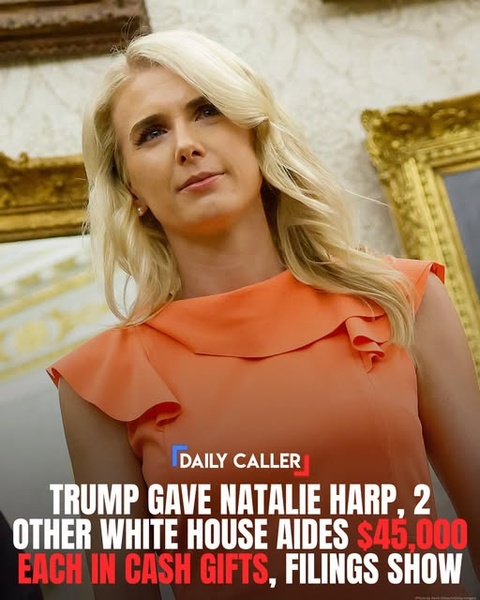
WASHINGTON — President Donald Trump gave $45,000 in cash holiday gifts to three of his closest White House aides last year, including executive assistant Natalie Harp, according to financial disclosure forms released by the administration.
Harp, communications adviser Margo Martin and White House aide Chamberlain Harris each reported receiving a $45,000 “cash gift for holidays” from Trump. Another longtime Trump aide, Walt Nauta, reported receiving a $20,000 gift.
The payments have triggered questions from government-ethics experts because the recipients are federal employees and the gifts were substantial relative to their government salaries. The White House, however, says the payments were personal gifts unrelated to the aides' official duties and therefore permissible.
Three Aides Received $45,000 Each
The financial disclosures show that Harp, Martin and Harris each earn approximately $150,000 a year from their White House positions.
A $45,000 gift therefore amounted to roughly 30% of each aide's annual government salary.
Nauta, director of Oval Office operations, earns $175,000 annually and reported a $20,000 gift from Trump.
In total, Trump gave the four aides $155,000 in reported cash gifts.
The documents describe the payments as holiday gifts rather than bonuses or compensation for government work.
The disclosures do not specify the exact dates on which the gifts were given, but the recipients described them as holiday gifts from 2025.
Natalie Harp at the Center of the Controversy
Harp, 35, has become one of the most visible members of Trump's inner circle.
She serves as a special and executive assistant to the president and is frequently seen near Trump during public events and travel.
During Trump's 2024 campaign, Harp became known as the “human printer” because she reportedly carried a portable printer and supplied Trump with physical copies of news stories, social-media posts and other material.
Her unusually close access to the president has attracted increasing attention from Trump's political opponents, particularly as she has continued to accompany him during his second term.
The $45,000 payment has now added another layer of scrutiny to her position.
The White House Says the Payments Were Legal
Trump's administration has defended the gifts.
White House spokesperson Davis Ingle said Trump has a longstanding practice of giving Christmas gifts to people in his orbit, including employees and aides, both during his time in government and in the private sector.
The administration argues that the payments were personal gifts rather than compensation and were unrelated to the recipients' official duties.
“The gifts at issue here have nothing to do with any of these individuals' official government duties,” Ingle said, arguing that they were permissible under applicable legal and ethical standards.
The recipients themselves did not immediately provide public comments to The Washington Post when contacted about the payments.
Ethics Experts Question the Arrangement
The size of the payments has nevertheless raised concerns among former government ethics officials.
Richard Painter, who served as chief White House ethics lawyer under President George W. Bush, argued that the payments could run into federal restrictions designed to prevent government employees from receiving additional compensation outside their official salaries.
Painter pointed to concerns over laws governing supplemental compensation for federal employees, arguing that labeling a payment a “gift” does not necessarily settle the legal question if the money effectively supplements a government salary.
The issue is particularly sensitive because Trump is not simply an acquaintance of the recipients. He is the president — and therefore their employer and ultimate superior within the executive branch.
That creates a potential question of whether a very large personal payment could influence an employee's relationship with the president, even if there is no evidence that the gifts were made in exchange for specific official actions.
But the Legal Question Is Not Completely Settled
Not every ethics expert agrees that the payments clearly violate federal law.
Don Fox, a former acting director of the Office of Government Ethics during the Obama administration, told The Washington Post that the available facts do not establish a violation.
The distinction is important.
Federal law does restrict additional compensation for federal employees in certain circumstances. For example, 5 U.S.C. § 5536 generally prohibits an employee whose pay is fixed by statute or regulation from receiving additional pay for government services unless specifically authorized by law.
At the same time, federal ethics rules governing gifts between employees have exceptions and have changed over time. The Office of Government Ethics has specifically noted that its regulations distinguish between gifts from subordinates to superiors and gifts from superiors to subordinates.
That means the available evidence does not justify declaring the payments definitively illegal.
Instead, the controversy centers on whether these unusually large personal gifts could be viewed as impermissible supplemental compensation or could undermine the appearance of impartial government service.
Why $45,000 Is Drawing So Much Attention
The scale of the gifts is extraordinary.
A $45,000 payment is not a conventional office holiday present. It is equivalent to several months of a federal employee's salary.
The Washington Post reported that ethics officials were unaware of another comparable example involving a sitting president giving such large cash payments to White House subordinates.
That creates a second issue beyond legality: the appearance of favoritism.
Federal ethics rules are designed not only to prevent outright corruption but also to protect public confidence in government decision-making.
The Office of Government Ethics has historically emphasized that federal gift restrictions exist to protect government institutions from conflicts of interest, improper influence and even the appearance of impropriety.
Trump’s Inner Circle Receives the Largest Payments
The identities of the recipients are also significant.
All four aides have longstanding personal or professional relationships with Trump.
Martin worked in Trump's first White House and later remained part of his political operation after he left office. She returned to the White House after Trump's 2024 victory and has become an important figure in the administration's social-media operation.
Harris also worked in Trump's first administration and later returned to Washington. Trump appointed her to the U.S. Commission of Fine Arts earlier this year.
Nauta served as Trump's personal valet during his first presidency and remained closely associated with him after Trump left office.
The pattern has therefore prompted questions about whether Trump's closest personal aides are receiving unusually generous treatment compared with ordinary federal employees.
The Gifts Were Not Paid With Taxpayer Money
Another important distinction is that the disclosed payments were personal gifts from Trump, not bonuses paid from a government account.
The aides' regular salaries are taxpayer-funded.
The $45,000 and $20,000 payments, according to the disclosures and White House explanation, came from Trump personally and were reported as gifts.
That does not automatically resolve the ethics issue, but it means the controversy is not about the White House secretly diverting taxpayer funds to reward staff members.
A Political Controversy as Midterms Approach
The disclosure arrives at a politically sensitive moment for the Trump administration.
Democrats have increasingly focused their attacks on what they describe as Trump's unusually personal style of governing and the influence of his closest loyalists.
Harp has already become a political target.
Sen. Jon Ossoff, a Georgia Democrat facing a difficult reelection environment, recently invoked Harp while criticizing Trump's priorities and his close circle of advisers.
The newly disclosed gift gives Democrats another example they can point to when arguing that Trump's administration rewards personal loyalty.
Republicans and the White House are likely to frame the matter differently: as a private president giving personal Christmas presents to trusted employees, with no connection to their government duties.
What the Viral Headline Gets Right — and Wrong
The Daily Caller graphic accurately identifies the basic financial disclosure:
- Natalie Harp received $45,000.
- Margo Martin received $45,000.
- Chamberlain Harris received $45,000.
- Walt Nauta received $20,000.
- The payments were described as holiday cash gifts.
- The recipients also receive six-figure federal salaries.
But the headline should not be interpreted as proof that Trump illegally paid his employees.
The White House says the payments were lawful personal gifts, while some former ethics officials have raised serious concerns about whether such large payments could constitute prohibited supplemental compensation or create an improper sense of obligation.
That legal question remains contested.
A Gift, a Bonus — or Something in Between?
The controversy ultimately comes down to a difficult question of government ethics.
If Trump gave an ordinary holiday present to a staff member, few people would consider it remarkable.
But $45,000 is not an ordinary holiday present, particularly when the recipient is a federal employee whose annual government salary is $150,000.
The administration insists the money was personal and unrelated to official duties.
Critics argue that the size and circumstances make the payments difficult to separate from the recipients' government employment.
For now, the financial disclosures establish the payments — but they do not by themselves establish a legal violation.
What they have unquestionably established is a new debate over money, loyalty and the unusual relationship between President Trump and the small group of aides who operate closest to him.
Comments (0)
Loading comments...
May You Like
TRUMP’S OHIO WARNING UNDER THE SPOTLIGHT
Obama Steps Back Into the Political Spotlight as Democrats Target Trump’s Senate Majority
OBAMA STEPS BACK INTO THE POLITICAL SPOTLIGHT