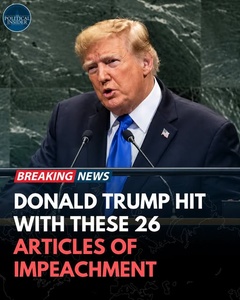
TRUMP HIT WITH 26 ARTICLES OF IMPEACHMENT
DONALD TRUMP HIT WITH 26 ARTICLES OF IMPEACHMENT

Representative Steve Cohen, a Tennessee Democrat and senior member of the House Judiciary Committee, has introduced 26 articles of impeachment against President Donald Trump.
Cohen unveiled the sweeping resolution on September 24, accusing Trump of multiple alleged abuses of presidential power, violations of his oath and other forms of misconduct.
The proposal represents one of the broadest impeachment efforts against Trump during his second presidency, covering issues ranging from foreign policy to immigration and executive authority.
Cohen's filing includes allegations involving Trump's conduct toward elections, military operations, immigration enforcement, federal spending, government agencies and the exercise of presidential powers.
One article accuses Trump of undermining democracy by sowing doubt about elections, while another alleges that he waged war against Iran without congressional authorization.
The resolution also addresses alleged extrajudicial killings in international waters near Venezuela and Trump's deployment of military forces against cities inside the United States.
Several articles focus on immigration policy, including Trump's executive order concerning birthright citizenship and the administration's use of immigration authorities.
Cohen also challenges the administration's use of federal funding, alleging that grants were withheld to punish states because of their political choices and that appropriated money was unlawfully withheld.
Another group of allegations concerns the federal workforce, including claims involving loyalty tests and the removal of inspectors general without following statutory requirements.
The impeachment package further accuses the administration of interfering with court orders connected to immigration enforcement and attempting to restructure or eliminate federally established programs.
Cohen's resolution also raises concerns about the Department of Education, federal prosecutors, universities and the administration's treatment of organizations receiving federal funding.
The media is another major component of the filing. Cohen accuses Trump of attacking a free press by restricting reporters and attempting to influence editorial decisions at major television networks.
The resolution additionally targets Trump's use of presidential pardon powers, describing certain pardons as an alleged abuse of authority and a misuse of executive power.
Cohen also included allegations concerning tariffs and emergency economic powers, arguing that the administration improperly imposed financial burdens on American citizens through executive action.
The final article makes an especially serious allegation, accusing Trump of personally profiting from the presidency and potentially violating constitutional restrictions involving presidential emoluments.
Cohen has acknowledged that his impeachment effort faces significant obstacles. He introduced the measure despite recognizing that it is unlikely to advance under the current congressional political landscape.
The initiative came only days after the House rejected a separate impeachment resolution introduced by Representative Al Green, another Texas Democrat, in a 232–147 vote.
That earlier defeat highlighted divisions among House Democrats over whether impeachment should become a central strategy against Trump ahead of the 2026 midterm elections.
Cohen previously introduced five articles of impeachment against Trump in 2017, making his latest filing another chapter in his long-running opposition to the president.
The 26 articles should not be interpreted as 26 criminal convictions or final legal findings. They represent allegations contained within a congressional impeachment proposal that would require further action.
For impeachment to proceed, the House would need to take additional procedural steps, while conviction and removal would ultimately require a two-thirds vote in the Senate.
For now, Cohen's filing has intensified an already bitter political confrontation in Washington, placing presidential power, congressional oversight and the upcoming midterm elections under renewed scrutiny.
The proposal is unlikely to immediately threaten Trump's presidency, but it gives Democrats a detailed framework for challenging his administration and could become politically significant if control of Congress changes after November's elections.

Comments (0)
Loading comments...
May You Like

Russian Drone Strikes Kyiv Bridge as German Chancellor Arrives in Ukraine

South Korea–Ukraine Rift Deepens Over North Korean POW Transfer as PURL Draws New Scrutiny

Obama Steps Back Into the Political Spotlight as Democrats Target Trump’s