
Trump “Hits Back” at Canada: What Is Actually Happening in the Escalating Trade Fight
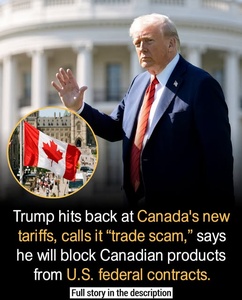
Verdict: TRUE AS TO THE ESCALATION — BUT THE VIRAL GRAPHICS ARE HIGHLY SENSATIONALIZED
A series of viral graphics claims that President Donald Trump has delivered a new “final warning” to Canada and is “hitting back” as Ottawa pushes back against U.S. tariffs.
There is a major and rapidly developing U.S.-Canada trade confrontation in September 2026. But the graphics blend several different developments—tariffs, Canadian retaliation, stalled negotiations and Canada’s new push toward Europe—into a single dramatic narrative.
The latest development is particularly significant: on September 16, 2026, Trump ordered the U.S. government to move toward excluding Canadian-origin goods from federal civilian procurement, while also warning that closer Canada-EU ties could trigger additional U.S. tariffs.
Trump really has escalated pressure on Canada
The current dispute is not based on a fabricated announcement.
On September 16, Trump signed a presidential memorandum directing U.S. agencies to identify and take steps toward removing Canadian-origin products from the federal civilian procurement system.
The White House said the action was a response to Canada's restrictions and preferences for Canadian products in its own government procurement market.
This followed a much larger tariff escalation.
In July, Trump imposed additional 50% tariffs on certain Canadian imports, including products ranging from wine and other alcohol to hockey sticks and cement. The administration invoked Section 338 of the Tariff Act of 1930.
Those measures were subsequently expanded and modified.
As of September 15, certain Canadian products covered by the July action remained subject to the additional 50% duty, while some products were removed from that particular tariff treatment.
Canada retaliated
Ottawa did not simply accept the new tariffs.
After negotiations broke down in August, Canada announced countermeasures covering approximately C$27.6 billion of U.S. imports.
Beginning September 8, Canada imposed new tariffs of 15%, 25% or 50%, depending on the product and the corresponding U.S. tariff. The targeted sectors include steel and aluminum, dairy, appliances, agricultural equipment, pulp and paper, plastics and electronics.
Canada described the measures as a dollar-for-dollar response to the new U.S. tariffs.
The Canadian government also announced a C$7.5 billion package of new and enhanced support measures for workers and businesses affected by the trade conflict.
So when a viral graphic suggests there is a genuine tariff confrontation between Washington and Ottawa, that part is accurate.
The trade war has now moved beyond tariffs
The September 16 procurement memorandum matters because it expands the dispute beyond conventional import duties.
The White House says the measure is intended to address Canada's treatment of U.S. companies in government procurement. It directs U.S. officials to identify Canadian-origin products that should no longer be available for purchase by federal civilian agencies.
That is different from simply putting a tariff on an imported Canadian product.
It means Canadian companies could potentially lose access to portions of the U.S. federal procurement market, depending on how the administration implements the memorandum.
The White House characterized the policy as restoring “reciprocity,” while Canadian officials have argued that their broader strategy is necessary to protect Canadian economic interests during the trade dispute.
Then Canada made another major move: Europe
This is where the latest viral graphics appear to be drawing much of their dramatic tone.
Canadian Prime Minister Mark Carney traveled to Europe this week and proposed a significantly deeper Canada-EU relationship.
During his September 17 address to the European Parliament, Carney welcomed an EU proposal to explore making Canada the bloc's first associate member.
He argued that Canada and Europe could cooperate more closely in areas including:
- defense;
- critical minerals;
- energy;
- artificial intelligence;
- quantum technology;
- digital trade;
- research and manufacturing.
Carney emphasized that the objective was collective resilience, rather than Canadian isolation from the United States.
The Canadian government has explicitly framed this broader diversification strategy as a way to reduce excessive dependence on any single partner.
Trump responded sharply
Trump's response came almost immediately.
On September 16, he described the possibility of Canada becoming an EU associate member as potentially a “hostile act” if it were pursued with what he considered bad intentions.
He said the United States could impose “very serious tariffs” on Europe or potentially stop trading with Europe on some products. He also called the idea of Canadian associate membership “laughable” and described Canada as a “terrible trade partner.”
That is an important distinction from the wording of the viral graphics.
Trump did not announce a new tariff specifically called a “final warning to Canada.”
Rather, he threatened potential consequences for the European Union if the EU-Canada relationship were pursued in a manner he viewed as hostile.
That is a real threat, but the graphic simplifies a complicated diplomatic development into a much more direct “Trump vs. Canada” confrontation.
Is Canada actually joining the European Union?
No.
The phrase “associate member” can easily be misunderstood.
Canada is not becoming a full EU member, and there is no indication that it is about to join the European Union as a normal member state.
The proposal is for a new form of deeper association and cooperation. Reuters reported that the concept has no established legal precedent and that EU diplomats have expressed skepticism about what exactly the status would mean.
Even if the idea advances, it would therefore be very different from Canada becoming the EU's 28th full member.
The US-Canada trade relationship is still enormous
The stakes are unusually high because the United States and Canada have deeply integrated economies.
The current tariff measures affect tens of billions of dollars in merchandise, but the overall bilateral relationship is considerably larger.
That is why the dispute is creating concern in industries and communities on both sides of the border.
Recent reporting from Reuters found that Canadian tariffs are already becoming a political issue in northern U.S. states such as Michigan and Maine, where businesses and voters have unusually strong economic connections with Canada.
AP likewise reported that small businesses on both sides of the border are feeling the effects of the escalating dispute, including higher costs, canceled orders and uncertainty over future trade.
What happened to the trade negotiations?
The immediate problem is that the negotiations have effectively stalled.
Carney's government said in August that it had been seeking a deal that would preserve tariff-free access for most Canadian businesses while reducing U.S. tariffs on strategic Canadian industries.
But Ottawa concluded that the terms being sought by Washington went too far, and Canada suspended negotiations rather than accept them.
That left both countries operating through retaliatory measures rather than a comprehensive settlement.
The uncertainty also matters for the future of the U.S.-Mexico-Canada Agreement (USMCA), which remains the framework underpinning much of North American trade.
What the viral graphics get right
True: Trump has escalated the dispute
The administration has imposed additional tariffs and other trade restrictions against Canadian products.
True: Canada has retaliated
Ottawa imposed new 15%, 25% and 50% counter-tariffs on selected U.S. goods beginning September 8.
True: Trump just announced another measure against Canada
The September 16 procurement memorandum directs the U.S. government to move toward excluding Canadian-origin goods from federal civilian procurement.
True: Canada is strengthening its relationship with Europe
Carney has openly pursued deeper economic, defense and strategic ties with the EU.
True: Trump threatened further tariffs
Trump explicitly threatened serious tariffs against Europe if he considered the Canada-EU initiative a hostile act.
What the graphics exaggerate
“Final warning”
There is no official U.S. document titled a “final warning to Canada.”
That's headline language used to create urgency.
“Trump hits back at Canada”
This is broadly descriptive of the overall dispute, but the latest Trump statement was actually directed at the EU as well as Canada, because it concerned Canada's proposed relationship with Europe.
“Canada in panic”
There is no objective evidence establishing nationwide “panic.” Canadian officials have instead publicly emphasized diversification, domestic investment and alternative international partnerships.
“Everything could change”
The consequences could certainly be substantial, but the eventual outcome remains uncertain.
The United States and Canada could still return to negotiations, modify tariff schedules, grant exemptions or reach a broader trade agreement.
One important detail the graphics leave out
The dispute is not simply a one-sided attack by Washington on Canada.
Both governments have imposed trade restrictions.
Washington says Canada discriminates against U.S. goods and businesses. Canada says the U.S. demands have become economically and politically unacceptable and has responded with its own tariffs and diversification strategy.
Those competing explanations are important because a graphic presenting only one side can make a complicated trade negotiation look like a simple sequence of threats and capitulations.
The bigger picture: North America is being economically reconfigured
The most significant development may not be any single tariff.
Canada is increasingly trying to reduce its economic dependence on the United States by strengthening ties with Europe and other markets. Carney has described this as building resilience rather than pursuing complete economic independence.
At the same time, Trump is using tariffs, procurement restrictions and other trade tools to pressure Canada to change its treatment of American commerce.
The result is a relationship that is becoming more transactional and less predictable.
For businesses, the immediate issue is uncertainty: which products will face tariffs, which will receive exemptions, how long the measures will last, and whether the USMCA framework can continue to provide the stability companies have relied on.
And the dispute is still developing.
Bottom line
The viral message has a real story underneath it, but it packages several different developments into one dramatic “Trump strikes back” narrative.
Trump has indeed escalated trade pressure on Canada. Canada has retaliated. The United States has now moved into federal procurement restrictions, while Canada is pursuing significantly deeper ties with Europe.
The newest flashpoint is particularly important: Trump has warned that the EU's proposed closer relationship with Canada could trigger serious U.S. tariffs against Europe.
But there is no verified “final warning” or single event in which Trump suddenly delivered an ultimatum that changed everything.
Verdict: REAL TRADE ESCALATION — BUT THE VIRAL “FINAL WARNING / SHOCK MOVE” FRAMING IS SENSATIONALIZED.
Comments (0)
Loading comments...
May You Like

South Korea–Ukraine Rift Deepens Over North Korean POW Transfer as PURL Draws New Scrutiny

FIGHT OVER OBAMA’S IRAN POLICY

Jack Smith Defends His Integrity as Trump Investigations Face Renewed Political Firestorm













