Trump Jokes About Withholding North Carolina Disaster Aid if GOP Candidate Loses — Then Says Funding Will Come
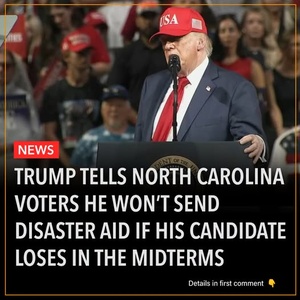
President Donald Trump tied additional Hurricane Helene assistance to Republican Senate candidate Michael Whatley during a campaign rally, before immediately telling the audience he was joking.
GASTONIA, N.C. — President Donald Trump generated controversy at a North Carolina campaign rally after briefly suggesting additional federal disaster assistance could depend on Republican Michael Whatley winning November’s Senate election.
Trump made the remarks Wednesday in Gastonia while campaigning for Whatley, his former Republican National Committee chairman, who is running against Democratic former North Carolina Gov. Roy Cooper.
The president was discussing the continuing recovery from Hurricane Helene, the devastating 2024 storm that killed more than 100 people in North Carolina and caused tens of billions of dollars in damage.
Trump praised Whatley as an advocate for Western North Carolina and said his administration had already provided more than $2 billion through the Federal Emergency Management Agency for recovery efforts.
He then acknowledged that North Carolina communities were still waiting for additional assistance and told Whatley that he intended to get more money to the state.
Trump followed that statement with the line generating headlines: “Now, if Michael loses, I’m not sending it.” But he immediately reversed course, telling the audience he was joking.
“No, I’m only kidding,” Trump continued, before telling Whatley that North Carolina was going to receive the additional assistance and saying the Senate candidate had repeatedly pressed him about it.
That full sequence makes the viral graphic incomplete. Trump did make the conditional statement, but he did not leave the audience with an unqualified declaration that disaster assistance would disappear following a Whatley defeat.
The remark nevertheless attracted attention because federal disaster assistance involves communities still recovering from a deadly natural disaster, making even a joking connection between aid and an election politically sensitive.
Local public radio station WUNC reported that federal assistance has so far covered only about 16% of the estimated damage, citing North Carolina Gov. Josh Stein, a Democrat.
Stein has requested another $10 billion in federal assistance, while residents and local officials in Western North Carolina have continued expressing frustration about the speed and scale of the recovery effort.
Trump told the Gastonia crowd that his administration was also approaching $3 billion for repairing roads and bridges and had approved relief applications involving nearly 20,000 North Carolina small businesses.
The president used the recovery effort to contrast Whatley with Cooper, repeatedly arguing that the Republican candidate had fought harder to secure assistance following Helene.
Trump accused Cooper, who served as governor when Helene struck, of doing essentially nothing following the disaster. Cooper and other North Carolina officials have disputed similar accusations about the state response.
PolitiFact separately examined Trump’s claim that Cooper had blocked assistance from Hurricane Helene victims displaying Trump signs and found no evidence supporting that allegation.
A FEMA employee was fired in 2024 after instructing workers to avoid certain Florida homes displaying Trump signs, but PolitiFact found no evidence connecting that episode to Cooper or his administration.
The disaster-aid exchange came during Trump’s first major campaign rally since Republicans held their midterm convention in Dallas, with the president attempting to boost Whatley in a closely watched Senate contest.
Whatley is competing for the seat being vacated by Republican Sen. Thom Tillis, who decided against seeking another term following disagreements with Trump.
Cooper presents Republicans with an unusually formidable opponent. The former governor has never lost a statewide election in North Carolina despite winning several races during elections in which Trump carried the state.
Trump therefore framed the Senate contest as part of a broader national struggle for control of Congress, telling supporters to behave as though his own name were once again appearing on their ballots.
The president also used the rally to repeat another election-dependent promise: his proposal to provide American adults with a $5,000 “Trump dividend” if Republicans retain control of Congress.
Unlike the disaster-aid remark, that $5,000 proposal was not presented as a joke. Trump explicitly told the crowd that Republicans winning would lead to the proposed payments.
The dividend has not yet been authorized by Congress, however, and AP reported that many Republican candidates have avoided making the proposal a central part of their own campaigns.
Trump’s FEMA remark is legally distinct. Federal disaster assistance operates through statutes, appropriations, FEMA programs and presidential disaster authorities rather than simply functioning as discretionary campaign rewards for politically supportive states.
The president does exercise significant authority within the federal disaster system, including over major-disaster declarations, while Congress determines appropriations and federal law governs numerous assistance programs.
That institutional framework helps explain why linking disaster money to an election result — even temporarily and jokingly — immediately attracted scrutiny beyond the ordinary campaign attacks exchanged at the rally.
Chris Cooper, a political scientist at Western Carolina University, told Blue Ridge Public Radio that the joke was unlikely to land well among residents who had lost homes or watched communities suffer extensive destruction.
At the same time, Cooper acknowledged the second half of Trump’s statement: the president explicitly said he was kidding and indicated the additional money would arrive regardless.
That distinction is essential when evaluating the graphic. “Trump says he won’t send disaster aid if his candidate loses” reproduces the provocative first half while omitting Trump’s immediate clarification.
A more complete description is that Trump joked about withholding additional North Carolina disaster assistance if Whatley loses, then immediately said the state would receive the funding anyway.
The episode still provides a revealing example of how disaster recovery has entered North Carolina’s 2026 Senate campaign, with both parties arguing over responsibility for the Helene response and remaining federal assistance.
For affected communities, however, the substantive question extends beyond Wednesday’s campaign rhetoric: how much additional federal assistance will actually reach Western North Carolina and when residents, businesses and infrastructure projects will receive it.
As of the latest reporting, Trump has not announced a policy making North Carolina’s future FEMA assistance conditional on electing Whatley. His full rally statement said precisely the opposite immediately after the joke.
Comments (0)
Loading comments...
May You Like

OBAMA STUNS ON INSTAGRAM: MESSAGE MARKING 34-YEAR MILESTONE SPARKS A BUZZ

South Korea–Ukraine Rift Deepens Over North Korean POW Transfer as PURL Draws New Scrutiny
Jack Smith Defends His Integrity as Trump Investigations Face Renewed Political Firestorm