
Trump Makes Emergency Appeal to Supreme Court to Allow Mail Ballot Restrictions
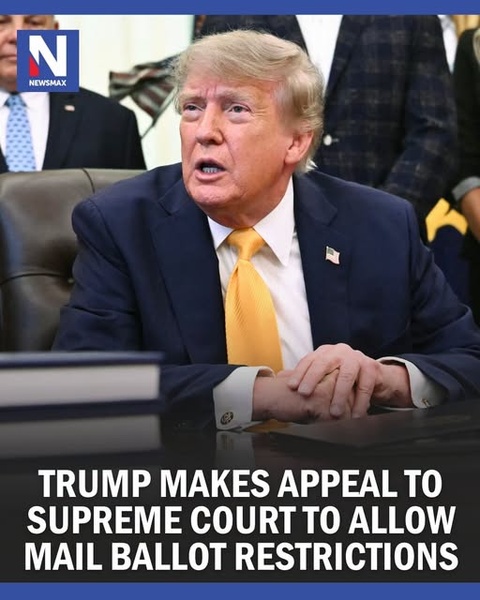
The Trump administration has filed an emergency application with the U.S. Supreme Court seeking to reinstate new restrictions on mail-in voting, after a federal judge indefinitely blocked the U.S. Postal Service rule that would have imposed strict new requirements on ballot envelopes and voter verification.
Justice Ketanji Brown Jackson, who handles emergency applications from the region, has set a Wednesday deadline for responses but has not granted the administration's request to allow the rules to take effect immediately. Meanwhile, states have already begun mailing ballots, leaving little time for a last-minute overhaul of election procedures.
WASHINGTON – The image circulating online captures a real and urgent legal development: the Trump administration is making a third appeal to the Supreme Court to allow its new mail-in ballot restrictions to go into effect before the November midterm elections .
The filing on Sunday came after U.S. District Judge Indira Talwani, an Obama appointee, issued a preliminary injunction on Friday that indefinitely blocked the Postal Service from enforcing the new rules . The judge had previously issued a 14-day temporary restraining order, which she extended into a longer-term freeze while the legal challenge proceeds .
What the New Rules Would Require
The Postal Service finalized the rules on August 21, 2026, implementing President Trump's March 2026 executive order titled "Ensuring Citizenship Verification and Integrity in Federal Elections." The requirements include :
| Provision | Details |
|---|---|
| Ballot envelope design | Envelopes must carry "Election Mail" logos, automation-compatible designs, and unique tracking barcodes |
| Online voter portal | States must submit names, addresses, and barcodes of intended mail-ballot recipients to a USPS online database |
| Verification requirement | Postal workers would only deliver ballots to voters appearing on state-provided lists |
| Non-compliance penalty | Non-compliant ballots would be returned to election offices and not delivered |
The Judge's Ruling: Unconstitutional and Unworkable
Judge Talwani issued a 49-page ruling that rejected the administration's arguments on multiple grounds .
Constitutional Violation
The judge found that the Postal Service overstepped its legal authority. Under the Elections Clause of the U.S. Constitution, the power to regulate the "time, place, and manner" of elections is reserved for states and Congress — not the executive branch .
"Through its body of election legislation, Congress has never delegated its Elections Clause power to the USPS," Talwani wrote . She added that the rule "is unconstitutional where it intrudes not only on Congress's Elections Clause powers but also that power left to the States" .
The judge also rejected the administration's argument that the Postal Service was acting under congressional authority, writing that the claim "rings hollow" .
Practical Impossibility
The judge found that requiring states to implement the new rules with less than 60 days before the election would cause "inevitable" disenfranchisement . Key practical concerns included:
-
Unclear readiness: Government lawyers could not confirm that the Postal Service's new online portal was fully operational .
Technology gaps: Many small rural jurisdictions lack the technology to print the required specialized barcodes .
No evidence of fraud: Talwani emphasized that the administration had not presented "any evidence regarding fraudulent absentee or mail-in voting" to justify the rushed implementation .
The Administration's Appeal
Solicitor General John Sauer filed the emergency application on Sunday, arguing that the judge's order "risks sowing confusion and chaos" because it makes compliance with the rule "voluntary, rather than mandatory" .
"Ballots have already begun to be mailed in North Carolina, and more States will begin the mailing process as the injunction remains in place — including Alabama on September 9 and at least five States the week of September 13," Sauer wrote . "Once those ballot envelopes enter the mailstream, there is no retrieving them."
Sauer also pushed back against "suggestions that the Postal Service is trying to federalize the rules for mail-in voting," arguing instead that "the Postal Service's final rule imposes only reasonable preparation requirements for certain election-related mail" .
The Legal Timeline: A Dizzying Back-and-Forth
The current appeal is the third time in less than six weeks that the administration has asked the Supreme Court to intervene :
| Date | Event |
|---|---|
| March 2026 | Trump signs executive order on mail-in voting |
| May 2026 | Federal judge in D.C. declines to block the executive order |
| July 27, 2026 | Trump administration makes first appeal to Supreme Court |
| August 2026 | Supreme Court allows administration to begin implementing executive order |
| August 27, 2026 | Judge Talwani issues 14-day temporary restraining order |
| September 3, 2026 | Administration files second appeal |
| September 4, 2026 | Judge Talwani issues preliminary injunction (indefinite block) |
| September 6, 2026 | Administration files third appeal |
Justice Ketanji Brown Jackson, who handles emergency applications from the region, set a Wednesday at 4 p.m. deadline for responses from the challengers . She has not granted the administration's request to allow the rules to take effect while the case is considered .
The Political Battle: Over 250 Lawmakers Join the Fight
More than 250 current and former members of Congress have filed an amicus brief urging the Supreme Court to block the administration's restrictions .
"As current and former legislators, amici took an oath to uphold and defend the Constitution of the United States — including its guarantee of the separation of powers," the lawmakers wrote . "The Constitution does not contemplate the Executive Branch acting unilaterally to assert power over federal elections. Yet that is what the Order and Final Rule do."
The group includes a bipartisan, bicameral coalition arguing that the president's incursion on congressional authority is "an attempt to disenfranchise people who depend on mail-in ballots to vote" .
What the Viral Graphic Gets Right
| What the Image Suggests | What Actually Happened |
|---|---|
| Trump made an appeal to the Supreme Court to allow mail ballot restrictions | Yes — the administration filed its third emergency application on Sunday |
| The case involves the Postal Service's new mail-in ballot rules | Yes — the rules stem from Trump's March 2026 executive order |
| The legal battle is ongoing | Yes — Justice Jackson has set a deadline for responses |
| States are already mailing ballots | Yes — North Carolina began mailing ballots on September 4, 2026 |
The Bottom Line
The image captures a real and consequential moment in the ongoing battle over mail-in voting: the Trump administration has made its third emergency appeal to the Supreme Court, seeking to impose new restrictions on mail ballots just weeks before the November midterm elections.
Judge Talwani's preliminary injunction, which indefinitely blocks the Postal Service rule, is now the subject of an urgent Supreme Court review. Justice Ketanji Brown Jackson is currently weighing responses from both sides, with no immediate action on the administration's request to allow the rules to take effect while the case is considered .
With states already mailing ballots and election officials scrambling to administer the midterms, the Supreme Court's decision could determine whether millions of Americans can vote by mail in the upcoming election .
The clock is ticking.
Comments (0)
Loading comments...
May You Like

FIGHT OVER OBAMA’S IRAN POLICY


gfnhgmnghnmfgnbvvvvvvvvv












