
Trump Moves to Cancel Nearly $1 Billion in Congress-Approved Funding for Immigrant and DEI-Related Programs
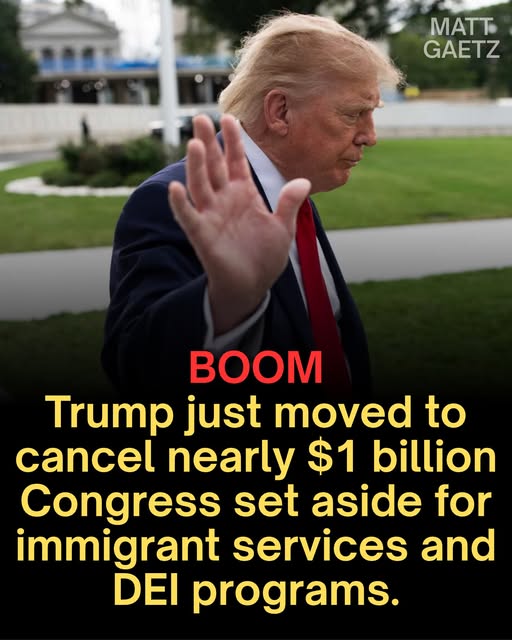
WASHINGTON — President Donald Trump has moved to cancel nearly $1 billion in federally approved spending, targeting programs serving immigrants, refugees, minority businesses and diversity-focused initiatives.
The White House announced the action on September 25, describing it as a rare “pocket rescission” intended to eliminate spending the administration considers wasteful or harmful.
About $810 million was at the center of the rescission package, covering 11 appropriations accounts across several federal departments, according to congressional and administration documents.
The largest portion, roughly $567 million, involved Health and Human Services funding for refugees, asylum seekers, unaccompanied minors and other noncitizens receiving federally supported services.
The administration argued that reduced border crossings made some of those funds unnecessary, while critics said Congress had already authorized the spending and the president could not simply cancel it.
Other targeted programs included migrant-student education, minority-business development, housing counseling, Justice Department initiatives addressing racial tensions, and several international or climate-related programs.
The White House also identified $10 million for Citizenship and Integration grants at U.S. Citizenship and Immigration Services, supporting nonprofit assistance for eligible immigrants seeking naturalization.
Administration officials portrayed the package as a broader effort to reverse programs associated with diversity, equity and inclusion policies and spending they regard as ideologically driven.
That framing is broader than the image suggests, because the rescission package was not limited to DEI programs or immigration services and included several unrelated domestic and international accounts.
Trump used a procedure known as a pocket rescission by sending the request only days before the September 30 end of the federal fiscal year.
Under the Impoundment Control Act, Congress generally receives 45 legislative days to consider a rescission proposal, creating a central dispute over the administration’s timing.
The Government Accountability Office said the administration could not withhold the money beyond its expiration date without congressional action, calling pocket rescissions inconsistent with federal law.
GAO’s position is significant because Congress holds constitutional authority over federal appropriations, while the executive branch is responsible for administering money after lawmakers approve it.
The administration disagrees with that interpretation and has argued that its approach is legally available, setting up another confrontation over presidential authority and Congress’s spending power.
Republicans and Democrats have criticized aspects of the move, although their reasons differ, with some lawmakers focusing on congressional authority and others objecting to the underlying policy cuts.
Senate Democrats attempted to block the rescission through legislation, but the effort failed after Republican Senator Ron Johnson objected to considering the measure by unanimous consent.
Legal challenges quickly followed, including a lawsuit from California and six other states arguing that the administration’s withholding of appropriated money violates constitutional spending rules.
A separate federal judge also temporarily blocked nearly $56 million in housing counseling grant cancellations while a lawsuit challenging the administration’s anti-DEI funding policies continues.
The disputes could ultimately require courts to determine how far a president may go in refusing or canceling congressionally approved spending without new legislation from Congress.
For now, the image’s central claim is broadly accurate about the scale and general targets, but “cancel” simplifies a legally contested process whose final outcome remains subject to litigation.
Key takeaway
The important development is not simply that Trump wants to cut nearly $1 billion. The larger issue is the constitutional and legal dispute over whether the president can effectively prevent Congress-approved funds from being spent without Congress approving the cancellation.
Sources
- White House — President Trump Takes Historic Action to Eliminate Wasteful and Harmful Spending
- Associated Press — Trump administration uses rare authority to claw back nearly $1B
- Government Accountability Office — What Is a “Pocket Rescission” and Is It Legal?
- Reuters — California and six other states sue Trump administration over federal funds
- Reuters — Judge blocks housing grant cuts while anti-DEI challenge proceeds
Comments (0)
Loading comments...
May You Like


South Korea–Ukraine Rift Deepens Over North Korean POW Transfer as PURL Draws New Scrutiny













