
Trump, Nicki Minaj, and the Debate Over Presidential Dignity
Trump, Nicki Minaj, and the Debate Over Presidential Dignity
A documented rally remark sparked a wider argument about public conduct, celebrity politics, and what voters expect from the presidency.
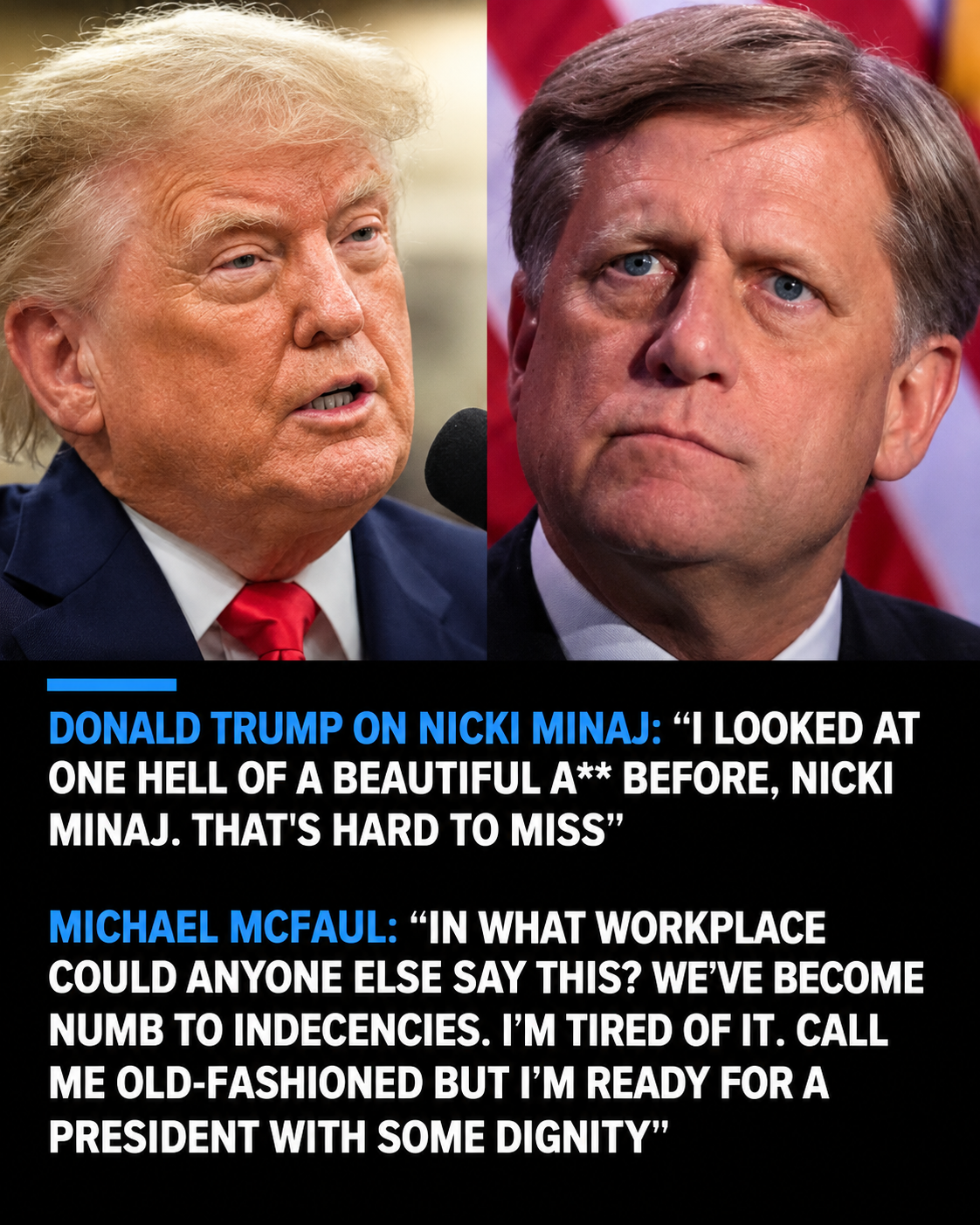
A political graphic juxtaposes Donald Trump’s remarks about rapper Nicki Minaj with a rebuke attributed to Michael McFaul, the former U.S. ambassador to Russia. The exchange has become a small but revealing flashpoint in the final stretch of the 2026 midterm campaign: one side sees an off-color personal compliment, while critics see a president using a campaign stage in a way they consider undignified.
The first quotation is grounded in a public event. At a Republican rally in Port Huron, Michigan, on October 25, 2026, Trump spoke about Ohio Senator Jon Husted’s physique, then turned to Minaj and said he had seen “one hell of a beautiful ass” before. He added that it was “hard to miss,” asked her to stand, and later said he hoped she had not been insulted.
The wording in the graphic is slightly edited. The Roll Call / Factba.se transcript records Trump saying, “By the way, I looked at one hell of a beautiful ass before, Nicki Minaj,” followed by “That, that’s hard to miss” and “That’s stand out, Nicki.” Other outlets transcribed parts of the passage somewhat differently, but the core remark is confirmed by video and multiple news reports.
Minaj was present at the rally and responded by standing and waving to the crowd. She later spoke in support of Trump, describing it as an honor to stand with him and saying she would continue to support him. Her presence was part of a broader effort to highlight celebrity support for Republicans ahead of the November 3 midterm elections.
The setting matters. Trump was campaigning for Republican candidates, including Senate candidate Mike Rogers, in a closely watched election cycle. Yet the comments about bodies and appearance became a major talking point in coverage of the event, competing with the campaign’s intended messages about candidates, policy, and turnout.
Trump’s remarks did not occur in isolation. In the same speech, he revisited comments he had recently made about Husted, explaining that he had been looking the senator up and down after learning about his football background. Trump framed the earlier observation as a joke about athletic build, then extended the topic to Minaj.
For critics, the issue was not simply whether Minaj was offended. They argued that a president’s public language sets a tone for political culture and that comments focused on a woman’s body can be disrespectful even when delivered as a compliment. Others saw the episode as another example of Trump’s unscripted, provocative style, which often attracts attention away from conventional campaign themes.
The second quotation in the graphic is attributed to Michael McFaul, who served as U.S. ambassador to Russia from 2012 to 2014 and has frequently criticized Trump’s conduct and foreign-policy approach. The text shown reads: “In what workplace could anyone else say this? We’ve become numb to indecencies. I’m tired of it. Call me old-fashioned but I’m ready for a president with some dignity.” Search-indexed social posts associate this statement with McFaul’s reaction to the rally remark, although the graphic itself is not a substitute for a direct link to the original post.
McFaul’s point, as presented in the image, is about standards of conduct. The workplace comparison asks whether an ordinary employee could make a similar remark about a colleague or visitor without consequences. The analogy is rhetorical rather than a literal legal analysis: presidents occupy a unique public office, and workplace rules differ across employers, but the comparison conveys the expectation that authority should come with restraint.
There is a distinction between a statement being vulgar and a statement being unlawful. The rally comment, by itself, does not establish a legal violation. The public controversy is primarily about judgment, respect, and the symbolic role of the presidency—not proof that a crime or formal workplace offense occurred.
Supporters of Trump may argue that the comment was a spontaneous, joking compliment, that Minaj was present and did not visibly object, and that voters should focus on policy rather than a brief aside. Critics respond that a person’s visible reaction does not settle whether a remark is appropriate, and that public officials should be judged by more than whether the target of a comment appears to laugh or wave.
The question of consent and context is often oversimplified in online debates. A public figure attending a rally has not necessarily invited every kind of personal comment, but the available video also does not establish that Minaj objected. The fairest account sticks to what can be observed and avoids claiming to know her private feelings unless she states them herself.

The episode also reflects the increasingly blurred boundary between celebrity culture and political campaigning. Minaj’s appearance gave the rally an entertainment dimension and drew attention from audiences who might not follow the Senate race closely. Her endorsement may energize some supporters, while the president’s remarks may alienate others who expect campaign events to focus on policy and candidates.
The broader political stakes are real even when the immediate controversy is about tone. In a close midterm environment, campaigns try to define what voters remember about candidates and their allies. A short viral clip can crowd out discussions of prices, healthcare, immigration, foreign policy, or the candidates’ plans for office, regardless of whether the clip reflects the event’s most consequential substance.
The reaction also shows how social platforms can turn a moment at a campaign stop into a debate about institutional norms. A clip is easy to share because it is short and emotionally clear; a full transcript is less likely to travel as far. That imbalance makes it especially valuable to preserve the original wording and distinguish it from the conclusions commentators draw from it.
Recent reporting has also placed the rally within a wider pattern of Trump’s provocative rhetoric during the campaign. Coverage of the Michigan event focused not only on the Minaj remark but also on Trump’s attacks against Democratic Senate candidate Abdul El-Sayed, whom Trump called a “jihadist”—a claim that drew criticism from Arab American advocates and others. Those separate controversies should be evaluated on their own evidence rather than merged into one undifferentiated allegation.
A careful reading of the graphic requires separating verified speech from interpretation. Trump’s comment about Minaj is documented in a public transcript and video. McFaul’s criticism is presented as a reaction to that comment, and its wording is widely reproduced in social posts, but readers should ideally consult the original post if they need to verify exact punctuation, timing, or context.

Images like this are designed to make a political argument quickly: the top half shows the remark, while the lower half supplies a moral judgment. That format can help communicate a reaction, but it also removes surrounding details, including the event’s broader context, the speaker’s follow-up, and any nuance in the original critic’s post.
Whether the remark demonstrates a lack of presidential dignity is ultimately a judgment about public standards. Voters may disagree about humor, informality, and the degree to which personal comments matter. Still, the debate is not meaningless simply because it concerns language rather than a bill or executive order; a president’s public behavior contributes to how citizens understand the office and its norms.
The most defensible conclusion is straightforward. Trump did make a crude comment about Minaj’s appearance at the Michigan rally, and the transcript confirms the substance of the quote shown in the graphic, though not every word is reproduced exactly. The criticism attributed to McFaul reflects a broader argument about dignity and public conduct. Readers can decide how persuasive that argument is, but should distinguish the recorded remark from the interpretation layered onto it.
Comments (0)
Loading comments...
May You Like

WEYMOUTH HORROR — FIRE TRUCK BRAKES TO SAVE DOG, ONE FIREFIGHTER DEAD, TWO CRITICAL!

EAST COAST CATASTROPHE — $20 BILLION AT STAKE, 5 MILLION AT RISK OF LOSING POWER, WATER AND HEAT!

WWE BRONSON REED—INSPIRED—SUDDEN COLLAPSE, MYSTERIOUS STIMULANTS, DEAD AT 38!









Popular Posts




