
Trump, Obama, and the Cognitive-Test Quote: What the Record Shows
Trump, Obama, and the Cognitive-Test Quote: What the Record Shows
A viral graphic draws on a real political boast—but the wording is not fully verified, and the test at issue is not an IQ exam.
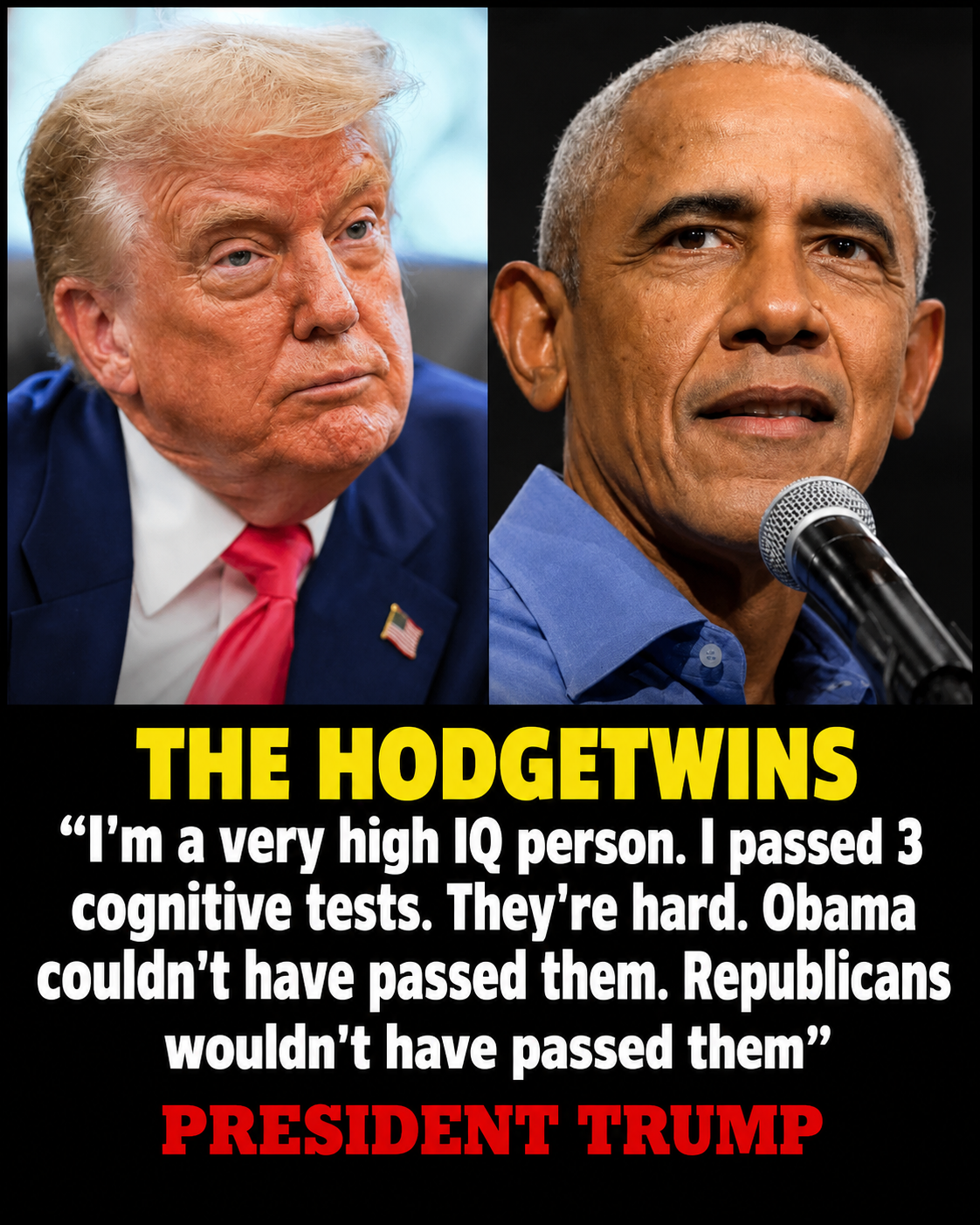
A viral graphic featuring Donald Trump and Barack Obama places a provocative quotation beneath the label “The Hodgetwins.” It presents Trump as saying he is a “very high IQ person,” that he passed three cognitive tests, and that Obama and Republicans would not have passed them. The image captures a real strand of Trump’s public rhetoric about cognitive testing, but the exact wording should not be treated as a verified verbatim transcript.
Public transcripts support part of the message. On May 1, 2026, Trump said he had taken three cognitive tests and “aced all of them.” He then said he did not think Obama could pass one. That speech provides a source for the central comparison, although it does not contain the complete wording shown in the image.
The distinction matters because social-media graphics often compress, paraphrase, or combine statements from different moments. Without a direct recording or transcript matching every sentence, it is more accurate to call this a graphic presenting a quote attributed to Trump, rather than to assert that every word is confirmed as exact.
The graphic’s attribution to the Hodgetwins also deserves care. The Hodgetwins are conservative political commentators and entertainers known for reaction videos and commentary. Their name may identify the account or publisher that circulated the graphic; it does not, by itself, establish that the full wording came from one Trump speech or was independently verified.
Trump has repeatedly discussed cognitive testing as evidence of his mental sharpness. In public remarks, he has said he passed multiple tests and challenged political opponents to take similar examinations. He has also suggested that former President Joe Biden and Obama would struggle with questions he describes as difficult.
The medical context is more specific than the political framing. Reporting by PolitiFact and medical experts indicates that the test Trump has described appears to be the Montreal Cognitive Assessment, commonly known as the MoCA. It is a brief screening tool used to look for signs of cognitive impairment, not an examination designed to measure IQ or rank people by intelligence.

The MoCA assesses several functions, including attention, memory, language, visuospatial ability, and executive skills. A perfect score can be reassuring in the limited sense that the screening did not detect obvious impairment at that time. It does not establish exceptional intelligence, prove superior judgment, or settle whether someone is fit for every aspect of a demanding job.
That distinction is important when interpreting Trump’s statements about having “aced” the tests. A screening result is one piece of medical information, not a comprehensive psychological or neuropsychological assessment. Experts have cautioned against treating a score as a definitive measure of overall intelligence or decision-making ability.
The same principle applies to political opponents. A person cannot reliably be judged incapable of passing a test simply because a politician speculates about it. Unless Obama or another named individual actually took the same assessment under comparable conditions and released the result, claims about how that person would perform remain conjecture.
Obama’s educational record also makes the graphic’s broader implication worth separating from the evidence. He graduated from Columbia University and Harvard Law School, where he was president of the Harvard Law Review. Those credentials do not tell us exactly how anyone would score on a cognitive screening test, but they underscore why unsupported assertions about someone’s ability should not be mistaken for factual assessment.
The image also says Republicans would not have passed the tests. That line is not supported by the May 1 transcript located for this article. It may be a paraphrase, a composite drawn from other remarks, or a rhetorical addition by the graphic’s creator. Until a matching source is identified, it should not be presented as a confirmed Trump quotation.
Public figures often use claims about intelligence to frame political competition as a contest between competence and incompetence. Such rhetoric can be effective because it turns a technical medical topic into a simple story about who is smart enough to lead. But that simplicity can obscure what the underlying test was actually designed to measure.

Cognitive screening can be useful in clinical care, particularly when a patient or clinician has concerns about memory or other changes. Results must be interpreted in context, including a person’s health, education, language, sensory abilities, and reason for testing. A brief screening does not replace a full clinical evaluation when one is indicated.
Repeated testing adds another layer of complexity. Clinicians may repeat a screening to monitor changes over time, but repeated exposure can also make the questions or format more familiar. Public reporting notes that Trump has described taking the assessment multiple times; without complete medical records and clinical context, outsiders should avoid drawing a diagnosis from that fact alone.
There is also a privacy boundary. Presidents’ health can be a legitimate public-interest topic because the job carries extraordinary responsibilities. At the same time, public commentary cannot substitute for medical evidence, and a media graphic should not be used to diagnose Trump, Obama, or any other person from a photograph or isolated quote.
For readers trying to verify the graphic, the strongest starting point is the original transcript of Trump’s May 1, 2026, remarks. That record confirms that he boasted about passing three tests and questioned whether Obama could pass one. It does not confirm every phrase displayed in the image, particularly the “very high IQ person” wording and the assertion about Republicans.
The medical fact-checks offer a second essential layer. PolitiFact, The BMJ, and other outlets have explained that the MoCA is intended to screen for cognitive impairment rather than to measure IQ. Their reporting helps separate Trump’s characterization of the test from the clinical purpose described by experts familiar with the assessment.
A fair reading does not require readers to endorse Trump or his critics. It requires distinguishing an exact quotation from a paraphrase, a political boast from a medical conclusion, and a claim about another person from evidence about that person. Those distinctions are especially important when a dramatic image is designed to spread quickly across social platforms.
The broader lesson is that cognitive health and intelligence are not interchangeable concepts. A screening test can provide useful information, but it cannot, on its own, establish genius, political competence, or how an untested person would perform. Claims about leaders should be assessed with the same evidentiary standards regardless of party or personal preference.
In short, the graphic draws on a genuine Trump statement about passing three cognitive tests and his belief that Obama could not pass one. However, the full quote as shown is not verified word-for-word by the transcript located here, and the test discussed is not an IQ test. Readers should treat the graphic as political commentary unless its publisher can provide a recording or transcript confirming the complete wording.
Comments (0)
Loading comments...
May You Like

WWE BRONSON REED DEAD AT 38, STIMULANTS DETECTED, $10M INSURANCE PAYOUT FROZEN!

WWE BRONSON REED—STAR COLLAPSES AT COMPANY EVENT, FATAL DRUG REACTION SUSPECTED!

DAVENPORT AIRBNB HORROR — “SHOTS AT THE DOOR” GAME, 1 DEAD, 6 INJURED!










Popular Posts


