
TRUMP VS. OBAMA IN 2028? THE CONSTITUTIONAL BARRIER THAT CHANGES EVERYTHING
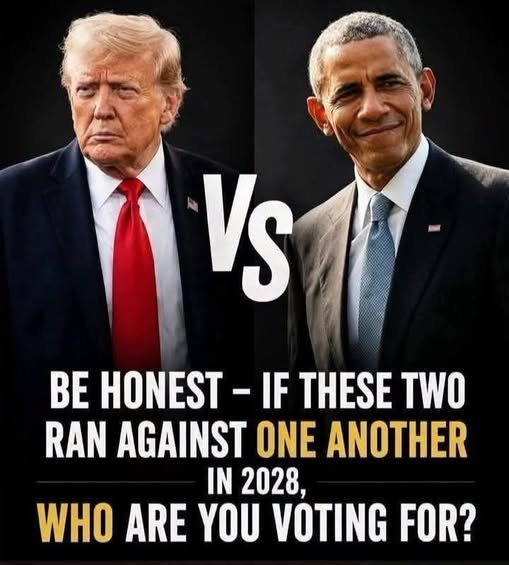
A provocative image showing Donald Trump and Barack Obama facing off in a hypothetical 2028 presidential election has reignited a familiar question in American politics: If these two presidents could compete against one another, whom would Americans choose? The viral graphic presents a simple choice, but the debate behind it is far more complicated. It touches on the economy, healthcare, immigration, presidential leadership, public trust and the deep political divisions that continue to shape the United States.
There is also a major constitutional obstacle that changes the entire scenario. Both men have already been elected president twice. Under the Twenty-Second Amendment, neither can be elected to the presidency for a third time under the current constitutional framework. That legal reality makes the viral matchup a political thought experiment rather than a realistic contest in the 2028 election.
How Americans compare the two presidents
The contrast between the two administrations goes beyond party loyalty. It reflects different expectations about what a president should prioritize and how the federal government should exercise its power.
Obama took office in January 2009 amid a severe financial crisis. His administration pursued economic recovery measures and enacted the Affordable Care Act, which expanded health insurance coverage and introduced new protections for people with pre-existing conditions. Supporters credit these policies with helping stabilize the economy and broaden access to healthcare. Critics argue that the recovery was uneven and that healthcare costs and government regulation remained significant concerns.
Trump's political appeal has rested on a different set of priorities, including tougher immigration enforcement, protectionist trade policies, tax cuts and a more confrontational approach to established institutions. Supporters argue that his approach challenges a political establishment they believe has failed working Americans. Critics raise concerns about tariffs, the cost of living, immigration enforcement and the concentration of executive power.
Neither record can be assessed fairly without considering the circumstances in which each president governed. Obama inherited the 2008 financial crisis, while Trump's first term included the COVID-19 pandemic. Their second-term circumstances and policy choices also differ. Comparing the two requires examining specific outcomes rather than relying solely on campaign slogans or retrospective impressions.
What recent polling tells us about public opinion

Recent polling offers some insight into the current political climate. A Pew Research Center survey conducted September 28–October 4, 2026, among 5,062 U.S. adults found that 30% approved of Trump's performance as president, while 68% disapproved. The same survey found that the economy remained a leading issue for voters ahead of the 2026 midterm elections.
These figures indicate substantial dissatisfaction with the current administration, but they do not demonstrate that Obama would win a hypothetical election. Approval ratings measure public assessments of a president's performance; they are not the same as a direct comparison between two candidates.
Public opinion is also divided by party affiliation, age, income, geography and the issues individual voters consider most important. A voter concerned primarily about immigration may evaluate the administrations differently from someone whose main concerns are healthcare costs, housing affordability or foreign policy.
The distinction matters because political debate online can turn a complicated set of opinions into a simplistic contest between two personalities. A viral image can show that a question has captured people's attention, but without a representative survey, it cannot establish how Americans as a whole would answer it.
The constitutional rule that makes the matchup impossible under current law

The central legal issue is the Twenty-Second Amendment to the U.S. Constitution, ratified in 1951. Its first section states that no person may be elected president more than twice. Obama won presidential elections in 2008 and 2012; Trump won in 2016 and 2024. Consequently, neither can be elected president for a third time under the current constitutional framework.
The amendment followed Franklin D. Roosevelt's four election victories. Before its adoption, the Constitution did not explicitly limit the number of times a person could be elected president, although George Washington had established a tradition of leaving office after two terms.
Changing the term limit would require a constitutional amendment through the demanding process established by Article V. This generally involves approval by two-thirds of both houses of Congress and ratification by three-fourths of the states, or a convention called by two-thirds of state legislatures followed by ratification by three-fourths of the states.
The restriction does not prevent former presidents from remaining politically active. Trump and Obama can endorse candidates, campaign for their preferred policies, speak publicly and influence their respective parties. The constitutional barrier concerns being elected president again, not participating in political life.
What happens next in American politics?
The more practical question is which eligible candidates will compete in 2028 and what policies they will offer. The November 2026 midterm elections will provide an important indication of public sentiment toward the current administration and could reshape the balance of power in Congress. However, midterm results cannot by themselves determine the outcome of the next presidential election.
Both major parties face challenges in building coalitions broad enough to win national elections. Republicans must consider how to maintain support among Trump's core voters while addressing concerns about the economy and governance. Democrats must determine which candidates and policy proposals can unite their own coalition while appealing to independents and voters dissatisfied with both parties.
For voters, the most useful comparison is not an impossible rematch between two presidents who have already won twice. It is a careful examination of eligible candidates, their policy proposals, their records and the likely consequences of their decisions.
The bottom line: The viral Trump-versus-Obama image captures a real debate about America's political direction, but it does not represent a legally available 2028 matchup under the current Constitution. Polling reveals public concerns and political divisions, not a guaranteed election outcome. The actual contest will be shaped by eligible candidates and by voters' judgments about the economy, healthcare, immigration, leadership and the future of the country.
Comments (0)
Loading comments...
May You Like

WWE BRONSON REED—STAR COLLAPSES AT COMPANY EVENT, FATAL DRUG REACTION SUSPECTED!

BOMBSHELL NEW JERSEY FLOOD — 112 KM/H WINDS, SEAWATER FLOODING INLAND, 120,000 HOMES AT RISK!

STAR DIED AT 38, $10M LIFE INSURANCE INCREASED JUST 30 DAYS BEFORE WWE BRONSON REED'S DEATH!











Popular Posts


