
Trump on the Iran War: “Whenever I Want It to End”
Trump on the Iran War: “Whenever I Want It to End”
The president’s confident declaration meets a more complicated reality: shifting timelines, regional risks, rising costs, and uncertainty over what a durable end to the conflict would require.
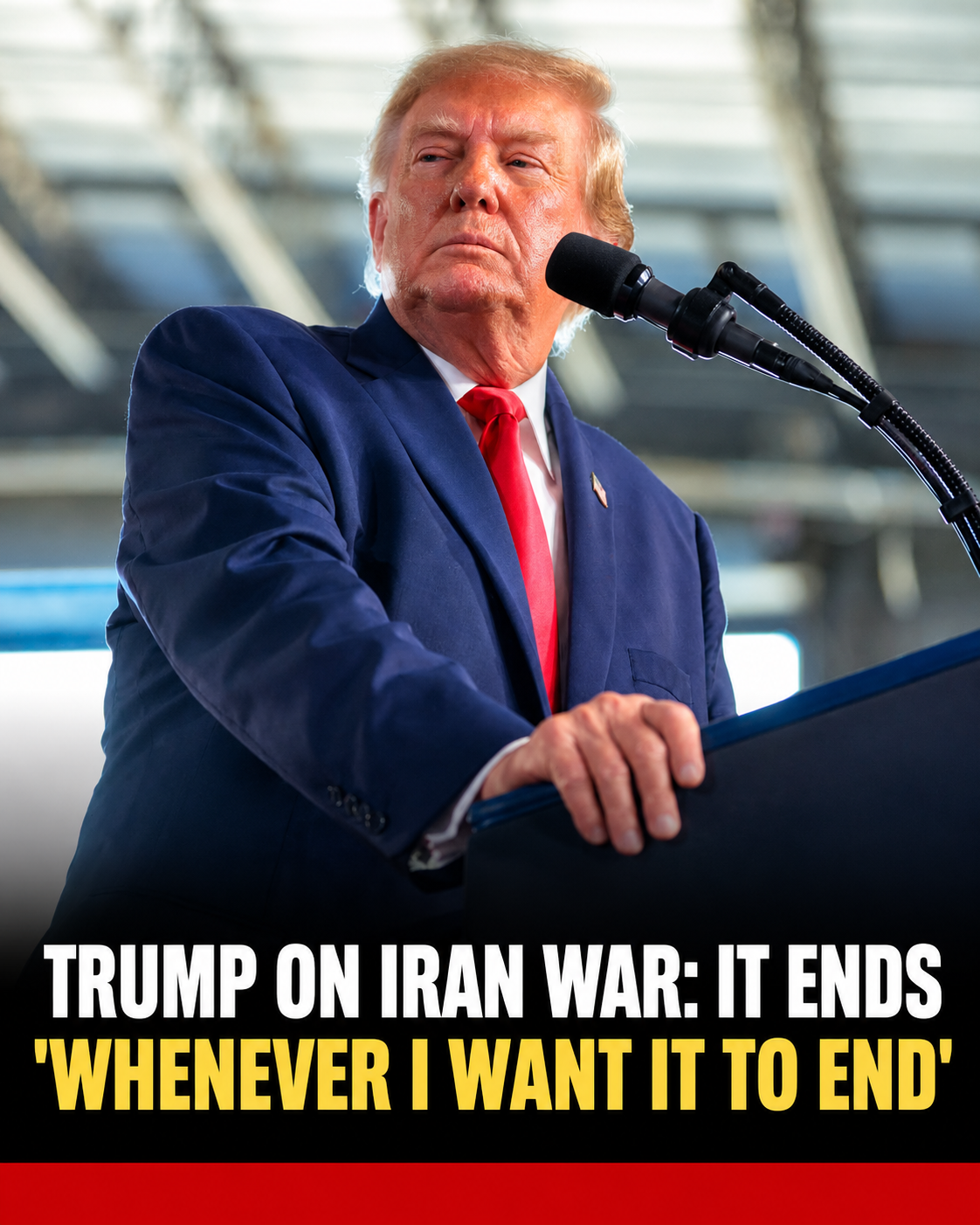
President Donald Trump has offered one of the most striking summaries of his approach to the war with Iran: “Whenever I want it to end.” The line is blunt, confident, and politically potent. It presents the conflict as a decision whose duration rests primarily with the American president.
The remark was not invented by the graphic circulating online. A transcript of Trump’s October 27, 2026, rally in Lubbock, Texas, records him saying that when someone asked when the war would end, he replied, “Whenever I want it to end.” He added that it would be quick, but said the conflict had to end in a way that ensured Iran would never have a nuclear weapon.
Yet a president’s confidence about the timing of a war is not the same thing as evidence that the conflict can be ended on command. Wars involve adversaries, military realities, alliances, negotiations, and consequences that no single leader can fully control. Trump’s words therefore raise a question larger than the sound bite: what would it actually take to end the fighting?
Trump has repeatedly projected the idea that the United States has the upper hand. In his Lubbock remarks, he said the conflict could end quickly and described preventing Iran from obtaining a nuclear weapon as a central condition. The administration’s challenge is to translate those assertions into a clear, achievable political outcome.
That distinction matters because military success and a durable end to a war are not identical. Destroying weapons, facilities, or military infrastructure may weaken an opponent, but it does not automatically settle the political disputes that caused the confrontation. A lasting settlement typically requires some combination of credible security arrangements, diplomacy, and agreement about what comes next.
Trump’s language also leaves key questions unanswered. What specific conditions would convince Washington that its objectives had been met? Would Iran need to accept a negotiated arrangement, or would the United States decide to stop operations regardless of Tehran’s position? And what mechanism would verify that any commitments were being honored?
Those questions have become more urgent as officials and regional governments prepare for the possibility of renewed strikes. The Associated Press reported on October 28 that U.S. officials had urged several Middle Eastern countries and regional allies to prepare for potential military action after the November 3 midterm elections, along with possible Iranian retaliation. The report said Trump had not made a final decision about new strikes.
The same report described a region on edge. Officials were concerned that retaliation could target energy facilities and other critical infrastructure, potentially widening the consequences beyond the immediate battlefield. Even if a new round of U.S. attacks lasted only days, the response could create a longer and more unpredictable cycle.

That possibility complicates the promise that the war can end whenever the president chooses. A decision in Washington may stop one phase of military operations, but it cannot by itself guarantee that Iran or groups aligned with Tehran will stop responding. The practical meaning of “ending” the war depends on what happens after the last announced strike.
Trump has also spoken in recent weeks about whether to finish the conflict quickly or allow it to “wither.” In an October 23 report, Reuters quoted him saying the United States could end the war very quickly, while questioning whether a swift conclusion was preferable to letting the conflict wind down. That framing suggests the administration is weighing not only military capability but also the political costs of different exit strategies.
The uncertainty has a direct economic dimension. The Associated Press reported that the estimated cost of the war to American taxpayers had reached $47.1 billion, while higher gasoline prices were adding pressure to households. The financial burden makes the timeline more than an abstract argument about presidential authority; it affects budgets, consumer costs, and the political environment at home.
Energy markets are particularly sensitive to instability around the Strait of Hormuz, a critical route for global oil shipments. Disruption or fear of disruption can influence prices well beyond the Middle East. That means a war’s consequences may continue to reach American families even when the fighting is geographically distant.
For voters, the conflict is unfolding alongside the midterm elections. The AP reported that the war has become a burden for Republican candidates as they try to address voter frustration over fuel costs and the broader cost of living. Trump’s insistence that the war can end quickly may be intended to project control, but voters will also judge the administration by what they experience at the pump and in the wider economy.

Political messaging rewards certainty, especially during a campaign. “Whenever I want it to end” is memorable because it casts the president as the decisive actor in a complicated international crisis. But the same confidence can become a liability if the timeline keeps shifting or if renewed violence contradicts predictions that the conflict is nearly over.
Trump’s public statements about timing have varied. At different points, he has suggested the conflict would end soon, that it could continue as long as necessary, or that it might conclude after the midterm elections. Such changes do not by themselves prove that a policy has failed; battlefield conditions and diplomacy can evolve. They do, however, make it harder for the public to understand what benchmarks the administration is using.
The central strategic issue is the relationship between military pressure and diplomacy. A government may use force to strengthen its bargaining position, but the ultimate test is whether the resulting arrangement reduces the risk of renewed conflict. If the objective is to prevent Iran from acquiring a nuclear weapon, the public deserves a clear explanation of how military action, inspections, enforcement, and negotiations fit together.
There is also a question of regional security. Neighboring countries must prepare for the possibility that they could be affected by attacks, retaliation, or disruption to trade and energy infrastructure. The AP report said regional allies had been urged to take precautions in anticipation of possible Iranian retaliation. These governments have their own interests and calculations, which may not always align neatly with Washington’s preferred timetable.
None of this means that Trump’s statement should be read as proof that the war is endless or that a rapid end is impossible. It means the claim should be assessed as a presidential assertion rather than a guarantee. The most reliable indicators will be concrete developments: whether military operations stop, whether diplomatic channels produce an agreement, whether shipping and energy flows stabilize, and whether the risk of renewed attacks diminishes.
The public also has a legitimate interest in understanding the legal and strategic basis for continued military action, the goals being pursued, and the criteria for ending it. Clear objectives and transparent explanations do not eliminate the uncertainty of war, but they help citizens evaluate whether the costs and risks are proportionate to the stated aims.
Ultimately, “Whenever I want it to end” is a powerful political line, but it is not a complete strategy. A war ends durably when the fighting stops and the conditions for restarting it are reduced—not merely when a leader says the decision is his to make. Whether the administration can turn Trump’s confidence into a stable outcome will depend on events, diplomacy, and the responses of other actors as much as on presidential will.
Comments (0)
Loading comments...
May You Like


WEYMOUTH HORROR—80-MPH WIND GUSTS, FIRE TRUCK FLIPS, 3 FIREFIGHTERS CRITICAL!










Popular Posts




