
Trump Orders Review of Canadian Goods for U.S. Federal Procurement as Trade Tensions Escalate
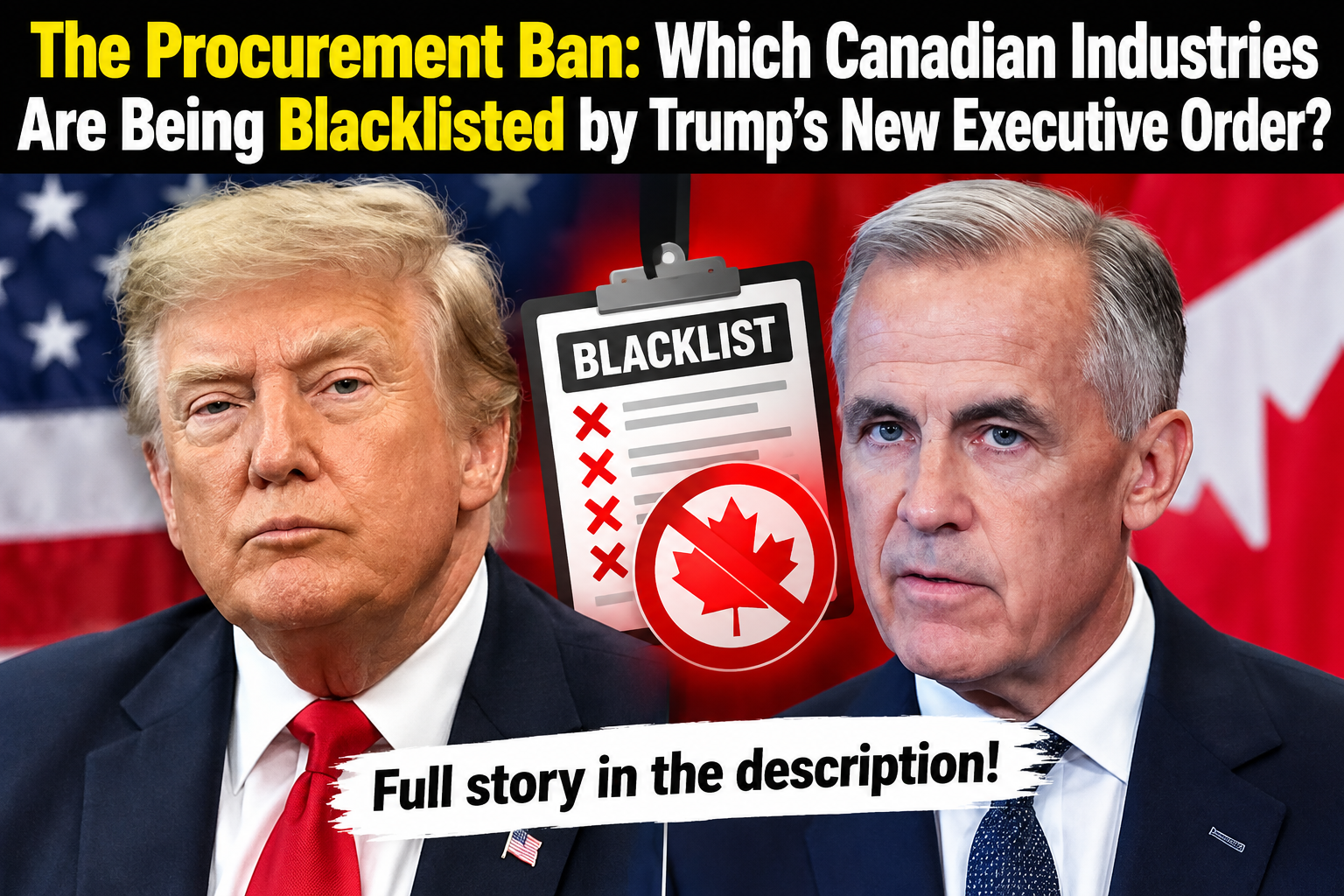
WASHINGTON — September 17, 2026 — President Donald Trump has ordered U.S. officials to identify Canadian-origin goods that could be removed from the federal government's civilian procurement system, escalating the trade dispute with Ottawa and raising new questions about which Canadian industries could lose access to U.S. government contracts.
The measure, signed September 16, is titled “Restoring Reciprocity in Government Procurement.” Despite the wording of some viral headlines, it is a presidential memorandum, not an executive order, and it does not yet publish a definitive blacklist of Canadian industries or companies. Instead, it directs federal officials to determine which Canadian-origin items can legally be removed or made unavailable for purchase.
The move comes just days after the Trump administration imposed new restrictions on certain Canadian products and as Canada simultaneously pursues closer economic and strategic relationships with Europe.


President Donald Trump has expanded trade measures against Canada as Washington and Ottawa remain locked in a dispute over tariffs and market access.
The “Blacklist” Is Not Yet a Published List
The most important detail behind the viral graphic is what Trump's memorandum actually does.
The document instructs the Office of Management and Budget (OMB) and the United States Trade Representative (USTR), working with federal procurement officials, to identify Canadian-origin items in the federal civil procurement system that can be removed or made unavailable for purchase where permitted by law.
That means the administration has started a process to identify affected products rather than publishing a completed industry-by-industry blacklist.
The memorandum also instructs agencies to identify domestic alternatives to Canadian products where permitted.
USTR is separately instructed to monitor Canada's treatment of U.S.-origin goods in Canadian federal and provincial procurement markets and report circumstances that could justify additional action—or restoration of Canadian products if Canada's policies change.
In practical terms:
| What the viral image suggests | What the memorandum actually says |
|---|---|
| Canada has been placed on a finalized blacklist | No finalized blacklist was published |
| Specific Canadian industries have already been banned | Officials must identify products that can be removed |
| Trump issued an executive order | Trump signed a presidential memorandum |
| All Canadian companies are excluded | The measure concerns Canadian-origin items in federal civilian procurement |
| The restrictions are permanent | The memorandum allows Canadian products to be restored if circumstances change |
This distinction matters because the ultimate scope will depend on the federal procurement review.
Why Did Trump Target Canadian Procurement?
The Trump administration says the measure is a response to Canada's “Buy Canadian” procurement policies.
The White House argues that Canadian federal and provincial governments have restricted U.S. companies' access to government procurement while Canadian companies continue to receive access to substantial U.S. federal purchasing opportunities.
The September 16 memorandum specifically points to Canadian preferences for Canadian products and Canadian content. It also cites provincial restrictions on U.S. companies.
The administration says the United States has agreed to cover more than $280 billion annually in federal procurement under the World Trade Organization's Government Procurement Agreement and argues that Canadian companies have benefited from access to that market.
The White House describes the new action as an attempt to establish what it calls reciprocity.


The latest procurement measure is part of a broader dispute over market access, tariffs and government purchasing.
Canada Had Already Adopted “Buy Canadian”
The U.S. action did not emerge without a corresponding Canadian policy.
Canada introduced its Buy Canadian Policy in December 2025. Ottawa says the policy is designed to prioritize Canadian suppliers and Canadian-made goods and services in federal procurement while strengthening domestic supply chains.
Canada expanded the policy in June 2026 by lowering the threshold for its strategic procurement preference from C$25 million to C$5 million.
According to the Canadian government, the change means approximately five times more federal procurements can potentially fall under Canadian-preference measures.
Canada says its federal government purchases more than C$37 billion in goods, services and construction each year. By June 25, 2026, the government said Buy Canadian had been applied to solicitations representing more than C$3 billion, with C$726 million in contracts awarded.
So there is a genuine policy dispute at the center of the confrontation.
Washington says Canadian procurement preferences discriminate against U.S. businesses. Ottawa says the Buy Canadian framework is intended to strengthen Canadian supply chains and create opportunities for Canadian businesses.
Those are competing policy positions rather than independently established conclusions about whether Canada's measures violate a particular trade obligation.
Which Canadian Industries Could Be Affected?
At this stage, it would be premature to claim that specific Canadian industries have been formally “blacklisted.”
The memorandum applies broadly to Canadian-origin items in the federal civilian procurement system, but it leaves the identification of affected products to U.S. officials.
That could potentially affect Canadian businesses that depend on U.S. federal procurement contracts, but the memorandum itself does not establish an industry-by-industry exclusion list.
Areas to watch
Manufacturing and industrial goods
Canadian manufacturers supplying products to U.S. federal agencies could potentially be affected if their goods are identified for removal.
Construction and infrastructure suppliers
Canadian companies supplying materials or equipment to U.S. civilian government projects could face changes depending on procurement decisions.
Technology and specialized equipment
Canadian-origin technology, equipment or services purchased through federal procurement systems could be reviewed.
Transportation and industrial equipment
The administration's broader trade actions have already targeted Canadian automotive products, while procurement restrictions could create another channel of pressure.
Defense-related companies
The memorandum is specifically about federal civil procurement, so it should not automatically be described as a blanket prohibition on Canadian defense products. Separate trade and defense procurement rules may apply.


Canadian manufacturing and other suppliers that rely on government purchasing will be watching how U.S. agencies implement the memorandum.
This Is Bigger Than Procurement
The procurement decision is only one part of a rapidly expanding U.S.-Canada trade dispute.
On September 8, the Trump administration announced additional measures under Section 338 of the Tariff Act of 1930, including import bans on certain Canadian products and changes to tariffs affecting Canadian goods. The White House said the measures were a response to what it characterized as discriminatory Canadian treatment of U.S. commerce.
Separate September 8 proclamations targeted certain Canadian alcoholic beverages and dairy products, while another measure addressed certain Canadian motor-vehicle products. The import exclusions are scheduled to take effect September 29.
The procurement memorandum therefore adds another layer:
Tariffs and import restrictions → Canadian retaliation → procurement restrictions → further negotiations or countermeasures.
Reuters previously reported that Trump had directed the General Services Administration and USTR to begin removing Canadian-origin products from the GSA's Multiple Award Schedules.
The September 16 memorandum broadens the policy direction by instructing officials to examine Canadian-origin items across the federal civilian procurement system.
Canada Is Simultaneously Moving Closer to Europe
The procurement announcement also comes at a particularly significant diplomatic moment.
Canadian Prime Minister Mark Carney is pursuing deeper economic and strategic ties with Europe as relations with Washington deteriorate.
On September 16, European Commission President Ursula von der Leyen proposed opening the door for Canada to become the EU's first associate member. The proposal does not amount to full EU membership and would require negotiations over its legal and economic structure.
Trump has separately warned that a closer EU-Canada relationship could have consequences for Europe.
On September 16, he said the move could constitute a hostile act depending on the EU's intentions and warned of potentially heavy tariffs or trade restrictions.
That means the procurement dispute is unfolding alongside a much broader debate over Canada's future economic relationships.


Prime Minister Mark Carney has been seeking closer economic and strategic cooperation with Europe while U.S.-Canada trade tensions intensify.
Why the Canadian Procurement Market Matters
Government procurement can be particularly important for companies that depend on large, long-term contracts.
A change in eligibility does not necessarily mean that an affected company immediately loses all U.S. business. The actual consequences depend on:
- which products federal agencies identify;
- which procurement programs are affected;
- whether exemptions apply;
- whether existing contracts are protected;
- whether domestic alternatives are available;
- and how the rules are implemented under existing U.S. procurement law.
The memorandum itself says implementation must remain consistent with applicable law and subject to available appropriations.
It also allows Canadian products to potentially return to federal procurement if Canada's treatment of U.S.-origin goods changes.
That makes the measure both an economic action and a negotiating instrument.
What Happens to Existing Contracts?
The September 16 memorandum does not state that every existing Canadian government contract in the United States is automatically terminated.
Instead, it directs officials to identify Canadian-origin items that can be removed or made unavailable and to take steps permitted by law.
The practical effect on existing contracts will therefore depend on how individual agencies implement the directive and on the legal status of those contracts.
This is another reason the phrase “Canadian industries are being blacklisted” goes beyond what the memorandum itself establishes.
A Broader Escalation in the U.S.-Canada Trade Dispute
The latest measures show how the dispute has expanded beyond conventional tariff negotiations.
Canada's Buy Canadian program is designed to give domestic suppliers greater access to government purchasing.
The Trump administration argues that such preferences reduce access for U.S. companies and has responded by examining whether Canadian products should receive the same treatment in U.S. federal procurement.
Meanwhile, both governments have taken tariff and trade measures against each other's goods.
The result is a feedback loop in which procurement policy, tariffs and supply-chain decisions are increasingly interconnected.
The Bank of Canada has warned that additional U.S. trade actions could raise business costs and add uncertainty to Canada's economic outlook.
What the Viral Image Gets Right — and What It Leaves Out
The graphic correctly identifies a major new development: Trump has directed his administration to remove or restrict Canadian-origin goods from portions of the U.S. federal civilian procurement system.
But several elements of the headline require clarification.
“The Procurement Ban” — The memorandum establishes a process for identifying Canadian goods that can be removed or made unavailable. It is not a blanket ban on all Canadian procurement.
“Blacklisted Canadian industries” — No comprehensive industry blacklist was published in the memorandum.
“Trump's New Executive Order” — The official document is a presidential memorandum, not an executive order.
“Which industries are affected?” — That remains partly unanswered because the administration has directed officials to conduct the identification process.
“Canada is being shut out of the U.S. market” — The measure concerns federal civilian procurement, not Canada's entire access to the U.S. commercial market.
The distinction is important because Canadian businesses can be affected differently depending on whether their revenue comes from federal contracts, private-sector customers, state governments or other markets.
The Bottom Line
Trump's September 16 memorandum represents a new escalation in the U.S.-Canada trade dispute, but the final list of affected Canadian products has not yet been established publicly.
The immediate instruction is for U.S. procurement and trade officials to identify Canadian-origin goods that can legally be removed or made unavailable for federal civilian purchasing.
The action follows Canada's expansion of its own Buy Canadian procurement preferences and comes amid a wider dispute involving tariffs, import restrictions and government procurement.
At the same time, Ottawa is attempting to strengthen its economic relationship with Europe, while Brussels is exploring an unprecedented associate relationship with Canada.
The next phase will therefore depend not only on which Canadian products U.S. agencies identify, but also on whether Washington and Ottawa return to negotiations—or continue adding new layers of trade restrictions.


The latest procurement directive adds another front to an increasingly broad U.S.-Canada trade dispute.
Comments (0)
Loading comments...
May You Like


South Korea–Ukraine Rift Deepens Over North Korean POW Transfer as PURL Draws New Scrutiny













