
Trump Pledges $5,000 “Dividend” to Americans if Republicans Win the Midterms
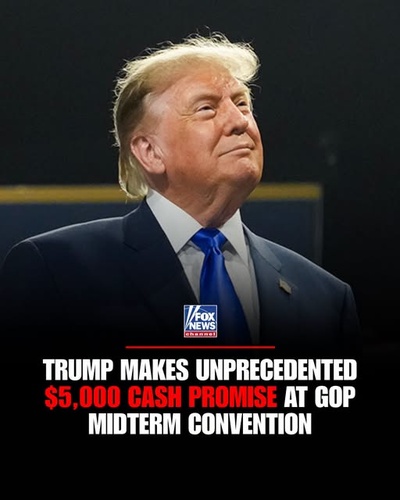
DALLAS — President Donald Trump has made an extraordinary election-year promise: a $5,000 “Trump Dividend” for American adults if Republicans retain control of both the House and Senate in the November 2026 midterm elections.
Trump announced the proposal during the Republican Party’s first-ever midterm convention in Dallas on September 9, putting a major cash payment at the center of the GOP’s campaign message.
“If the Republicans win, you win with us and you get $5,000,” Trump said, describing the payment as a dividend similar to a company distributing cash to its shareholders.
The proposal is not an approved federal payment. Trump has not provided a detailed mechanism for distributing the money, and the plan would likely require action by Congress.
A $1 Trillion-Plus Proposal
The scale of the proposed program would be enormous.
With roughly 270 million U.S. adults, analysts estimate that a $5,000 payment to every eligible adult could cost approximately $1.2 trillion to $1.35 trillion, before accounting for additional financing costs.
The White House has presented the proposal as a reward for Americans following what it describes as strong economic performance under Trump's administration. The White House said the payments would represent Americans sharing in the country's economic gains.
Trump also said the money would have to be spent inside the United States rather than overseas.
Republicans Are Already Divided
The proposal has received an unexpectedly mixed response within Trump's own party.
Some Republicans have embraced the idea as a way to energize voters ahead of the midterms. Ohio Sen. Bernie Moreno, for example, said he would work toward legislation to establish the dividend.
But other Republicans have raised serious concerns about the cost.
Rep. David Schweikert, an Arizona Republican, has warned that injecting such a large amount of money into the economy could fuel inflation, raise interest rates and worsen the country's fiscal position. Reuters reported that several Republicans expressed skepticism about the proposal.
The United States is already carrying more than $40 trillion in national debt, adding to questions about how the payments would be financed.
Would Congress Have to Approve It?
That remains one of the biggest unanswered questions.
Trump did not explain during his convention speech precisely where the money would come from or how the federal government would legally authorize the payments. Major news organizations and fiscal-policy experts have said congressional approval would likely be necessary.
Vice President JD Vance subsequently suggested that the program would primarily benefit the American middle class and that wealthy Americans would not necessarily receive the payment. That would reduce the overall cost but still leave a potentially trillion-dollar program.
The administration has not yet released a detailed eligibility formula, payment schedule or legislative proposal establishing the program.
A New Midterm Strategy for Trump
The announcement also illustrates how directly Trump is inserting himself into the 2026 congressional elections.
Although Trump is not personally running for president this year, he told convention attendees to treat the midterms as if he were on the ballot and framed Republican control of Congress as essential to his agenda.
The timing is significant. Republicans are defending their congressional majorities while facing concerns about inflation, the cost of living and Trump's political standing.
The $5,000 promise therefore goes beyond an economic proposal: it has become a highly visible part of Trump's effort to motivate Republican voters.
What the Graphic Gets Right — and What It Leaves Out
The uploaded graphic accurately captures the central announcement: Trump did make an unprecedented $5,000 cash-payment promise at the GOP's 2026 midterm convention.
However, the wording “$5,000 cash promise” should not be interpreted as meaning Americans have been approved to receive $5,000. As of September 11, 2026, the payment remains a conditional proposal, dependent on Republicans retaining both chambers of Congress and on the government establishing a mechanism to fund and authorize it.
The proposal is already generating debate over its cost, inflationary consequences, impact on the national debt and whether Congress would support it. Reuters reported that even some Republicans are skeptical.
Comments (0)
Loading comments...
May You Like

gfnhgmnghnmfgnbvvvvvvvvv


Barack Obama Draws Attention With New Literary Podcast












