Trump Pledges to Defend Christians and Americans of Faith ‘100%’ as White House Expands Religious Liberty Agenda
WASHINGTON — President Donald Trump has pledged to defend Christians and other Americans of faith while in the White House, placing religious liberty at the center of his administration's broader domestic agenda.
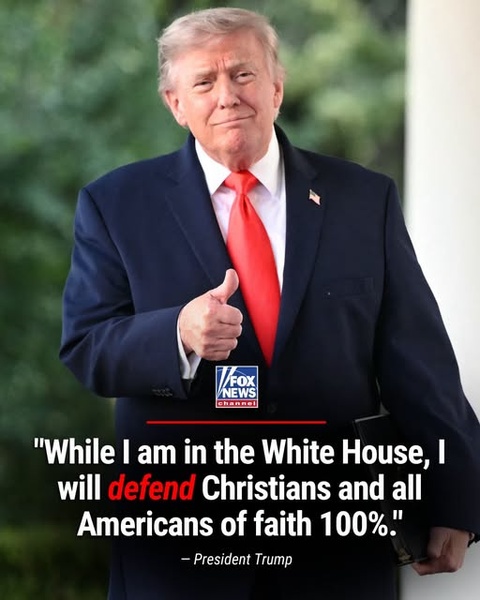
“While I am in the White House, I will defend Christians and all Americans of faith 100 percent,” Trump said during the Faith & Freedom Coalition's 2026 Policy Conference in Washington on June 26. The statement is accurately reproduced in the graphic provided.
Trump made the remarks while discussing his administration's efforts to promote religious freedom, including the creation of a White House Faith Office and a Presidential Religious Liberty Commission.
Trump Highlights Religious Liberty Initiatives
Speaking to a largely conservative Christian audience, Trump argued that religious freedom had been threatened under the previous administration and presented his own presidency as a reversal of those policies.
He pointed to several initiatives his administration has established, including the White House Faith Office, the Religious Liberty Commission and a Justice Department task force focused on alleged anti-Christian bias.
The White House says the Faith Office, established in February 2025, is the first West Wing office dedicated exclusively to advancing faith-related issues. The administration says its broader religious-liberty agenda is intended to protect Americans of all faiths.
Trump also said his administration had created a commission to examine threats to religious freedom and recommend policies to strengthen protections for religious believers.
Religious Liberty Commission Releases Sweeping Report
The president's comments came as the Religious Liberty Commission presented a 224-page draft report to him at the White House.
According to the Justice Department, Trump established the commission in 2025 to identify emerging threats to religious liberty, examine federal protections and develop strategies to protect the free exercise of religion. The commission held seven hearings and received testimony from more than 100 witnesses, according to the department.
The draft report calls for a stronger role for religious expression in American public life. Among its recommendations are changes involving religious expression in schools and government, faith-based organizations' access to public funding and the relationship between religious institutions and government.
One of its more controversial arguments is that Americans should seek to build “bridges” between church and state rather than emphasize a strict separation between the two.
Supporters Say Trump Is Protecting Religious Freedom
Trump and his administration argue that the policies are designed to protect constitutional religious liberty rather than establish a preferred religion.
The White House says the administration has taken steps to combat what it describes as anti-Christian and anti-religious bias, while establishing mechanisms intended to protect people of different faiths.
The administration has also highlighted its task force addressing alleged anti-Christian discrimination and an executive order targeting antisemitism.
At the Faith & Freedom Coalition event, Trump portrayed these measures as evidence that he was following through on his campaign promises to religious voters.
Critics Raise Church-State Concerns
Trump's approach, however, has drawn criticism from religious-liberty and civil-rights organizations that argue the administration's definition of religious freedom places too much emphasis on conservative Christianity.
The Associated Press reported that the commission was composed overwhelmingly of conservative Christians, while critics argued that its recommendations could weaken the traditional understanding of church-state separation and fail to adequately reflect America's religious diversity.
A coalition that included the Interfaith Alliance, Muslims for Progressive Values, the Sikh American Legal Defense and Education Fund and Hindus for Human Rights challenged the commission in federal court, arguing that its composition did not provide the balance required under the Federal Advisory Committee Act.
A federal judge dismissed that lawsuit in July, ruling that Trump had broad discretion in selecting the commission's members.
The Bigger Political Picture
Trump's emphasis on Christianity and religious liberty also reflects the importance of evangelical and other religious voters to the Republican coalition.
His administration has repeatedly connected religious freedom with broader issues including education, abortion, parental rights, free speech and cultural policy. The White House describes these policies as part of a wider effort to restore what it calls America's religious heritage.
At the same time, opponents argue that protecting religious liberty must apply equally to Christians, Jews, Muslims, Hindus, Sikhs, atheists and other Americans rather than giving one religious tradition a privileged role in government.
That debate is likely to continue as the administration implements recommendations from the Religious Liberty Commission and faces further legal and political challenges over the proper boundary between faith and government.
What the Viral Graphic Gets Right — and What It Leaves Out
The graphic correctly attributes the statement — “While I am in the White House, I will defend Christians and all Americans of faith 100%” — to Trump. The quote comes from his June 26, 2026 speech to the Faith & Freedom Coalition.
But the image leaves out important context:
- The statement was made at a Faith & Freedom Coalition conference, not during a formal White House address.
- Trump was discussing his administration's religious-liberty policies and initiatives.
- His administration has established a White House Faith Office and Religious Liberty Commission.
- The Religious Liberty Commission's draft report has advocated a more prominent role for religious expression in public life and a different approach to church-state relations.
- Critics have challenged the commission's ideological balance, although a federal judge dismissed the lawsuit challenging its composition.
In other words, the quote itself is genuine, but the graphic presents it without the broader political and constitutional debate surrounding Trump's religious-liberty agenda.
Comments (0)
Loading comments...
May You Like

Russian Drone Strikes Kyiv Bridge as German Chancellor Arrives in Ukraine
OBAMA STEPS BACK INTO THE POLITICAL SPOTLIGHT