
Trump Points Finger at Iran After Flydubai Attack as U.S.-Iran Diplomacy Hangs in the Balance
A dramatic aviation incident involving a Flydubai passenger jet has suddenly become entangled with the broader U.S.-Iran conflict after President Donald Trump suggested that Tehran may be connected to the attempted attack — even as investigators have not established an Iranian link.
The development comes at an especially sensitive moment. Iran has just received a U.S. response to its proposed seven-day confidence-building plan, while Qatar continues mediating between Washington and Tehran over the war, the Strait of Hormuz and Iran's nuclear program.
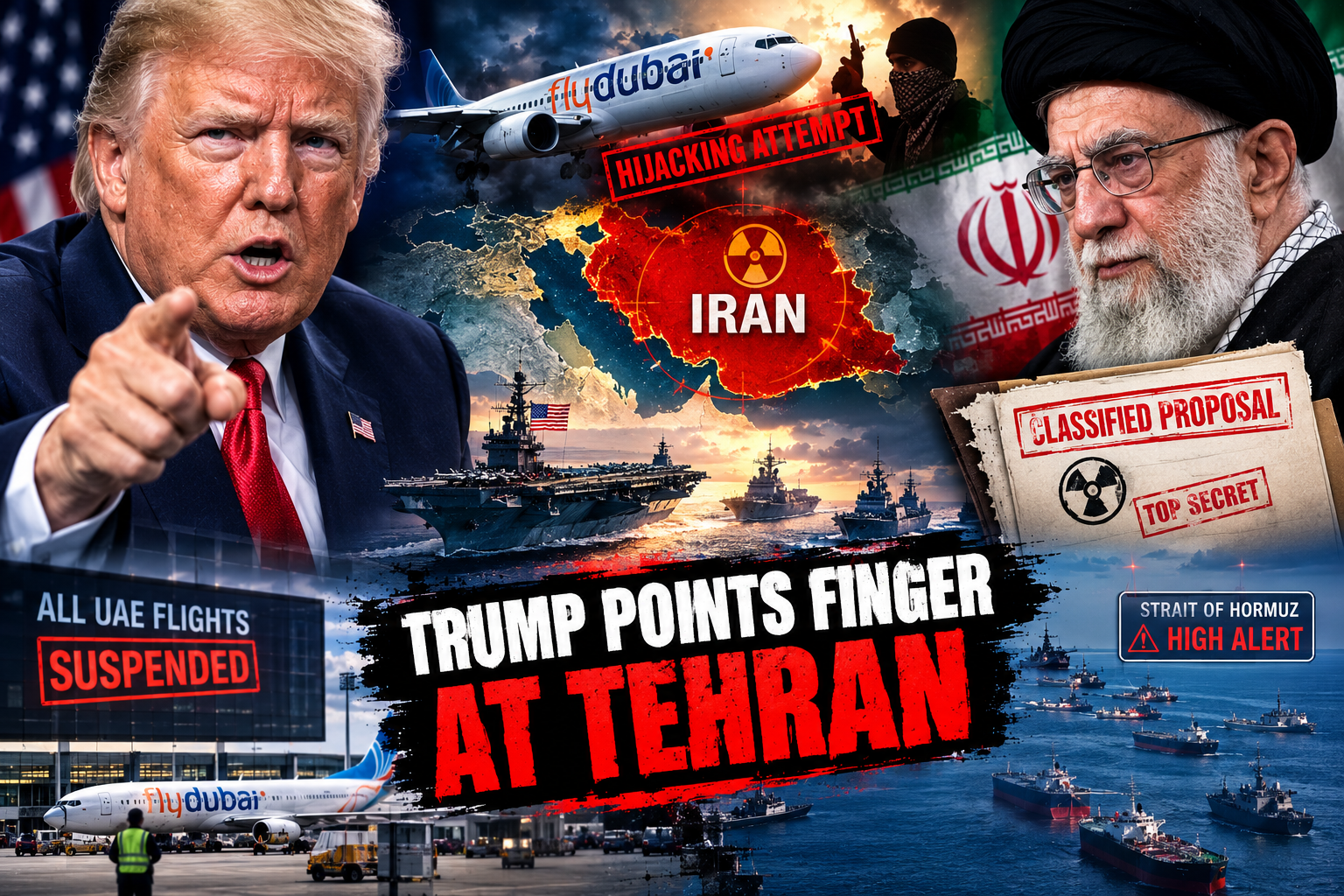
The supplied graphic captures the geopolitical tension, but several elements require important clarification.


What Happened Aboard the Flydubai Flight?
Flydubai Flight FZ1073 was traveling from Dubai to Tel Aviv on Sept. 30 when a violent confrontation erupted in the cockpit.
According to reporting from Reuters and the Associated Press, the co-pilot allegedly stabbed the captain and the aircraft subsequently entered a steep descent. Passengers and crew managed to enter the cockpit and subdue the attacker, while reserve crew members aboard the flight helped regain control of the aircraft. The plane eventually landed safely at Tabuk in Saudi Arabia.
The aircraft was carrying more than 170 people. Reuters reported that it descended approximately 14,000 feet in less than 30 seconds, underscoring how serious the emergency became.
Investigators are examining what caused the incident and whether it involved terrorism, prior planning or another motive.
The UAE has launched its own investigation and specifically said authorities would examine whether the incident was connected to terrorist activity or prior planning.
Trump Now Says Iran May Be Connected
On Oct. 1, Trump was asked whether the attacker had links to Iran.
His answer was considerably stronger than the evidence publicly available at the time.
“I would say the answer, based on what I'm hearing, is yes, but we're working on it right now.”
Trump did not provide details supporting the assertion. When asked whether the attacker might have been placed on the flight by Iran's Islamic Revolutionary Guard Corps or radicalized through another channel, Trump responded that it “could have been.”
Trump also warned that Iran would face severe consequences if Tehran were ultimately found to be responsible.
“They'll be hit very hard.”
That was a conditional threat, rather than an announcement that the United States had determined Iran was responsible.
Israeli Officials Have Been More Cautious
The difference between Trump's statement and the public position of Israeli officials is significant.
Prime Minister Benjamin Netanyahu said it was too early to determine whether Iran was behind the incident. Reuters reported that Netanyahu said investigators would seek to establish whether the attacker had accomplices and whether Iran was involved.
The UAE investigation is also still examining the circumstances and motive.
In other words, an Iranian connection has not been publicly established as of Oct. 2, 2026.
That makes the image's presentation of Iran as directly responsible premature.
Flydubai Has Suspended Israel Flights
There is also an important distinction between the graphic's claim that “ALL UAE FLIGHTS” were suspended and what actually happened.
Flydubai temporarily suspended all flights to and from Israel following the incident while authorities investigated.
That is not the same thing as the UAE shutting down all flights.
Separately, the UAE had already suspended flights operated by Iranian airlines beginning Sept. 24 as part of the implementation of U.S. sanctions on Iranian carriers. That decision predates the Flydubai incident.
So the viral graphic appears to merge two separate aviation developments:
- the Sept. 24 UAE suspension of Iranian airline operations; and
- the Sept. 30 Flydubai incident and subsequent suspension of Israel flights.
The Strait of Hormuz Is a Separate but Related Pressure Point
The aviation incident occurred while the Strait of Hormuz remained at the center of U.S.-Iran negotiations.
Iran recently proposed a seven-day confidence-building process under which the strait could be reopened and normal maritime traffic restored if certain conditions were met. Qatar has been carrying messages between Washington and Tehran.
On Sept. 30, Reuters reported that Iran had received U.S. feedback through Qatari mediators.
The document reportedly outlines a seven-day period designed to return the two sides to an enhanced version of a June memorandum of understanding, including concrete steps concerning Iran's nuclear program. According to the source, however, the principal disagreement is over the sequencing of those steps.
The precise contents of the U.S. response have not been publicly disclosed.
What the “Classified Proposal” Image Does Not Prove
The document shown in the supplied graphic is labeled “CLASSIFIED PROPOSAL” and “TOP SECRET.”
There is no public evidence establishing that the pictured document is an authentic copy of the U.S. response delivered to Iran.
Reuters has confirmed that a U.S. response exists, but reporting does not establish that the graphic's document is the actual text of that response.
That distinction is particularly important because the graphic presents the document as if its contents are already known.
They are not.
Trump Had Already Predicted a Rapid End to the War
The Flydubai incident comes only days after Trump said the U.S. would win the Iran war “very soon.”
Speaking from the Oval Office on Sept. 28, Trump said:
“We're going to win, as far as I'm concerned, it's going to be one way or the other.”
He also said the conflict would “go pretty quickly.”
Those comments came as mediators were continuing efforts to bring Washington and Tehran back toward negotiations.
But the latest developments demonstrate why the diplomatic situation remains unsettled: the two countries are simultaneously exchanging proposals while maintaining military pressure and preparing for the possibility of renewed escalation.
A New Aviation Incident Could Complicate That Diplomacy
The significance of Trump's Iran allegation therefore goes beyond the flight itself.
If investigators ultimately establish that Tehran or an Iranian-linked organization directed the attack, the incident could become another issue in the already tense confrontation between Washington and Tehran.
But if investigators conclude that the incident had another cause, Trump's preliminary allegation would remain unsubstantiated.
For now, authorities are still investigating.
The Associated Press reported that investigators from Saudi Arabia, the UAE, Israel, the United States and Oman are involved in efforts to determine the attacker's motive. Multiple possibilities remain under examination.
The Situation Is Moving on Two Tracks
The latest developments therefore show two parallel stories unfolding at the same time.
Track one is security: an alleged cockpit attack, an emergency landing, an investigation and Trump's warning that Iran would face a severe response if Tehran is found responsible.
Track two is diplomacy: Iran has received Washington's response to a seven-day confidence-building proposal, with Qatar continuing to mediate over the Strait of Hormuz and nuclear issues.
Whether the aviation investigation affects those negotiations remains uncertain.
For now, one fact is clear: the Flydubai incident has raised a serious new question about Iran's possible involvement, but investigators have not publicly established that connection.
And while the U.S. response to Iran's seven-day proposal has been delivered, its detailed contents remain undisclosed.
What the Viral Image Gets Right — and What It Leaves Out
Supported by current reporting:
- A Flydubai flight from Dubai to Tel Aviv experienced a serious cockpit incident.
- The co-pilot allegedly attacked the captain.
- Passengers and crew intervened.
- The aircraft landed safely in Saudi Arabia.
- Flydubai suspended Israel flights while the investigation continued.
- Trump has publicly suggested that Iran may be connected.
- Trump threatened a severe response if Iran is proven responsible.
- Iran has received a U.S. response to its seven-day proposal.
- Qatar is continuing to mediate between Washington and Tehran.
Not established by current evidence:
- That Iran ordered or organized the Flydubai attack.
- That the attacker was an Iranian agent.
- That the incident has been officially classified as an Iranian operation.
- That all UAE flights were suspended.
- That the “TOP SECRET” document shown in the graphic is the actual U.S. response.
- That the contents of Washington's response are publicly known.
The next major development could therefore come from either side: the investigators examining the Flydubai attack or the diplomats negotiating the seven-day U.S.-Iran framework.
Comments (0)
Loading comments...
May You Like

Shocking news from Ohio: an unexpected development ahead of Trump's rally

Jack Smith Defends His Integrity as Trump Investigations Face Renewed Political Firestorm

Barack Obama Draws Attention With New Literary Podcast













