
Trump Promises $45 Billion in Savings by Ending Biden-Era Methane Rule
Trump Promises $45 Billion in Savings by Ending Biden-Era Methane Rule
The president says rolling back methane restrictions will lower costs and expand energy production. The headline figure is an administration estimate, while the rule’s supporters point to projected climate and public-health benefits.
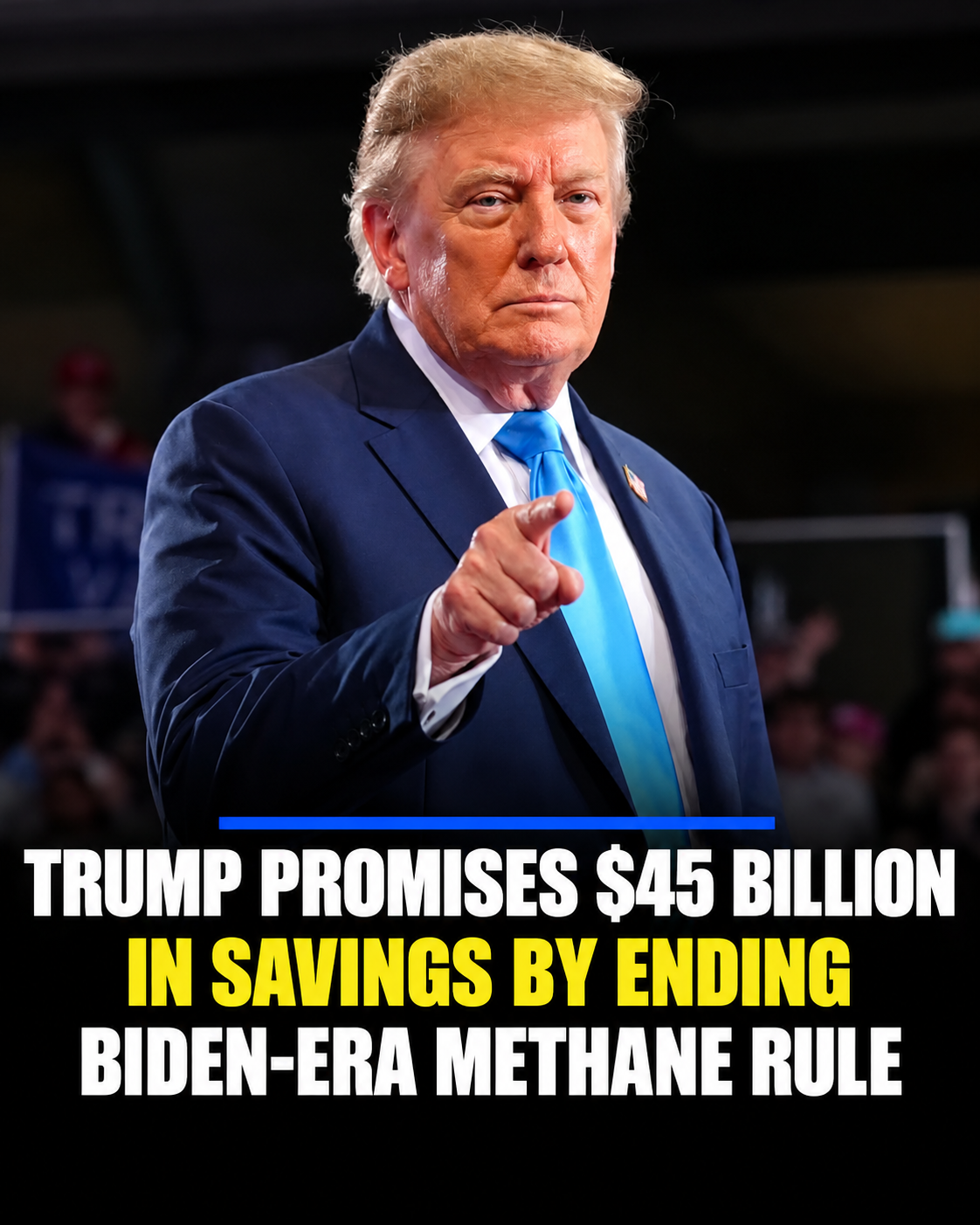
President Donald Trump has put a striking price tag on his plan to roll back a major federal methane rule: $45 billion in savings for consumers and energy producers. He announced the move at a campaign rally in Lubbock, Texas, on October 27, 2026, presenting deregulation as a way to expand domestic energy production and lower costs.
The announcement concerns a Biden-era Environmental Protection Agency rule designed to reduce methane pollution from oil and natural gas operations. Methane is the main component of natural gas, so leaks are not only an environmental problem: they can also represent fuel that companies extract but fail to sell.
Trump framed the rollback as a direct economic win. Alongside the $45 billion figure, he said loosening the restrictions would unlock 210 million barrels of oil. The Associated Press noted that amount is roughly equivalent to ten days of U.S. petroleum consumption, a comparison that helps put the production claim into perspective.
The headline figure, however, should be read as an administration estimate rather than money already saved or a guaranteed reduction in household bills. Regulatory cost estimates depend on assumptions about compliance spending, energy markets, the timing of investment, and the value assigned to health and environmental effects.
The Biden administration’s 2024 methane rule sought to curb leaks at both new and existing oil and gas facilities. It required operators to find and repair leaks, expanded oversight of smaller wells, and established measures for responding to unusually large releases. Those provisions were intended to address emissions that older rules did not cover as comprehensively.

Federal officials under Biden estimated that the rule would prevent about 58 million tons of methane emissions by 2038. They also projected approximately $98 billion in benefits by 2034, including benefits associated with climate impacts and public health. Those estimates use a different accounting approach from the Trump administration’s cost-saving claim, so the figures should not be compared as if they were identical measures.
Trump’s Environmental Protection Agency, led by Administrator Lee Zeldin, has argued that the requirements impose substantial costs on energy producers and limit domestic energy potential. The administration has described the rules as burdensome and says removing them will encourage production. Those arguments are central to its broader campaign to reverse climate regulations adopted under the previous administration.
A key question is what the $45 billion estimate includes. The administration has contrasted projected savings from the rollback with costs it says companies would face under the existing rule. Such a comparison can be useful, but it does not by itself establish the net effect on society unless avoided compliance costs and lost environmental or health benefits are assessed on a consistent basis.
The rule also addresses a practical feature of oil and gas production: methane leaks can be difficult to see without specialized equipment. Routine inspections and repairs can capture gas that might otherwise escape into the atmosphere. Industry groups may see those requirements as added expense, while supporters argue that recovered gas can offset some of the cost of detecting and fixing leaks.
Methane matters because it traps much more heat than carbon dioxide over shorter periods, although it remains in the atmosphere for less time. Scientists estimate that methane contributes roughly a third of current global warming. Reducing leaks from oil and gas systems is therefore often treated as one of the faster ways to slow the pace of near-term warming.

The economic effects will not be distributed evenly. Producers with older equipment or many small wells may face different compliance costs from large companies with modern infrastructure. Consumers, meanwhile, do not automatically receive savings from lower regulatory costs; whether prices fall depends on competition, supply, demand, transport costs, and conditions in energy markets.
The political timing is also important. Trump announced the change during a midterm campaign appearance as his administration faced criticism over high fuel prices amid the U.S. war with Iran. The promise connects energy deregulation with a familiar political message: increasing domestic supply is presented as a route to affordability and energy security.
But additional oil or gas production does not necessarily translate into an immediate drop in gasoline prices. Oil is traded in global markets, and prices can be shaped by geopolitical risk, refinery capacity, transportation bottlenecks, and decisions by producers at home and abroad. The 210-million-barrel figure is a potential production claim, not a guarantee about when or how much consumers will save at the pump.
Another issue is enforcement. The Biden rule included a Super Emitter Program designed to identify major methane releases and prompt operators to investigate and address them. The Trump administration has said it intends to eliminate that program and relax certain standards, including requirements affecting smaller wells. Critics warn that reducing monitoring can make it harder to detect large leaks quickly.
Supporters of the rollback argue that energy companies should not be forced to spend money on rules they consider inefficient, particularly when the United States is trying to increase supply. They contend that the regulatory burden can discourage investment, make marginal wells uneconomic, and divert resources from production. Those concerns deserve to be evaluated against evidence about actual costs and performance.

Environmental and public-health advocates take the opposite view. They argue that methane leaks waste a valuable product while worsening climate change, and that oil and gas pollution can occur near communities where people live, work, and attend school. They warn that weaker requirements may shift costs away from companies’ balance sheets but leave some of the consequences to the public.
The disagreement is partly about how government should measure a regulation’s value. Compliance spending is visible to companies and can be estimated directly. Benefits such as reduced climate damage, fewer harmful co-pollutants, and better detection of leaks are harder to translate into a single dollar figure, but difficulty measuring them does not mean they are zero.
The rollback’s legal and administrative details will matter as well. A public announcement at a rally is not the same thing as a complete regulatory record. The exact scope, implementation schedule, and legal durability of changes depend on formal agency actions and the rules that remain in effect while those actions proceed.
For that reason, readers should distinguish the political promise from the eventual results. Independent analysis will need to examine the final regulatory text, the assumptions behind the $45 billion estimate, the effect on methane emissions, and whether energy prices or production change in ways that can be attributed to the policy rather than broader market forces.
Trump’s methane announcement captures a larger argument over American energy policy: should the federal government prioritize lower compliance costs and expanded fossil-fuel production, or retain stronger pollution controls to reduce climate and health risks? The $45 billion figure is the administration’s headline case for deregulation. Whether it represents a net public benefit will depend on the full accounting of costs, savings, emissions, and consequences over time.
Comments (0)
Loading comments...
May You Like

WEYMOUTH HORROR — FIRE TRUCK BRAKES TO SAVE DOG, ONE FIREFIGHTER DEAD, TWO CRITICAL!

MINNESOTA NIGHTMARE—UNDERGROUND GAS LEAK, HUNDREDS OF HOMES AT RISK, $300M DAMAGE!










Popular Posts




