
Trump proposes bill to prevent future presidents from reversing his border policies
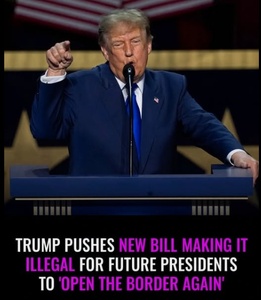
DALLAS — President Donald Trump announced a proposed bill called the “No Invasion of Our Country Act”, saying it would make it legally difficult for future presidents to reverse his administration’s current border-enforcement policies.
Trump unveiled the proposal during a speech at the Republican midterm convention in Dallas on September 9, saying the legislation would prevent a future president from reopening the southern border.
The proposal comes as Trump continues making immigration enforcement a central issue of his second administration and as Republicans campaign ahead of the November 3, 2026, midterm elections.
Trump said the legislation would seek to make it “legally impossible” for a future president to reverse the border restrictions currently implemented by his administration.
However, it remained unclear whether Congress would take up the proposal before the midterm elections. Several other major Republican-backed measures, including voting legislation, had also not completed the congressional process at the time of the announcement.
Background on the border policies
The proposal follows a major reversal in immigration policy between the Biden and Trump administrations.
During Trump’s first term, his administration implemented measures aimed at restricting immigration at the southern border. After taking office in 2021, President Joe Biden reversed or modified several of those policies.
Trump returned to the White House in January 2025 and again introduced stricter border-enforcement measures, including policies focused on detention and deportation of migrants who enter the country illegally.
Republicans have repeatedly criticized Biden-era immigration policies, particularly the release of some asylum seekers into the United States while their immigration cases were pending.
Trump has argued that those policies contributed to increased illegal immigration and border insecurity.
Border arrests fall sharply
According to figures cited by the New York Post, daily arrests at the southern border have fallen by more than 90% under Trump’s second administration.
The administration has also said that migrants apprehended at the border are no longer being routinely released into the United States under the current enforcement approach.
Trump and congressional Republicans have subsequently supported additional funding for border-wall construction and federal immigration enforcement.
The Republican-controlled Congress also passed significant funding through budget legislation for immigration enforcement and border-security programs.
The Laken Riley Act
The article also highlights the Laken Riley Act, which became the first legislation Trump signed during his second presidential term.
The law was named after Laken Riley, a Georgia nursing student who was killed by a Venezuelan national who had entered the United States illegally.
The legislation requires federal authorities to detain certain noncitizens who are arrested or charged with specified crimes, including burglary, theft and assaults against law-enforcement officers.
What remains uncertain
Trump's proposed legislation would represent a significant attempt to restrict the ability of future administrations to change federal immigration policy.
However, presidents generally have substantial authority over immigration enforcement, while Congress controls statutory law. The precise legal mechanism and constitutional limits of Trump's proposal would therefore be important if legislation is formally introduced.
The article does not establish that the proposed bill had already become law. At the time of publication, it remained a proposal whose prospects in Congress were uncertain.
Comments (0)
Loading comments...
May You Like

FIGHT OVER OBAMA’S IRAN POLICY

South Korea–Ukraine Rift Deepens Over North Korean POW Transfer as PURL Draws New Scrutiny

Shocking news from Ohio: an unexpected development ahead of Trump's rally












