
Trump Pushes for Law That Would Make It Harder for Future
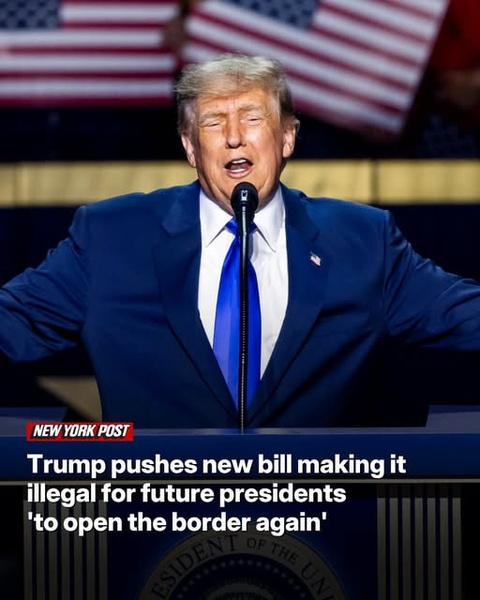
DALLAS — President Donald Trump is escalating his immigration agenda ahead of the 2026 midterm elections, calling for legislation that would make it legally difficult for any future president to reverse his border policies and “open the border again.”
Speaking at the Republican Party’s first-ever midterm convention in Dallas, Trump said Republicans should pass what he described as the “No Invasion of Our Country Act.” He argued that the legislation would prevent a future administration from dismantling the restrictions his administration has imposed at the U.S.-Mexico border.
“We will make it legally impossible for any future president to destroy our country by having the right to open the border again,” Trump said, according to reports from the convention.
The proposal adds another major immigration issue to a Republican midterm campaign that has increasingly centered on Trump's record and his vision for a long-term transformation of federal immigration policy.
Trump Wants His Border Policies to Outlast His Presidency
Trump's central argument is that executive actions can be reversed by the next president.
During his first term, Trump implemented aggressive restrictions on asylum, immigration and border crossings. Many of those policies were subsequently modified or reversed under President Joe Biden. Trump has repeatedly pointed to that reversal as evidence that immigration policy cannot depend solely on who occupies the White House.
That argument is already reflected in legislation moving through Congress.
Rep. Chip Roy, a Texas Republican, introduced H.R. 9773, the Permanent Trump Secure Border Act, in July. The bill was referred to the House Judiciary and Foreign Affairs committees and was reported favorably by the Judiciary Committee on a 16-14 vote.
The legislation seeks to codify many of the Trump administration's immigration policies into federal law rather than leaving them dependent on presidential executive orders.
Among other provisions, the measure addresses asylum eligibility, detention, immigration parole and other areas of immigration enforcement. At its July committee hearing, Republicans explicitly argued that Congress should ensure that future presidents cannot simply reverse the administration's border policies through executive action.
The Viral Headline Needs One Important Correction
The New York Post graphic describes Trump's announcement as a “new bill” that would make it illegal for future presidents “to open the border again.”
That wording captures Trump's stated objective, but it should not be interpreted to mean that such a law has already been enacted — or even that Congress has already passed a bill formally titled the “No Invasion of Our Country Act.”
As of Sept. 10, 2026, Trump was calling for the legislation, while the more concrete congressional measure already on the books is H.R. 9773, the Permanent Trump Secure Border Act. The House Judiciary Committee has advanced that bill, but it still faces further congressional action.
The New York Post also reported that it remains uncertain whether Trump's proposed legislation could move through Congress before the Nov. 3 midterms.
What the Permanent Border Bill Would Do
H.R. 9773 is considerably more detailed than Trump's brief convention description.
The legislation would permanently codify a range of Trump administration immigration policies, including tighter asylum rules and restrictions on parole. During the Judiciary Committee debate, Republicans described the measure as an effort to close statutory loopholes that they believe allowed the Biden administration to pursue a substantially different immigration strategy.
The bill's supporters argue that presidential administrations should not be able to dramatically alter border enforcement simply through executive action.
Democrats have strongly challenged that characterization, arguing that the United States did not literally have an “open border” under Biden and warning that Trump's approach could undermine asylum protections and impose sweeping restrictions on migrants and vulnerable families. The committee record shows Democratic members raised concerns about detention conditions, asylum restrictions and the treatment of migrants.
Trump Administration Says the Border Has Been Transformed
The White House has made border security one of the central achievements it wants voters to associate with Trump's second presidency.
In a Sept. 9 statement, the administration claimed that illegal immigration had fallen dramatically under Trump, pointing to reduced crossings, deportations and increased enforcement resources. The White House also highlighted the Secure America Act and other immigration legislation as evidence that Trump's policies are becoming embedded in federal law.
Those figures and descriptions are presented by the administration as evidence of a historic border turnaround and should be understood as White House claims, rather than independent assessments of every aspect of the immigration system.
Still, the broader political direction is clear: Trump wants the immigration policies of his second term to survive beyond his own presidency.
A Constitutional and Political Question
Trump cannot personally prevent a future president from changing immigration policy.
If Congress passes a law establishing immigration requirements, however, a future administration would generally have to operate within those statutory limits unless Congress changes the law or courts invalidate relevant provisions.
That distinction is crucial.
A future president would still retain significant authority over immigration enforcement, foreign affairs and the administration of federal law. The precise ability of any statute to prevent a future president from “opening the border” would therefore depend on the language Congress ultimately adopts, the scope of executive authority and how courts interpret the law.
In other words, Trump's rhetoric describes a goal of making his border strategy permanent, but the legal reality would be considerably more complicated.
Immigration Becomes a Major 2026 Election Issue
The proposal arrives as Republicans prepare for a difficult midterm campaign in which control of Congress is at stake.
Trump has made clear that he wants the November election to function as a referendum on his presidency. At the GOP convention, he urged Republican voters to treat the election as though he himself were on the ballot.
The border is likely to remain one of the party's strongest mobilizing issues.
Republicans argue that Trump's policies have restored order after what they describe as years of uncontrolled immigration. Democrats counter that the administration's approach has gone too far, particularly on asylum, deportation and detention.
The battle is therefore no longer simply about how Trump wants the border managed during his presidency.
He is now seeking to make his immigration philosophy part of federal law — and to make it much harder for the next president to undo.
Comments (0)
Loading comments...
May You Like


gfnhgmnghnmfgnbvvvvvvvvv
OBAMA STEPS BACK INTO THE POLITICAL SPOTLIGHT













