Trump Pushes New Bill to Make It "Illegal" for Future Presidents to Reopen the Border — But Can a Law Actually Do That?
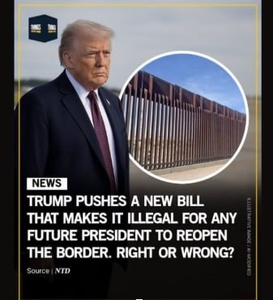
A viral graphic circulating on social media shows President Donald Trump with a photo of the border wall and the headline: "Trump pushes a new bill that makes it illegal for any future president to reopen the border. Right or wrong?" The post has sparked intense debate — but the central question is not whether one supports the policy. It is whether any Congress can actually bind a future Congress.
The graphic appears in multiple forms online, from political news accounts to social media posts, and consistently attributes the proposal to the source NTD. According to reports, Trump announced the idea at a Republican convention in September and called it the "No Invasion of Our Country Act" .
The proposal is designed to prevent a future president from reversing the border policies Trump has put in place. It would seek to make it illegal for any future administration to "open the border again" .
What the Bill Would Do
The first half of the proposal is standard: Congress writes immigration law all the time. That is the ordinary business of the legislative branch .
The second half is where the controversy lies. The bill is designed to lock in Trump's border policies permanently — meaning a future president could not undo them.
The proposal would establish strict rules for who may enter the country, claim asylum, or receive an exception. It would codify the current border enforcement regime into federal law .
The Legal Problem: Can a Law Bind a Future Congress?
The answer is no. A later Congress can change or scrap any law a previous Congress passed, and no wording can change that. Permanence is the one thing a law cannot promise .
This is a foundational principle of constitutional law. The current Congress cannot bind a future Congress. Immigration law is especially susceptible to this dynamic, since border enforcement is inherently an executive function — presidents have broad discretion in how they enforce immigration laws.
Even if the bill passes and is signed into law, a future president could decline to enforce its provisions, or a future Congress could simply repeal it.
The Practical Reality: The $46 Billion "Smart Wall"
While the legal debate over the bill continues, the Trump administration is already racing ahead with construction of a $46 billion "smart wall" along the U.S.-Mexico border .
The project includes advanced surveillance technology, sensors, and physical barriers. The administration has framed the spending as essential to national security and border enforcement.
However, reports note that past border wall construction during Trump's first term largely replaced barriers installed by previous administrations rather than adding significant new mileage. Only about a third of the U.S.-Mexico border had barriers, and that percentage had not increased significantly during Trump's first presidency .
What Supporters and Critics Are Saying
Supporters argue that the proposal is necessary to prevent future presidents from reversing Trump's immigration policies. One commenter wrote: "That's a GREAT IDEA! I hope he can get it done, so the Dems can't fill their weakened party. That's why they want open borders!" .
Critics argue that no generation of voters should be governed by the preferences of a past one. One commenter put it bluntly: "No. Nobody should have the power to control the policies of future generations of leaders from the grave" .
Others noted that the proposal raises more questions than it answers: "What would the law actually require? Who could enter the country, claim asylum, or receive an exception? And what would happen if circumstances changed after Trump left office?" .
Comments (0)
Loading comments...
May You Like