
Trump Pushes New Bill to Make It Illegal for Any Future President to Reopen the Border — Right or Wrong?
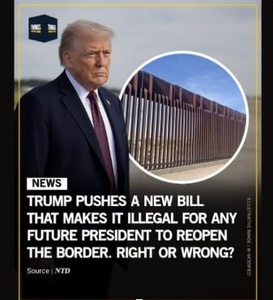
A viral graphic circulating on social media asks a provocative question: Should Congress pass a law that would permanently lock in President Trump's border policies — and prevent any future president from reversing them? The answer, according to the actual legislation now moving through the House, is more complicated than a simple yes or no.
WASHINGTON – President Donald Trump is pushing Congress to pass legislation that would make it illegal for any future president to reopen the U.S.-Mexico border, a move that has sparked fierce debate over executive power, immigration policy, and the limits of one administration's ability to bind its successors.
The proposal — introduced as H.R. 9773, the Permanent Trump Secure Border Act — would enshrine several Trump-era asylum and border enforcement policies into federal law, making them far harder for a future president to undo through executive action alone .
The House Judiciary Committee reported the bill favorably, as amended, on July 21, 2026, by a narrow 16-14 vote . But the bill has not become law — and whether it ever will remains an open question.
What the Bill Actually Does — and Doesn't Do
Despite the viral claim that the bill would make it "illegal for any future president to reopen the border," the reality is more nuanced.
According to GovInfo, the bill was introduced in the House on July 20, 2026. If enacted, it would put several asylum and border policies into federal statute. This means a future president could not simply erase its requirements through an executive order alone — they would need Congress to repeal or amend the law .
However, the bill has not been passed by the full House, let alone the Senate. And even if it became law, a future Congress could still repeal it with a simple majority vote. The legislation would make it harder to reverse Trump's border policies — but not impossible .
A Campaign Promise, Not Yet a Law
Trump first announced the idea at a Republican convention in September 2026, calling it the "No Invasion of Our Country Act" . The proposal was framed as a way to "stop a future president from opening the border again" .
But as analysts have pointed out, the details matter enormously. Key questions remain unanswered:
-
What specific restrictions would the bill create?
How would it affect legal immigration, asylum claims, and humanitarian protections?
Would it allow exceptions under certain circumstances?
How much flexibility would future administrations have to respond to changing conditions?
As one analysis put it: "Legislation is ultimately defined by its language, not its slogan. Before lawmakers or voters decide whether to support or oppose the idea, they should have the opportunity to examine the bill's actual provisions and understand how it would operate" .
The Debate: Security vs. Executive Power
The proposal has ignited a fierce debate online, with thousands of comments on social media posts about the bill.
Supporters argue that the legislation is necessary to protect national security gains and prevent a future administration from undoing years of work. "This is definitely much needed legislation," one commenter wrote. "We don't want some future brainless [president] to simply wave his or her hand and reverse all the hard work that President Trump has done for this nation" .
Critics counter that the bill represents an unprecedented attempt by one president to bind his successors. "No. Nobody should have the power to control the policies of future generations of leaders from the grave," one commenter wrote. "The process should stay in line with the process driven by the three branches of government per the Constitution" .
Others pointed out the practical reality: even if the bill passes, "the Dems can repeal it" when they regain power .
Legal scholars have also raised questions about whether Congress even has the constitutional authority to limit the executive branch's future immigration powers in this way .
The Numbers Behind the Policy
The debate over the bill comes as the Trump administration races ahead with its $46 billion "smart wall" along the U.S.-Mexico border . The project represents a massive investment in physical border infrastructure, complementing the legislative effort to lock in policy changes.
Trump has framed the push as essential to national security, arguing that without statutory protections, his border policies could be erased "with the stroke of a pen" by a future president.
Comments (0)
Loading comments...
May You Like

Shocking news from Ohio: an unexpected development ahead of Trump's rally

Shocking news from Ohio: an unexpected development ahead of Trump's rally

Jack Smith Defends His Integrity as Trump Investigations Face Renewed Political Firestorm













