
Trump Questions Brazil’s Election Without Evidence After Lula Defeats Bolsonaro
October 29, 2026 | Brasília, Brazil, and Washington, D.C. | International Politics & Democracy
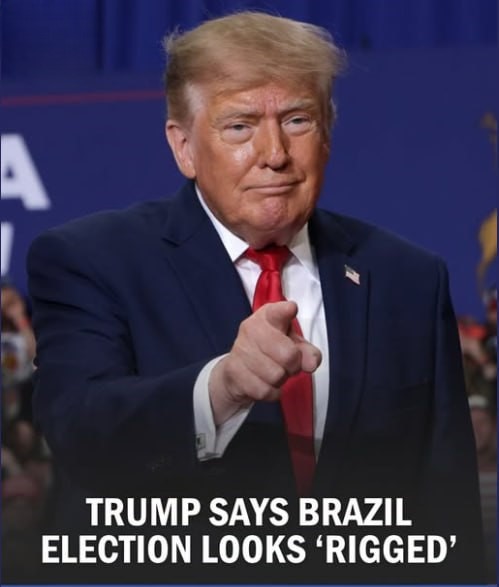
U.S. President Donald Trump has questioned the legitimacy of Brazil’s presidential election, calling the vote “another rigged election” after incumbent Luiz Inácio Lula da Silva defeated right-wing senator Flávio Bolsonaro in the October 25 runoff. Trump offered no evidence to substantiate the allegation, according to Reuters and other news organizations.
The image accurately captures the central claim, but its headline does not establish that the election was fraudulent. Trump’s comments have intensified political tensions around a closely contested result and renewed questions about how leaders respond when their preferred candidates lose.
What Trump Said About the Vote
On October 26, reporters asked Trump whether Brazil’s election had been fair. He said he had not taken sides, but described the result as looking like “another rigged election” and said elections should be beyond dispute.
Trump also criticized the way the vote had been tabulated and questioned a decision to extend voting hours in some locations. He said he liked Lula and had a good relationship with the Brazilian president, while maintaining that the election had created a troubling impression.
The president did not present evidence of manipulated ballots, altered vote totals or a coordinated effort to falsify the result. His public remarks expressed suspicion about the process rather than documenting specific acts of election fraud.
The distinction is important: questioning an election is not the same as proving it was stolen. Establishing fraud requires verifiable evidence, such as documented irregularities, audit findings or judicial determinations that materially affect the result.
A Narrow Election and a Contentious Aftermath
Lula won the runoff with 51.79% of valid votes, compared with 48.21% for Flávio Bolsonaro, according to reported results. The close margin reflected a deeply polarized electorate and a competitive contest between Brazil’s left and right.
Flávio Bolsonaro, the son of former president Jair Bolsonaro, initially refused to concede defeat and called for Lula’s victory to be annulled. His response added to uncertainty in the immediate aftermath, although a candidate’s refusal to concede does not itself invalidate an election.
The dispute also carries a personal and political dimension. Jair Bolsonaro was a close ally of Trump during his presidency, and Trump has maintained ties with the Bolsonaro family. Flávio’s candidacy consequently attracted attention from conservative political movements beyond Brazil.
Why Voting Hours Became a Point of Dispute
Trump questioned an extension of voting hours in some areas. Brazilian authorities extended voting at certain polling locations where public transportation problems delayed voters, rather than changing the rules uniformly after voting had ended. Reports indicate that the measure applied to polling places that were still open.
Election officials face the challenge of balancing orderly administration with the right to vote. Extending hours in locations where access has been disrupted can be intended to help eligible voters cast ballots, but decisions must be applied under established rules and transparently documented.
Brazil’s electoral system provides public access to official results and election records. The country’s Superior Electoral Court publishes vote totals and information that allows the public to examine the tabulation process, including records from individual polling sections.
These mechanisms provide a basis for evaluating claims of irregularities. Any credible allegation should be assessed against the official records and relevant evidence, rather than accepted solely because a political leader says the result looked suspicious.
The Wider Political Implications
Trump’s comments come amid a broader shift in Latin American politics, where his administration has welcomed several recent victories by right-wing candidates. His criticism of Brazil’s result contrasts with that broader political narrative and has drawn attention to his relationship with conservative allies in the region.
For Brazil, the immediate challenge is to preserve public confidence in the electoral process while allowing legitimate complaints to be examined through established legal channels. Unsupported claims of fraud can deepen divisions and weaken trust, particularly when repeated by influential international figures.
For the United States, the episode highlights the diplomatic consequences of a president publicly questioning another country’s election without presenting supporting evidence. Brazil and the United States have substantial economic and strategic ties, making the tone of their political relationship consequential beyond the campaign itself.
What Is Verified—and What Is Not
The verified facts are that Trump described Brazil’s election as apparently rigged, Lula won the runoff, and Flávio Bolsonaro disputed the outcome. Trump did not publicly provide evidence demonstrating that fraud changed the result.
The allegation that the election was rigged remains unsubstantiated in the reporting reviewed for this article. That does not mean every administrative decision is beyond scrutiny; it means claims of fraud must be tested against evidence and official records.
The bottom line: The image reflects genuine comments by Trump on October 26, 2026, but it should not be interpreted as proof of election fraud. Brazil’s result and any allegations about the voting process must be judged on documented evidence, not political assertions.
Comments (0)
Loading comments...
May You Like

STAR DIED AT 38, $10M LIFE INSURANCE INCREASED JUST 30 DAYS BEFORE WWE BRONSON REED'S DEATH!

DAVENPORT AIRBNB HORROR — 40 OF 50 TEENS TEST POSITIVE FOR DRUGS SUPPLIED BY THE HOST'S MOM!










Popular Posts




