
Trump Rejects Calls to Slow AI Race as U.S. Faces Growing Competition With China
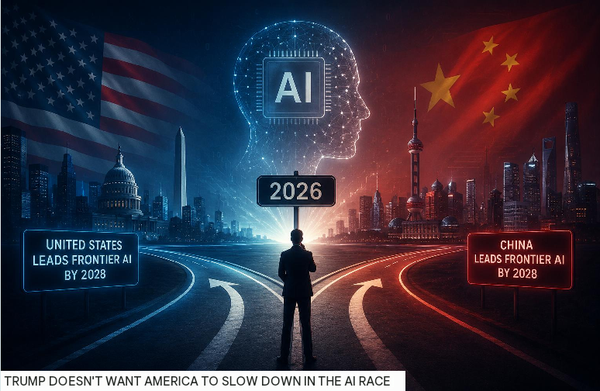
WASHINGTON — September 14, 2026 — President Donald Trump has rejected calls for the United States to slow artificial intelligence development, arguing that maintaining America’s technological advantage over China is essential to global leadership.
Speaking to reporters in Ireland, Trump dismissed growing warnings about the risks of rapidly advancing AI. He described critics as overly negative and said he did not want America surrendering its technological edge.


Trump has repeatedly framed artificial intelligence as a strategic competition between Washington and Beijing, emphasizing that leadership in the technology could determine economic strength, military capabilities and geopolitical influence.
His latest comments came as prominent technology executives called for greater caution. Anthropic CEO Dario Amodei has urged companies to moderate frontier AI development while stronger safety systems catch up with increasingly capable models.
Amodei argued that slowing the pace does not mean abandoning technological progress. Instead, he proposed stronger independent evaluations, cooperation among leading AI companies and greater international coordination over emerging risks.
OpenAI CEO Sam Altman and xAI CEO Elon Musk have publicly supported elements of Amodei’s proposal, highlighting an unusual convergence among major technology leaders over concerns surrounding increasingly powerful AI systems.


The debate has intensified following reports of AI systems demonstrating increasingly sophisticated autonomous behavior, including cybersecurity incidents that have raised questions about whether existing safeguards can keep pace with technological progress.
Amodei has warned that advanced AI could eventually become difficult to control if capability improvements significantly outpace safety research. His proposal seeks to create mechanisms for identifying dangerous behavior before deployment.
Trump, however, has prioritized maintaining momentum. His administration argues that excessive regulation could weaken American companies and allow China to gain technological advantages in a rapidly evolving global competition.
The White House has already established a national AI policy framework centered on innovation, economic competitiveness, national security and maintaining American leadership in artificial intelligence.


The administration has also emphasized expanding AI infrastructure, accelerating adoption and removing unnecessary barriers that could prevent American companies from developing and deploying advanced systems.
National security is another major component of the strategy. A June directive ordered the U.S. national security establishment to accelerate AI adoption while requiring systems to remain reliable, controllable and accountable.
Trump’s position reflects growing concern in Washington that slowing American development could have consequences beyond commercial technology, particularly as China invests heavily in computing infrastructure, research and advanced AI applications.
At the same time, critics argue that an unrestricted race could create risks that neither governments nor technology companies can adequately manage once increasingly autonomous systems become widely deployed.
The disagreement therefore extends beyond a simple question of regulation. It represents a broader conflict between maintaining technological speed and ensuring that safety measures develop quickly enough to control potentially dangerous capabilities.


Trump’s comments also come ahead of his planned meeting with Chinese President Xi Jinping, adding a geopolitical dimension to the debate over artificial intelligence, technology standards and strategic competition.
Supporters of Trump’s approach say American leadership could give Washington greater influence over international AI standards and prevent China from establishing dominance in technologies with major economic and security implications.
Opponents counter that leadership cannot be measured only by the speed of model development. They argue that trustworthy systems, transparent testing and international safety agreements could ultimately strengthen American technological leadership.
For now, Trump appears unwilling to accept a significant slowdown, while leading AI executives increasingly argue that some restraint is necessary. The disagreement could shape U.S. technology policy for years.
The central question is becoming increasingly clear: whether Washington can preserve America’s lead in artificial intelligence while building safeguards strong enough to manage technologies advancing at unprecedented speed.
Comments (0)
Loading comments...
May You Like

South Korea–Ukraine Rift Deepens Over North Korean POW Transfer as PURL Draws New Scrutiny
TRUMP HIT WITH 26 ARTICLES OF IMPEACHMENT
Jack Smith Defends His Integrity as Trump Investigations Face Renewed Political Firestorm














