Trump Rejects Democratic $1.5 Trillion Spending Demand as Healthcare and Immigration Fuel Shutdown Fight
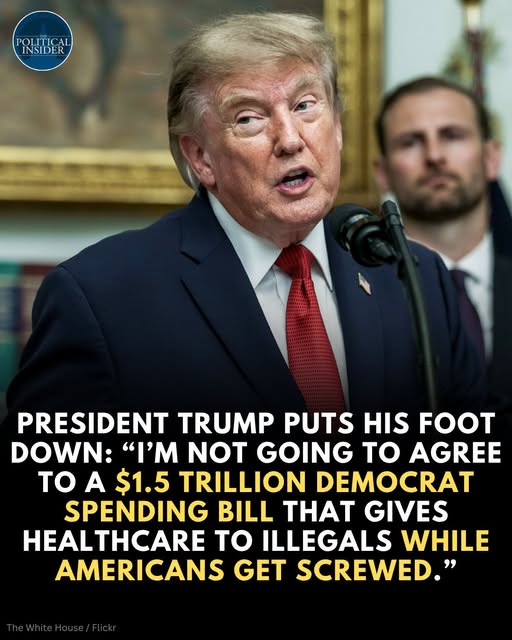
WASHINGTON — President Donald Trump sharply rejected a Democratic spending proposal during the 2025 U.S. government shutdown, accusing Democrats of seeking roughly $1.5 trillion in new spending that he said would provide healthcare to undocumented immigrants while leaving American citizens to bear the cost.
The claim, echoed widely on social media and in political messaging, became a central talking point in the partisan battle over federal funding. But the figure and the healthcare allegation require important context: the $1.5 trillion referred to the overall cost of the Democratic proposal over 10 years, not $1.5 trillion in healthcare spending for undocumented immigrants. FactCheck.org and the Associated Press found that undocumented immigrants are generally barred from receiving federally funded comprehensive health coverage.
The dispute behind the $1.5 trillion figure
The confrontation took place amid the 2025 government shutdown, when Democrats and Republicans were divided over how to reopen the federal government and what healthcare provisions should accompany a funding agreement.
Democrats sought to extend enhanced Affordable Care Act tax credits and reverse or modify healthcare changes included in the Republican-backed 2025 budget law. Their proposal was valued at roughly $1.5 trillion over a 10-year period when all of its spending provisions were included.
Republicans, however, portrayed the proposal as an attempt to expand taxpayer-funded healthcare to undocumented immigrants.
Trump adopted that argument, repeatedly claiming that Democrats were demanding $1.5 trillion for healthcare for people in the country illegally.
FactCheck.org concluded that characterization was false. The organization reported that the $1.5 trillion represented the estimated cost of the broader proposal and that the majority of the money was unrelated to immigration.
Undocumented immigrants generally cannot receive federal health coverage
Federal law already restricts undocumented immigrants from receiving federally funded comprehensive health insurance through programs such as Medicaid and the Affordable Care Act marketplaces.
The distinction is important because the Democratic proposals would have restored or expanded coverage for certain lawfully present immigrants, rather than creating general federal healthcare eligibility for people living in the country without legal status.
The nonpartisan KFF similarly found that undocumented immigrants were already excluded from federally funded Medicaid, CHIP, Medicare and subsidized ACA Marketplace coverage. Changes contained in the 2025 Republican budget law primarily affected categories of lawfully present immigrants, including some refugees, asylees and people with temporary protected status.
There is, however, an important exception involving emergency medical treatment. Hospitals are required to provide emergency care regardless of immigration status, and a limited portion of Medicaid funding can reimburse hospitals for certain emergency services. KFF estimates that Emergency Medicaid accounts for less than 1% of total Medicaid spending.
Healthcare became a major point of the shutdown battle
The disagreement was not simply about immigration.
Democrats argued that extending enhanced ACA premium tax credits was necessary to prevent health insurance costs from rising for millions of Americans. Republicans opposed tying those healthcare provisions to legislation needed to reopen the government.
Reuters reported during the standoff that the Democratic proposal would have increased federal healthcare spending by hundreds of billions of dollars over a decade, primarily through healthcare subsidies, while Republicans wanted the government reopened before negotiating separately over healthcare policy.
The issue became politically potent because the enhanced ACA subsidies were scheduled to expire, potentially increasing premiums for many people who purchase insurance through the marketplaces.
A later KFF poll found that 74% of Americans supported extending the enhanced ACA tax credits, while only 47% correctly understood that undocumented immigrants are not eligible to purchase ACA marketplace coverage.
The broader Republican healthcare agenda
The controversy also came as Trump and congressional Republicans pursued significant changes to Medicaid and other federal health programs.
The 2025 tax and budget law enacted during Trump's second term included major Medicaid reductions and tightened eligibility for several categories of lawfully present immigrants. KFF estimates that approximately 1.4 million lawfully present immigrants could lose federally funded health coverage by 2034 as a result of the immigration-related provisions.
Those changes are separate from the claim that Democrats were seeking $1.5 trillion to provide healthcare to undocumented immigrants.
In other words, the political debate combined several distinct issues: Medicaid cuts, ACA subsidies, immigration eligibility and the broader federal budget.
The shutdown eventually ended, but the political argument continued
The 2025 confrontation became one of the longest federal funding disputes in modern U.S. history, with healthcare and immigration enforcement at the center of the political standoff.
The issue has also continued to shape later budget battles. In September 2026, Congress again faced a potential shutdown, although lawmakers ultimately passed a temporary funding measure. The House approved the measure 370-48, extending federal funding through December 11, and Trump signed it into law on September 2, 2026.
The latest dispute illustrates how healthcare, immigration and federal spending remain closely intertwined in Washington, with both parties using the issues to draw sharp contrasts with voters ahead of the 2026 midterm elections.
What the Viral Graphic Gets Right — and What It Leaves Out
The image accurately reflects the broader political argument that Trump opposed a Democratic spending proposal valued at approximately $1.5 trillion over 10 years.
However, its presentation is misleading in two important respects:
- The $1.5 trillion was not $1.5 trillion exclusively for healthcare.
- The proposal did not simply give federally funded healthcare to undocumented immigrants. Undocumented immigrants are generally ineligible for federally funded comprehensive coverage under existing law.
The Democratic proposal did involve substantial healthcare spending, particularly around ACA subsidies and changes to provisions affecting immigrant eligibility. But those provisions primarily concerned lawfully present immigrants and U.S. citizens, rather than creating broad federal health coverage for people in the country illegally.
The Bottom Line
Trump's opposition to the Democratic spending proposal was real, and healthcare and immigration were central elements of the 2025 shutdown fight. But the viral graphic compresses a complicated budget dispute into a much simpler claim.
The $1.5 trillion figure represented the estimated cost of a broader 10-year Democratic proposal, not $1.5 trillion earmarked for healthcare for undocumented immigrants. Independent fact-checkers and health-policy researchers have found that framing to be inaccurate
Comments (0)
Loading comments...
May You Like
TRUMP HIT WITH 26 ARTICLES OF IMPEACHMENT

FIGHT OVER OBAMA’S IRAN POLICY

South Korea–Ukraine Rift Deepens Over North Korean POW Transfer as PURL Draws New Scrutiny