
Trump Renames Lake Ontario “Lake America” — And Canada Is Refusing to Play Along
President Donald Trump’s decision to rename Lake Ontario “Lake America” has turned a geographic name into another flashpoint in the increasingly strained relationship between the United States and Canada.
Trump signed an executive order on August 27 directing the U.S. government to replace “Lake Ontario” with “Lake America” in federal geographic records. The order came as Washington and Ottawa were locked in a worsening trade dispute involving tariffs and stalled negotiations.
But the order does not give Trump authority over what Canada calls the lake. Canadian officials have continued to use Lake Ontario, while some U.S. and international mapping services are now displaying different names depending on the user's location.


Why Did Trump Want to Rename Lake Ontario?
Trump first raised the idea publicly on August 25, saying the United States was giving “serious consideration” to changing Lake Ontario’s name to “Lake America.”
In the same statement, Trump linked the proposal directly to the deteriorating U.S.-Canada economic relationship, saying the United States did not expect to be doing much business with Ontario any longer.
Two days later, he followed through.
Trump signed Executive Order 14422, directing the Interior Department and the U.S. Board on Geographic Names to update federal geographic records and replace references to Lake Ontario with “Lake America.”
The administration's stated rationale is broader than the trade dispute.
The executive order says the United States has made major contributions to protecting and developing the Great Lakes and argues that the lake is an important part of American history, commerce, transportation and defense. It specifically points to U.S. Coast Guard icebreaking operations and federal investment in the Great Lakes.
Trump’s Order Applies to U.S. Federal Usage
There is an important legal distinction behind the headline.
Trump can direct U.S. federal agencies to use a particular geographic name. The executive order instructs the Interior Department to update the Geographic Names Information System, or GNIS, and tells federal agencies to use the new name on maps, documents and other official materials.
But the order does not compel Canada to change its terminology.
Lake Ontario sits along the border between New York and the Canadian province of Ontario. As Reuters reported, the U.S. order applies to American federal usage and does not determine what Canada, international organizations or other countries call the lake.
That means two names can now appear depending on where someone is viewing the lake.
Canada’s Answer: “Lake Ontario, Then, Now and Always”
Canadian Prime Minister Mark Carney rejected Trump's renaming effort almost immediately.
After Trump signed the order, Carney said Canadians know the body of water by its original name and will continue to call it Lake Ontario.
He also emphasized the history behind the name, noting that it predates both Canadian Confederation and the founding of the United States. The name comes from a Wendat term, according to Carney's statement.
The message was straightforward: the United States can change its own federal records, but Canada is not adopting the new name.


Ontario Premier Doug Ford Takes the Dispute to the Shoreline
Ontario Premier Doug Ford responded with a more visible demonstration.
On August 29, Ford unveiled a large sign at Fifty Point Conservation Area near Hamilton reading “Lake Ontario” with “Now and Always” underneath.
Ford said the lake would continue to be called Lake Ontario in Canada and elsewhere, regardless of what the U.S. government chooses to call it.
The sign became a physical symbol of Canada's refusal to adopt Trump's terminology.
The Name Dispute Is Part of a Much Bigger Trade Fight
The lake controversy did not happen in isolation.
U.S.-Canada trade negotiations had already deteriorated before Trump announced the proposed name change. Washington imposed 50% tariffs on about $20 billion worth of Canadian goods, while Canada announced retaliatory tariffs of its own.
Trump's initial statement about renaming the lake explicitly referenced the economic relationship with Ontario.
That connection made the geographical decision more significant than an ordinary change to a map.
For Ottawa, the dispute became another issue in a broader disagreement over Canadian sovereignty, trade and the country's relationship with the United States.
Google Maps Has Already Created a Two-Name Reality
The dispute has now moved beyond government documents and into everyday technology.
Google Maps has adopted “Lake America” for users in the United States, following the U.S. government's geographic naming database.
Canadian users continue to see “Lake Ontario,” while users in other countries may see both names.
That creates an unusual situation in which the same body of water can have different names depending on where a person is looking at a digital map.
Trump's administration has also been pushing other technology companies to adopt the new terminology.
Interior Secretary Doug Burgum said Trump had contacted Apple directly about changing the name on Apple's mapping service.
U.S. Federal Agencies Are Beginning to Use “Lake America”
The change is no longer limited to Trump's executive order.
On September 14, the National Oceanic and Atmospheric Administration began updating weather maps, products and websites to use “Lake America” in accordance with the executive order.
The change is expected to appear progressively across U.S. federal maps and digital services.
However, NOAA's Lake Ontario National Marine Sanctuary has not automatically been renamed; that would require a separate public rulemaking process, according to reporting on the agency's implementation.
So even within the U.S. government, the transition is not necessarily instantaneous or universal.
Why the Name Matters Beyond Politics
Lake Ontario is not simply a line on a map.
It is one of the five Great Lakes and is connected to a major transportation and commercial system linking the Great Lakes with the Atlantic Ocean.
The lake also sits directly between a major Canadian population center and New York State, making it one of the most visible geographic symbols of the U.S.-Canada relationship.
That is why the naming dispute has taken on significance beyond the wording used on government documents.
The Trump administration presents the change as recognition of America's historical and economic contribution to the Great Lakes. Canada's federal and provincial governments have instead continued to use the historic name.
Indigenous Leaders Have Also Raised Concerns
The controversy has another layer involving Indigenous history.
Canadian Press reported that Indigenous leaders on both sides of the border criticized Trump's order and emphasized that Indigenous peoples and languages existed in the region long before either modern country was established.
The name Ontario itself has Indigenous linguistic roots, making the dispute about more than a modern political disagreement between Washington and Ottawa.
For critics of the order, changing an established name without agreement from the other country that borders the lake raises questions about whose history is being represented in official geographic naming.
The “Lake America” Name Is Not Universally Recognized
Despite Trump's executive order, the lake has not suddenly acquired one universally accepted international name.
Instead, the situation is increasingly divided:
U.S. federal government: Lake America
Canada: Lake Ontario
Google Maps in the U.S.: Lake America
Google Maps in Canada: Lake Ontario
Some international users: Both names may appear.
The distinction is important because the executive order governs U.S. federal usage rather than international naming conventions.
What Trump’s Move Means for U.S.-Canada Relations
The timing may be more important than the name itself.
The decision arrived after trade negotiations broke down and as tariffs were escalating between the two countries.
The lake therefore became another visible symbol of a relationship that had already become increasingly contentious.
For Trump, the name change fits into a broader effort to alter longstanding geographic names through executive action, including the administration's earlier push to use “Gulf of America” instead of Gulf of Mexico in U.S. federal usage.
For Canada, continuing to use Lake Ontario is a way of maintaining its own official terminology rather than adopting a name imposed by another government.
Neither side needs the other's terminology for its own domestic government systems to continue functioning.
But the disagreement demonstrates how even a symbolic issue can become entangled with trade, national identity and diplomatic relations.
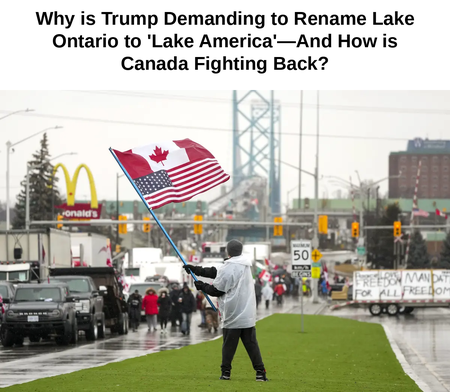
What the Viral Image Gets Right — and What It Leaves Out
The image asks:
“Why is Trump Demanding to Rename Lake Ontario to ‘Lake America’ — And How is Canada Fighting Back?”
What is correct:
✓ Trump did order the U.S. government to rename Lake Ontario “Lake America.”
He signed Executive Order 14422 on August 27, 2026.
✓ The decision came amid a major U.S.-Canada trade dispute.
Trump's initial proposal explicitly referenced the deteriorating economic relationship with Ontario.
✓ Canada rejected the new name.
Prime Minister Mark Carney has continued to refer to it as Lake Ontario, and Ontario Premier Doug Ford publicly reinforced that position.
✓ Digital maps are now reflecting the dispute.
Google Maps uses different naming depending on the user's location.
What needs context:
The executive order does not rename the lake internationally.
It directs U.S. federal agencies to use “Lake America.” Canada is not required to adopt the name, and neither Trump nor the U.S. government can dictate what Canadian authorities or international organizations call the lake.
So the headline is accurate in describing Trump's action, but the situation is better understood as a U.S. federal naming change that Canada has rejected, rather than a universally recognized renaming of the lake.
The Dispute Is Still Developing
As of September 16, the name fight remains tied to a much larger deterioration in U.S.-Canada relations.
The Trump administration is implementing “Lake America” across federal systems, while Canadian officials continue using Lake Ontario. Mapping companies are responding differently according to geography and government naming databases, creating an unusual split in how the same lake is labeled.
Meanwhile, the underlying trade conflict continues to generate economic consequences for businesses and consumers on both sides of the border. Recent reporting has documented Canadian efforts to reduce reliance on U.S. products as tensions persist.
For now, the lake itself remains unchanged.
The real change is appearing on maps, government documents and in the increasingly complicated relationship between the two countries that share its shoreline.
Suggested SEO Setup
SEO Title:
Trump Renames Lake Ontario “Lake America” — Why Canada Is Fighting Back
Alternative Headline:
Trump Calls It “Lake America.” Canada Says It’s Still Lake Ontario. Here’s Why
Meta Description:
Trump has ordered U.S. federal agencies to rename Lake Ontario “Lake America.” Canada has rejected the change as tensions over trade and sovereignty deepen.
Slug:trump-lake-ontario-lake-america-canada-response
Category:
U.S. Politics / Canada / International News
Tags:
Donald Trump, Lake Ontario, Lake America, Canada, Mark Carney, Doug Ford, U.S.-Canada Relations, Trade War, Great Lakes, White House, Canadian Politics
Title from Image:
Why Trump Is Renaming Lake Ontario “Lake America” — And How Canada Is Fighting Back
Image placement used
- Image 1: Trump signing the executive order — after the introduction.
- Image 2: Lake Ontario aerial/geographic view — in the section explaining the lake's location and importance.
- Image 3: Mark Carney/Trump — in the Canada response section.
- Image 4: Doug Ford's “Lake Ontario — Now and Always” response — in the section on Canada's public pushback.
Comments (0)
Loading comments...
May You Like

Shocking news from Ohio: an unexpected development ahead of Trump's rally

South Korea–Ukraine Rift Deepens Over North Korean POW Transfer as PURL Draws New Scrutiny

Barack Obama Draws Attention With New Literary Podcast












