Trump Renews $5,000 Payment Pledge if Republicans Win Congress
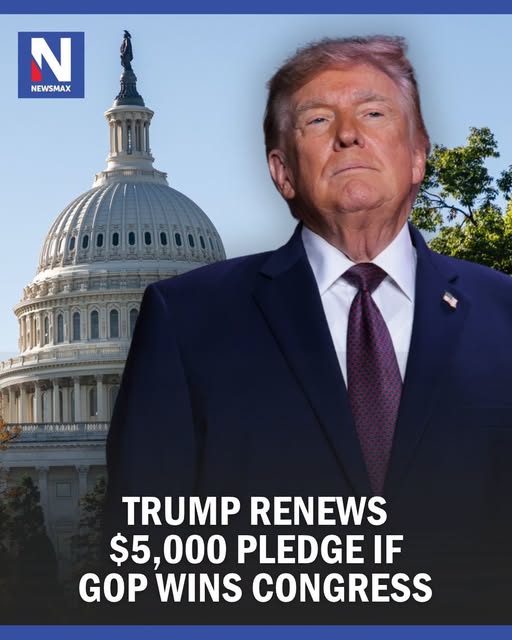
President Donald Trump has renewed his promise to give every adult U.S. citizen $5,000 if Republicans win control of both chambers of Congress in the November 2026 midterm elections.
The pledge, branded by Trump as a “Trump Dividend,” was originally announced at the Republican midterm convention in Dallas in September and has since become part of his campaign messaging.
On October 3, Trump reiterated the proposal in a video posted to social media, saying that if Republicans win the House and Senate, he would give adult citizens $5,000.
The latest version of the pledge again makes the payment conditional on Republicans winning both chambers, meaning the proposed checks would not simply be an across-the-board government benefit regardless of the election result.


Trump has described the payment as affordable because of what he calls strong economic performance and substantial investment in the United States, although those claims have faced scrutiny from economists and independent analysts.
The proposal would be extraordinarily expensive. The Associated Press reported that sending $5,000 to roughly 240 million adult Americans could cost more than $1 trillion.
The Committee for a Responsible Federal Budget has estimated the cost at approximately $1.2 trillion, depending on eligibility, making the proposal comparable to a significant share of annual federal spending.
That price tag has prompted questions about how the payments would be financed, particularly because the federal government already runs large annual deficits and carries more than $40 trillion in national debt.
Trump has suggested that tariff revenues could help finance the payments. However, analysts have questioned whether tariff collections could generate enough money to cover a program of this size without additional borrowing.


There is also a legal and legislative question. A payment program of this scale would require congressional authorization and funding, although Trump has previously suggested that Congress might not necessarily need to approve the proposal.
House Speaker Mike Johnson has acknowledged that significant details would have to be worked out before such a plan could become reality, according to reporting following Trump's original announcement.
The proposal has received support from some Republicans. Ohio Republican Sen. Bernie Moreno said he would prepare legislation seeking to establish the dividend after the November election.
Other Republicans have been more cautious, while several candidates in competitive races have not prominently incorporated the $5,000 pledge into their own campaign advertising or messaging.


Democrats have criticized the proposal as an attempt to influence voters, while some economists have warned that injecting more than $1 trillion into the economy could increase inflationary pressure.
Whether the payments would actually stimulate the economy, increase inflation, reduce other government spending, or increase federal borrowing would depend heavily on how Congress ultimately designed and financed the program.
The pledge also differs from a conventional campaign promise because Trump has explicitly tied the proposed payment to his party's performance in the congressional elections.
Legal experts quoted by the Los Angeles Times have nevertheless questioned whether the proposal would violate federal vote-buying laws, noting that candidates routinely campaign on promises of future government benefits or policy changes.
The distinction is important: Trump has made a political promise about what his administration would seek to accomplish if Republicans win, but no $5,000 payment has been authorized or scheduled.
The November 3 election will determine the composition of Congress, while any future dividend program would still depend on legislation, funding decisions, eligibility rules, and implementation by the federal government.


The key fact behind the image is therefore accurate but incomplete: Trump has repeatedly pledged $5,000 payments if Republicans win both chambers, but the proposal remains unapproved and faces major fiscal and legislative questions.
Comments (0)
Loading comments...
May You Like

Russian Drone Strikes Kyiv Bridge as German Chancellor Arrives in Ukraine

TRUMP’S OHIO WARNING UNDER THE SPOTLIGHT

Shocking news from Ohio: an unexpected development ahead of Trump's rally