
Trump Renews Attack on Obama’s Iran Nuclear Deal, Saying He Was
WASHINGTON — President Donald Trump has renewed his long-running attack on the Iran nuclear agreement negotiated under former President Barack Obama, portraying his decision to withdraw the United States from the deal as one of the defining achievements of his first administration.
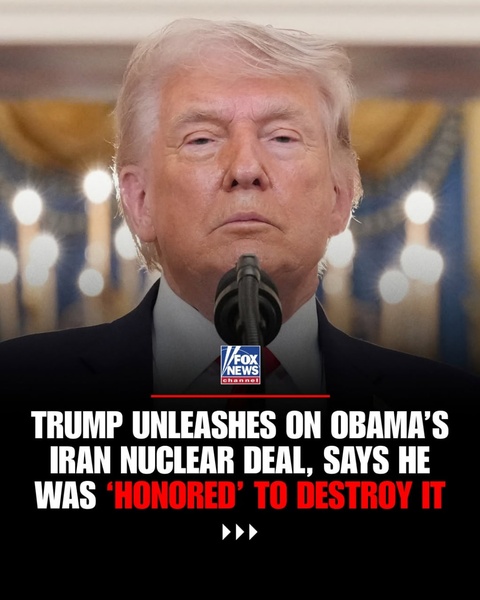
The remarks have resurfaced in a widely shared Fox News graphic declaring that Trump “unleashed” on Obama’s Iran nuclear deal and said he was “honored” to destroy it.
The underlying claim reflects a genuine and longstanding Trump position, although the graphic compresses a much more complicated history into a provocative headline. Trump withdrew the United States from the 2015 Joint Comprehensive Plan of Action, or JCPOA, in May 2018, calling it one of the worst agreements ever made by the United States.
Trump Says Leaving the Deal Was the Right Decision
Trump has repeatedly argued that the Obama-era agreement did not prevent Iran from ultimately developing a nuclear weapon.
In March 2026, while discussing the U.S. military campaign against Iran, Trump said the JCPOA was “a road to a nuclear weapon” and claimed that Iran could have possessed a major nuclear weapon had he not terminated the agreement during his first term.
Trump has also argued that the agreement effectively gave Iran a path toward nuclear capability while providing Tehran with sanctions relief.
His position has remained remarkably consistent since 2018: the United States should not accept an agreement that permits Iran to maintain significant enrichment capabilities or imposes restrictions that eventually expire.
The Washington Post noted that Trump previously described the agreement as “horrible,” “defective at its core,” “one sided” and a “road to a nuclear weapon.”
What the Obama-Era Deal Actually Did
The JCPOA was considerably more restrictive than Trump's characterization sometimes suggests.
Negotiated by Iran, the United States, China, France, Germany, Russia, Britain and the European Union, the agreement was finalized in July 2015 after more than a year of negotiations.
Its central objective was to place verifiable limits on Iran's nuclear program in exchange for sanctions relief.
Under the agreement, Iran was permitted to enrich uranium only to 3.67% for 15 years, far below the roughly 90% enrichment level generally associated with weapons-grade uranium. The deal also dramatically reduced Iran's enriched-uranium stockpile and restricted the number and type of centrifuges it could operate.
The agreement also established an extensive international monitoring system involving the International Atomic Energy Agency.
In other words, the JCPOA did not give Iran permission to build a nuclear weapon.
Instead, it established restrictions designed to make the production of weapons-grade material considerably more difficult and easier for international inspectors to detect.
Trump Withdrew From the Agreement in 2018
On May 8, 2018, Trump announced that the United States would withdraw from the JCPOA and reimpose sanctions on Iran.
At the time, Trump argued that the agreement failed to permanently prevent Iran from developing a nuclear weapon and did not adequately address Iran's ballistic-missile program or support for regional armed groups.
The decision was strongly criticized by the other parties to the agreement, who continued trying to preserve the deal without Washington.
Iran subsequently began reducing its compliance with the agreement.
By 2019, Iran had exceeded the JCPOA's limits on its stockpile of low-enriched uranium and later increased both its enrichment levels and nuclear capabilities.
Did Leaving the Deal Stop Iran From Getting a Nuclear Weapon?
This is where Trump's claim becomes much more difficult to establish.
Trump argues that abandoning the agreement prevented Iran from eventually obtaining a nuclear weapon.
But independent experts cited by FactCheck.org have reached a different conclusion.
Laura Rockwood, a former senior IAEA official, argued that Iran's nuclear program advanced to the levels it reached largely because Trump withdrew the United States from the JCPOA, rather than because of the agreement itself.
Richard Nephew, a former U.S. State Department official who worked on Iran policy, similarly said Trump's withdrawal had a “significant accelerating effect” on Iran's nuclear program.
FactCheck.org also noted that the JCPOA substantially increased Iran's so-called “breakout time” — the estimated time needed to produce enough weapons-grade uranium for one nuclear weapon.
According to the analysis it cited, breakout time increased from roughly two to three months before the agreement to more than a year while the deal was operating. After the U.S. withdrawal, that period eventually fell to only a few weeks.
That does not prove that Iran would never have pursued a nuclear weapon if the JCPOA had remained in force. But it does challenge the claim that withdrawing from the agreement clearly prevented Iran from becoming a nuclear state.
The Debate Has Become Even More Relevant in 2026
The issue has taken on new significance because Trump's second administration has once again been negotiating with Iran — this time after a major military confrontation.
In June, the Trump administration reached a preliminary memorandum with Tehran that was intended to provide a framework for a longer-term nuclear agreement.
The administration presented the framework as substantially stronger than Obama's JCPOA.
But CBS News reported that the document was only a preliminary roadmap rather than a comprehensive final agreement. Major questions about Iran's enriched uranium, centrifuges and the future structure of its nuclear program remained unresolved.
That creates an unusual historical comparison.
Trump spent years condemning Obama's nuclear agreement as dangerously weak. Yet his own administration is now attempting to negotiate another agreement with Iran after the collapse of the earlier one.
Trump’s New Deal Is Not the Same as the JCPOA
The differences are significant.
The Obama-era JCPOA contained detailed technical restrictions on enrichment, uranium stockpiles and centrifuges.
The preliminary Trump framework, by contrast, was described as a roadmap toward a future agreement, with many of the most difficult technical issues left for subsequent negotiations.
CBS reported that the new framework calls for Iran not to acquire or develop nuclear weapons, but leaves important questions about enforcement and the disposition of enriched uranium unresolved.
Trump has also expressed interest in restrictions lasting considerably longer than the JCPOA's original provisions.
The president has said he wants Iran to suspend uranium enrichment for 15 to 20 years while seeking permanent restrictions on military enrichment.
The Nuclear Question Has Become More Urgent
The stakes are now substantially higher than they were when Obama negotiated the JCPOA.
Iran accumulated uranium enriched to 60% purity in the years after the U.S. withdrawal — far above the 3.67% limit established by the JCPOA.
Weapons-grade uranium is generally considered to require enrichment to about 90%.
Before major U.S. and Israeli attacks on Iranian nuclear facilities, Iran had accumulated more than 400 kilograms of uranium enriched to 60%, according to the analysis cited by FactCheck.org.
The current condition of Iran's nuclear infrastructure is difficult to establish with certainty because international inspectors have faced major restrictions on access to damaged facilities.
That uncertainty has become one of the central problems in determining how much of Iran's nuclear capability survived the military campaign.
Trump’s “Victory” Claim Faces a Complicated Reality
Trump's supporters view his withdrawal from the JCPOA as evidence that he was willing to abandon what they considered a fundamentally flawed agreement.
His critics argue that the decision removed international constraints and helped accelerate Iran's nuclear program.
Both sides agree on one important fact: the JCPOA no longer exists in its original form.
But whether its destruction made the United States safer is a much more difficult question.
The evidence does not support the simple conclusion that the deal would inevitably have allowed Iran to obtain a nuclear weapon. Nor can anyone definitively prove what Iran would have done had the agreement remained intact.
Trump Now Faces the Consequences of His Own Iran Policy
The irony of the current situation is difficult to miss.
Trump spent his first term dismantling Obama's Iran nuclear framework.
Now, during his second term, he is once again attempting to prevent Iran from becoming a nuclear-armed state — but doing so after years of increased Iranian enrichment and after a devastating military conflict.
Meanwhile, the war has entered its seventh month, with no clear end in sight.
On Wednesday, Trump said the conflict would end “immediately after” the November midterm elections, arguing that Iran is under severe economic pressure. But Reuters reported that the fighting has continued to escalate, including attacks on shipping near the Strait of Hormuz, while oil prices have climbed above $100 a barrel.
Trump has simultaneously threatened further strikes against Iran's Pickaxe Mountain, a heavily fortified site near Natanz associated with Iran's nuclear infrastructure.
What the Viral Graphic Gets Right — and Wrong
The graphic's central message is based on a real political position.
Trump really did withdraw the United States from Obama's Iran nuclear deal, and he has repeatedly described that decision as one of his major accomplishments.
But saying that Trump “destroyed” the agreement is political shorthand. The United States withdrew from the multinational agreement; the other parties did not simply disappear from it overnight.
More importantly, the claim that Trump's decision unquestionably prevented Iran from obtaining a nuclear weapon is not an established fact.
Experts cited by FactCheck.org argue that the opposite may be closer to reality: the JCPOA imposed substantial restrictions and monitoring, while Trump's withdrawal ultimately contributed to Iran's expansion of its nuclear activities.
A Battle Over Two Very Different Iran Strategies
The Obama and Trump approaches represent two fundamentally different theories of dealing with Tehran.
Obama's strategy was based on verification, restrictions and international diplomacy.
Trump's strategy has emphasized maximum pressure, economic sanctions and, ultimately, military force when negotiations fail.
Yet the current administration's attempt to negotiate another nuclear framework suggests that even Trump's strategy ultimately requires some form of diplomatic agreement.
That is the unresolved question at the center of the Iran crisis:
Can Trump produce the kind of permanent nuclear restrictions he says Obama's agreement failed to deliver — without repeating the cycle of confrontation that followed the collapse of the JCPOA?
For now, the answer remains uncertain. What is clear is that the decision Trump once celebrated as the destruction of Obama's Iran deal has become part of the complicated history behind the nuclear crisis he is now trying to resolve.
Comments (0)
Loading comments...
May You Like

gfnhgmnghnmfgnbvvvvvvvvv

Russian Drone Strikes Kyiv Bridge as German Chancellor Arrives in Ukraine

Obama Steps Back Into the Political Spotlight as Democrats Target Trump’s Senate Majority












